A ‘profound and painful’ decision
Board votes to close Bloomingdale Elementary, move middle school to HS building, have K-12 busing
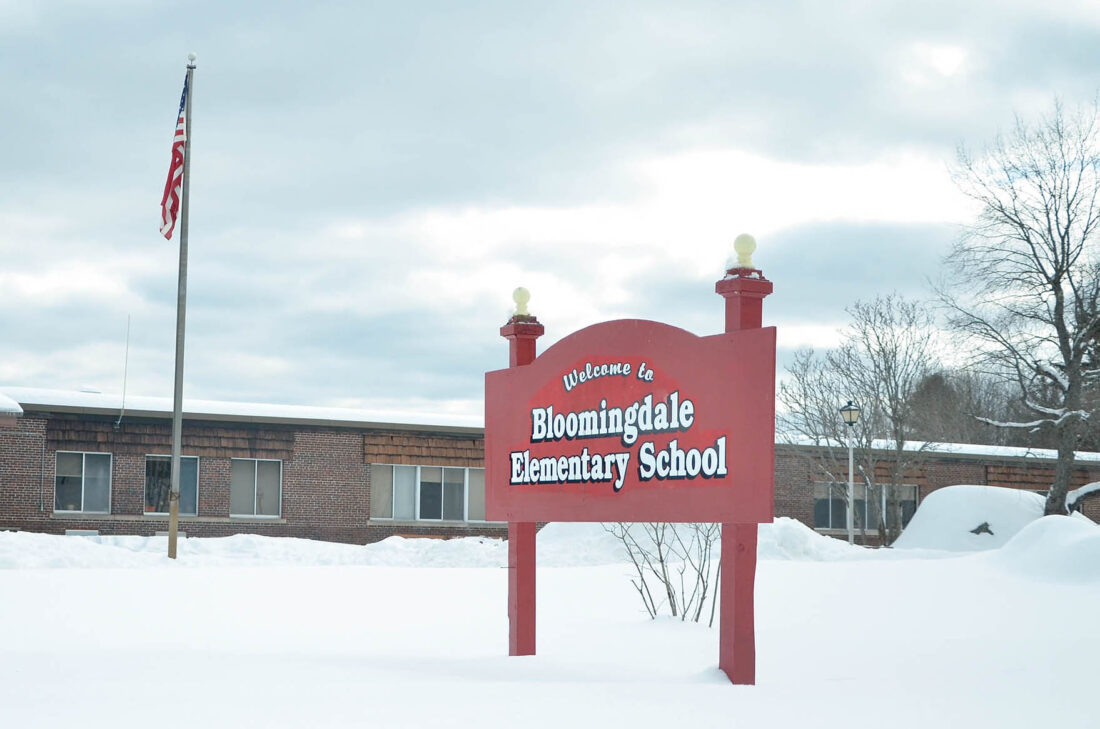
Bloomingdale Elementary School on Thursday. (Enterprise photo — Aaron Marbone)
BLOOMINGDALE — It’s official. Bloomingdale Elementary School is set to close at the end of the school year.
In a unanimous vote on Wednesday night, the Saranac Lake Central School District Board of Education made the decision, one they all said was painful to make.
It was an emotional meeting. By the end, multiple people had cried and people were hugging in the hallways and parking lot.
Franklin town Supervisor Dot Brown was one of several dozen people who had urged the board to not close the neighborhood school. At the meeting, she said losing Bloomingdale Elementary will weaken the community foundation.
The decision marked a somber moment for the district, which has less than half the students it did 30 years ago and is facing financial struggles. The price of everything has gone up the state demands more of rural school districts and the district has a working-class tax base it does not want to overburden.
Board member Joe Henderson said the board is “managing decline.” These problems have been building for decades.
“I think this plan stabilizes us,” he said. “I don’t enjoy it.”
The public did not enjoy it either. The process has been marred with accusations of the board not seriously looking for other options or the outcome being “predetermined.”
“If you guys don’t vote ‘no’ on this, or at least vote to postpone a little more, I want you all to know you failed,” Preston Darrah told the board.
At this meeting, and at previous ones, a contingent of residents who want to keep the Bloomingdale school open offered creative solutions. They believe the housing efforts of the past years are set to pay off and bring more children to the area. The board mostly said the ideas, though appreciated, would not work, would not be legal with education regulations or would not stop the root cause of declining enrollment.
Supporters of the school have accused the board of not really taking the time to look at solutions, or that the board had an agenda.
School board member Mike Martin fought back tears as he said this was a difficult decision to make, but the right one. His five kids all attended Bloomingdale — he had a kid in that school from 2007 to 2022.
“I understand what we’re losing,” Martin said. “But the cost and the services that can be provided by consolidation are just irrefutable.”
Martin, who was a member of the building facilities subcommittee said it was hard to hear the community bashing their integrity. He said they had no agenda.
Along with the closure of Bloomingdale Elementary, the board also unanimously voted to move the middle school seventh and eighth grade classes at Petrova Elementary over to the high school building, and to have students of all grade levels ride together in a single bus run to and from school.
The state Education Department must still approve all these reconfiguration plan.
If approved, this slate of changes will all take effect at the start of the next school year in September. They will impact nearly every student in the district in some way. Certain students will be impacted more than others.
Board members have said they have “zero intentions” of selling the Bloomingdale building. They have not discussed ideas of what it would be used for much, outside of naming a couple of potentials. They’ve also said if the youth population of the district rises again, they’ve left the potential to reopen the school.
St. Armand town Supervisor and building facilities subcommittee member Davina Thurston said she believes SLCSD Superintendent Diane Fox has a plan for the Bloomingdale building but is not telling the public.
Petrova Elementary will become a Pre-K-6 school. The high school will become a junior-senior high school.
Instead of having two bus runs in the morning and two in the afternoon — separated mostly by age — students will be bused to school through one run in the morning and one in the afternoon, with students of all grade levels riding together.
This year, Fox shifted Bloomingdale students in grades three, four and five to Petrova Elementary, making the Bloomingdale school a K-2 building. Bloomingdale Elementary has 67 students currently. The school opened in 1967.
To read more about the background and lead-up to this vote, go to tinyurl.com/4ca794r4.
–
Loss
–
Board member Nancy Bernstein said she heard rumors about the Bloomingdale school closing before she ran for her seat on the board in 2018. As a Vermontville resident and Bloomingdale school parent, she thought she could defend the need for the beloved neighborhood school.
But, she said her perspective shifted quickly once she got on the board, looking at whole district.
“Every September, I mourned the size of each incoming kindergarten class, hoping things might change,” she said.
The closing of Bloomingdale Elementary is a “bitter reality,” she said, but the board had few options.
It’s a “profound and painful loss,” Bernstein said.
But she added that the school is a resource, it’s not the community itself. She believes the community can rise from the ashes.
Board member Justin Garwood said his children would have attended Bloomingdale. He was looking forward to them being able to have the same school experience he had as a kid. But, he felt that closing the school — given the circumstances — is not just the best option, but one he’s excited about because of the possibilities it provides.
Henderson said the board is asking a lot of their teachers and students to make this change over the summer before classes start in September. He said the board, the community and the administration will need to support them.
Board member Zach Randolph said he hopes the community will rally around the kids.
–
Finances
–
The district estimated it could save up to $600,000 annually by closing Bloomingdale. This will not lead to a reduction in taxes, but would stave off larger tax increases or budget cuts.
At the meeting, SLCSD Business Executive Nikki Sears said the district is expecting a 1% increase in state foundation aid this year, only $77,227 more than it got last year. This will not come close to covering the increased electric costs the district is facing after Nation Grid’s recent major rate hike.
Sears said this state aid increase will barely cover the increased electric costs for the high school building alone from now until the end of the school year.
At the same time, as the district prepares to create its budget, Sears said their tax cap will be at 0.75% — only allowing them to raise $191,575 more in taxes this year than this year, unless they want to risk exceeding the cap and needing a 60% public vote to pass the budget instead of a 50% vote.
Last year, the tax cap was 4.44%. Sears said the district will need to dip into its reserves again to balance the budget this year.
–
Division
–
Fox said this move is an “important step” for the district’s educational and fiscal sustainability. She said consolidating the elementary schools will allow for better access to services for all students. Because of budget, regulation and state aid constraints, they cannot afford a complete contingent of special educators in each building.
All board members expressed confidence in administrators, faculty and staff. They voiced hopes that the community trusts that they did the right thing. Some community members said they don’t. Board members also said they’ve been transparent in this process. Some members of the public feel they haven’t.
“The Buildings and Facilities Committee did not fail. We were disbanded before we could succeed,” Davina said. “In truth, no brainstorming sessions took place. … This school board failed us by not allowing us to finish the work that we were tasked to do.”
She said the region needs good schools to get families to move here. She said this move isn’t helping.
Kelsey Mathis read a letter from Saranac Laker Anne Cantwell-Telfer. Cantwell-Telfer, an attorney, said she had thought about filing a preliminary injunction, but decided against it.
She questioned the lessons students will learn about democracy watching this process.
“They will hear our superintendent wanted the school board to pass a resolution to close Bloomingdale School without hearing from the public. They will hear the board chose the public to be involved in this process only to cut that process short by four months,” Cantwell-Telfer said in her letter. “They will learn that when a timeline does not fit a person of authority’s agenda, it’s OK to burden your volunteers with accelerated timelines and demand a decision relying on incomplete data. They will learn to make a decision without completing your due diligence — like what are the social, emotional and educational effects of shifting our seventh and eighth graders to the high school. They will learn that when you make a mistake, like removing special education services from Bloomingdale School, you do not admit your mistake and take accountability, but instead trudge forward, compounding those mistakes.”
–
Mixing grades
–
Brown said her kids were the first ones on and last ones off the bus. These long travel times are not good for kids, she said. She worried that the single bus runs will result in longer rides for the students living furthest from the schools.
Fox said the new schedule will reduce ride times for the longest riders. She said the new schedule will have more direct routes. Currently, she said students with long wait times have them extended because they transfer buses in Bloomingdale and end up waiting a while.
With the new schedule, she said the longest route — from McColloms — will be just over an hour long.
Henderson said middle school is a “developmentally fraught time,” but has no doubt staff and faculty will be able to help them through the transition to the middle school. They will have separate classroom areas there. Fox said that class sizes for all grades will stay the same.
Fox said more than half of seventh to 12th grade students already participate in athletics and extracurricular activities together.
She said the district will probably “overcompensate” for safety. She said movement and recess will be maintained for the middle schoolers.
Brown voiced concerns people have had throughout the process about younger students being bused with older students.
“Teenagers and young children are at completely different stages, emotionally, socially and cognitively,” Brown said. “The language and conversations that are normal for high school students are not appropriate for very young children. … Young children absorb what they hear and see.”
Not many high schoolers ride the bus, Fox said. Most drive once they are able to.
She got a count of students who rode the bus at least once this year. There were 39 seniors, 37 juniors, 42 sophomores, 51 freshmen and 50 eighth graders. Fox said only 50% of them rode the bus two or more times a week.
Board member Tori Thurston said her daughter attended St. Bernard’s Elementary and rode the bus to and from Saranac Inn with high school students. Her daughter made great older friends and those kids looked after her and were responsible, she said.
Tori remembered one of them coming up to her during Oktoberfest at Mount Pisgah and giving her daughter piggyback rides up the mountain.
Bernstein said her son rode the bus with high schoolers when he was in kindergarten and it was fine. She also said there are cameras and microphones all over the buses now.
Henderson said that separating children by age is not the norm and that most cultures do not do it.
He also said High School Principal Josh Dann has said the kids in the high school are kinder than previous generations. Dann confirmed that he’s said this at the meeting.
“I have no doubt that the older kids will rise to this challenge,” Henderson said.
–
Enrollment
–
Enrollment is at record lows for the modern era.
The district had its highest population in 1995, with twice as many students as there are today — more than 2,000. Enrollment has been on a steady decline ever since, she said. A majority of this drop has happened in the past quarter-century. At the turn of the millennium, the district had 1,743 students. In the 2014-15 school year, the district had 1,266 students. The district reported 984 students enrolled on opening day this year — 60 fewer than reported on opening day last year.
Local News
Snowshoer found dead in lean-to in Pharaoh Lakes Wilderness
SCHROON — A Florida man was found dead in a lean-to in the 44,400-acre Pharaoh Lakes Wilderness in southern ...
A ‘profound and painful’ decision
Paul Smith’s College announces Operation Hardwater event
PAUL SMITHS — Paul Smith’s College has announced its upcoming event, Operation Hardwater, spotlighting the ...
Lake Placid braces for high energy bills
Hiker found alive after extensive two-day search in Dix Range