Transparency takes center stage at heated Tupper town board meeting
Contentious public comment period as several residents air concerns
-
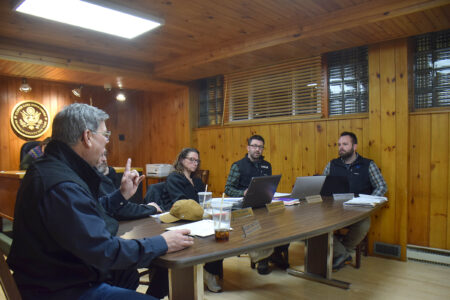
- The Tupper Lake Town Board is seen at its meeting on Monday. From left, town Supervisor Rickey Dattola, Councilman and Deputy Supervisor Timmy Larkin, Councilwoman Crystal Boucher, Councilman Adam Boudreau and Councilman Owen Littlefield. (Enterprise photo — Chris Gaige)
-

- Tupper Lake resident Mike Kohan, a retired State Trooper, speaks at the Tupper Lake Town Board’s meeting on Monday. Kohan raised concerns about the town’s property assessment practices, and called for more transparency in the process. (Enterprise photos — Chris Gaige)
-

- Tupper Lake resident and former village Trustee Ron LaScala addresses the Tupper Lake Town Board at its Monday meeting. (Enterprise photo — Chris Gaige)
-

- Downtown businessman Steve Jellie addresses the Tupper Lake Town Board at its Monday meeting. Jellie raised education, public safety and assessment concerns, and reiterated his call for town Supervisor Rickey Dattola to resign. (Enterprise photo — Chris Gaige)
-
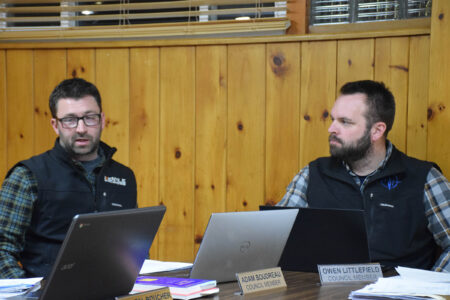
- Tupper Lake’s two newly-elected town councilmen Adam Boudreau, left, and Owen Littlefield, are seen at the town board’s meeting on Monday. (Enterprise photo — Chris Gaige)
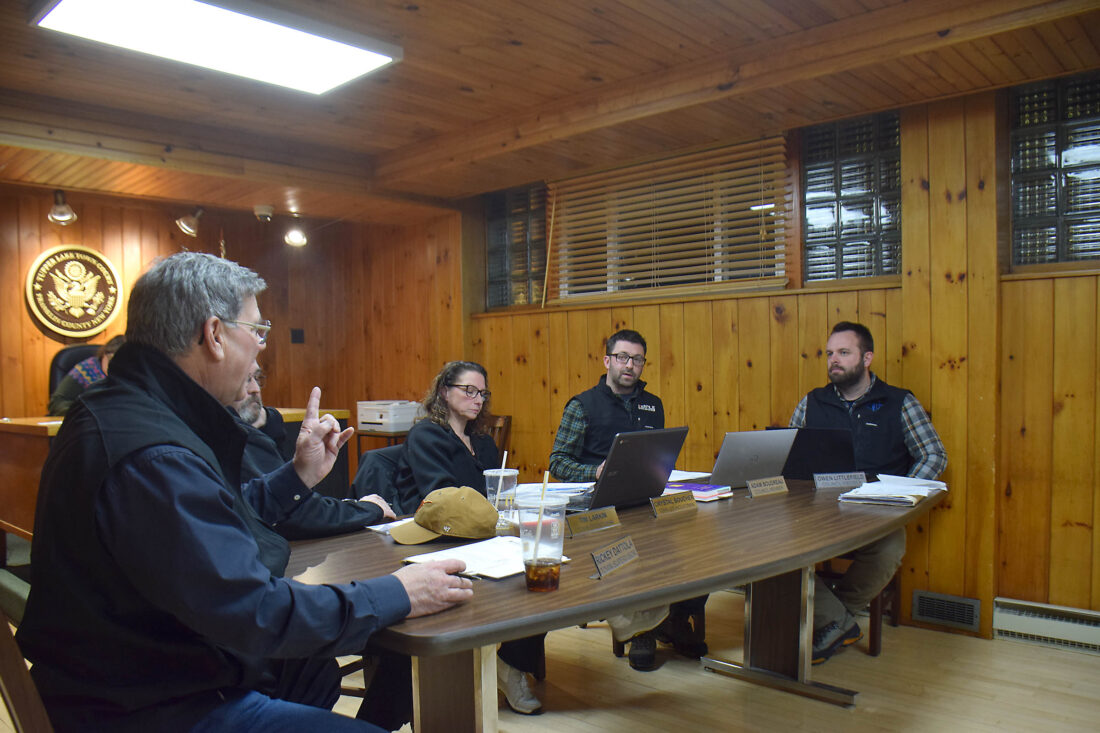
The Tupper Lake Town Board is seen at its meeting on Monday. From left, town Supervisor Rickey Dattola, Councilman and Deputy Supervisor Timmy Larkin, Councilwoman Crystal Boucher, Councilman Adam Boudreau and Councilman Owen Littlefield. (Enterprise photo — Chris Gaige)
TUPPER LAKE — Several residents at Monday’s town board meeting raised concerns about the town’s assessment practices and appearances of impropriety. Ron LaScala, a former village trustee, also spoke on a separate matter pertaining to code enforcement — or, as he views it, the lack thereof — at one of the properties surrounding the home he owns on Woulf Avenue.
When public comment opened at 6:08 p.m., the first person to speak was Stephen Jellie, who owns and operates Larkin’s Junction Depot, a downtown convenience store and gas station. Jellie began by chiding the town board for, as he alleged, beginning the meeting a couple of minutes early, given the amount of time it took to get through the agenda. The Enterprise arrived just before 6:02 p.m., and could not independently verify this.
Jellie then told the three incumbent town board members — Supervisor Rickey Dattola, Councilman and Deputy Supervisor Timmy Larkin and Councilwoman Crystal Boucher — that the upcoming part of his speech would all be complaints they’ve heard before, but he felt it was important to reiterate them because he doesn’t feel they’ve been addressed, and wanted the the two newly elected board members — Councilman Adam Boudreau and Councilman Owen Littlefield — to hear them.
Jellie’s most pressing concern was the school district, and specifically its financial struggles. He said the town should be doing more to support the school district. An earlier report on the school district’s long-term financial condition is available at tinyurl.com/mr35surn.
“I feel like Tupper Lake is at a crossroads now,” he began. “The town government has not been leading to get us to the crossroads. The town government has really been taking a back seat, leaving a lot of things to the village, leaving a lot of things to the school district.”
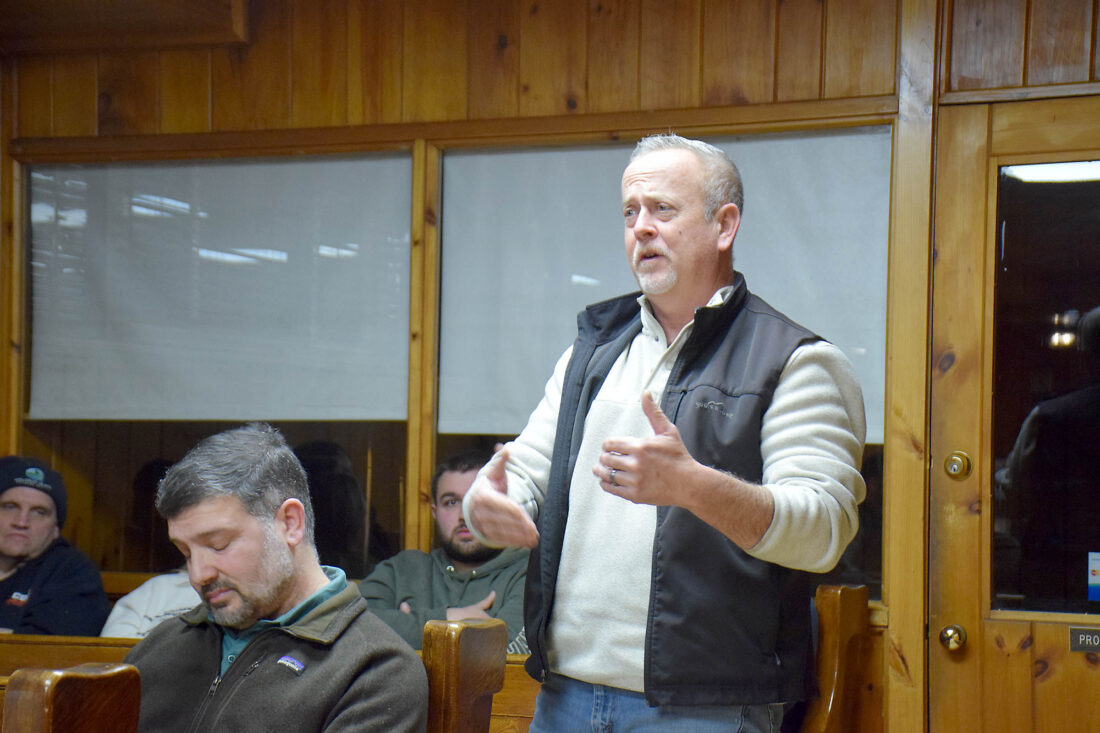
Tupper Lake resident Mike Kohan, a retired State Trooper, speaks at the Tupper Lake Town Board’s meeting on Monday. Kohan raised concerns about the town’s property assessment practices, and called for more transparency in the process. (Enterprise photos — Chris Gaige)
He said this should begin with assuming ownership and operations of the Tupper Lake Memorial Civic Center, which houses the community’s indoor ice rink. That’s currently run by the Tupper Lake Central School District, but receives no state aid for it, as it’s not an educational asset like a school building or in direct support of education, such as a bus fleet.
TLCSD received a donation to commission an economic impact study for its school district. It was publicly released in November. The study found that the civic center is a boon to the local economy, generating a value to itself and the broader community that’s roughly five times its operating costs. However, the study also found that several financial problems arise from a school district’s ownership, and recommended TLCSD either sell the civic center, or find an operating partnership where another entity could absorb the costs while running it more efficiently to offset those.
“The (school) district runs what is fundamentally a community recreation asset, a role largely outside of its core expertise,” the report states. “The arrangement constrains eligibility for many grant programs, puts an annual operating deficit on the school budget and embeds higher labor and benefit costs than a volunteer or recreation-department model would.”
A report on the study’s presentation is available at tinyurl.com/3jj9fkhz.
Jellie said a successful school system is crucial to a thriving community. Without one, it can’t exist, he said, adding that right now, things are bad.
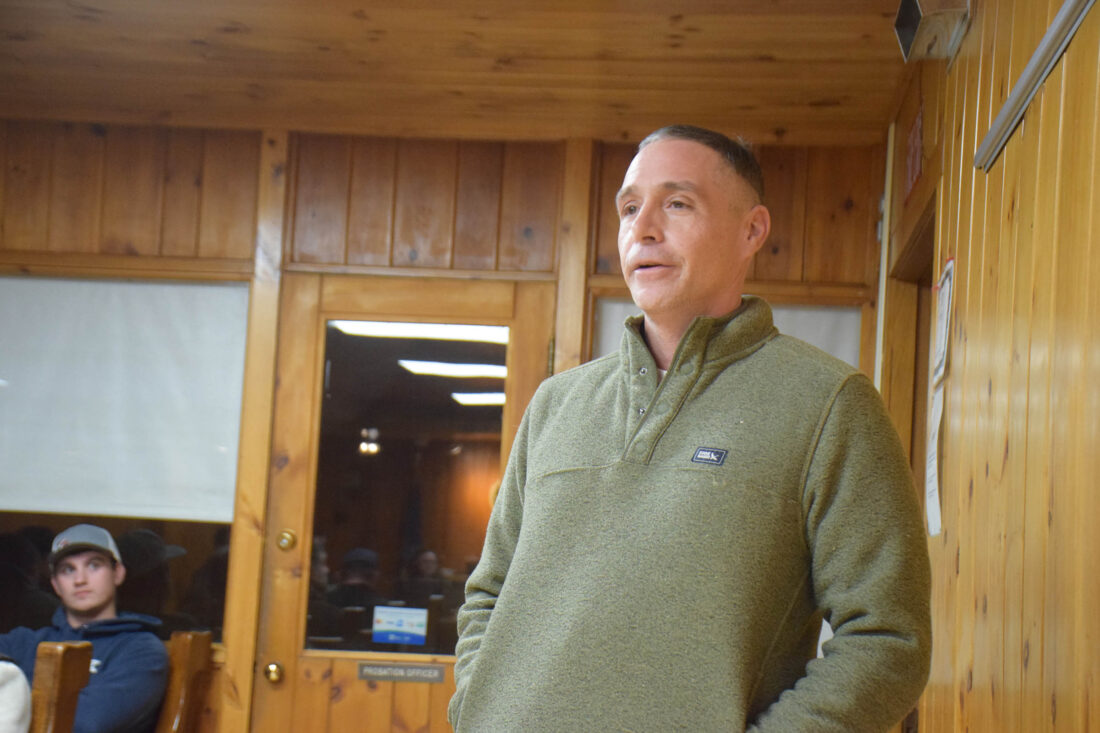
Tupper Lake resident and former village Trustee Ron LaScala addresses the Tupper Lake Town Board at its Monday meeting. (Enterprise photo — Chris Gaige)
“You know our school is suffering,” he told the town board. “We can’t just worry about saving our school financially, which is a really big problem. We’ve got to get them out of the financial waters, bad waters, so they can start thinking about teaching excellence, raising the standard. By any standard, you all know what the reviews say. By any standard, we’re at the bottom.”
For the 2025 state assessments, 25.7% of Tupper Lake Central School District students in grades 3-8 received a proficient or better score in English, and 28.6% in math. The state averages were 53% and 55%, respectively.
“We’ve got to get off the bottom, but we’re not going to get off the bottom until we can get these financial problems figured out,” Jellie said. “Give them one bone while this new Superintendent (Jaycee Welsh) figures out how to clean up the financial mess that’s been going on for a couple decades.”
He then moved on to his second issue, public safety, stating that it was only second in this context because of how absolutely important he views the school situation.
“I just submit to the town board that we’re not taking public safety seriously,” he said. “This board does nothing to support the village police department, yet they expect service throughout the town.”
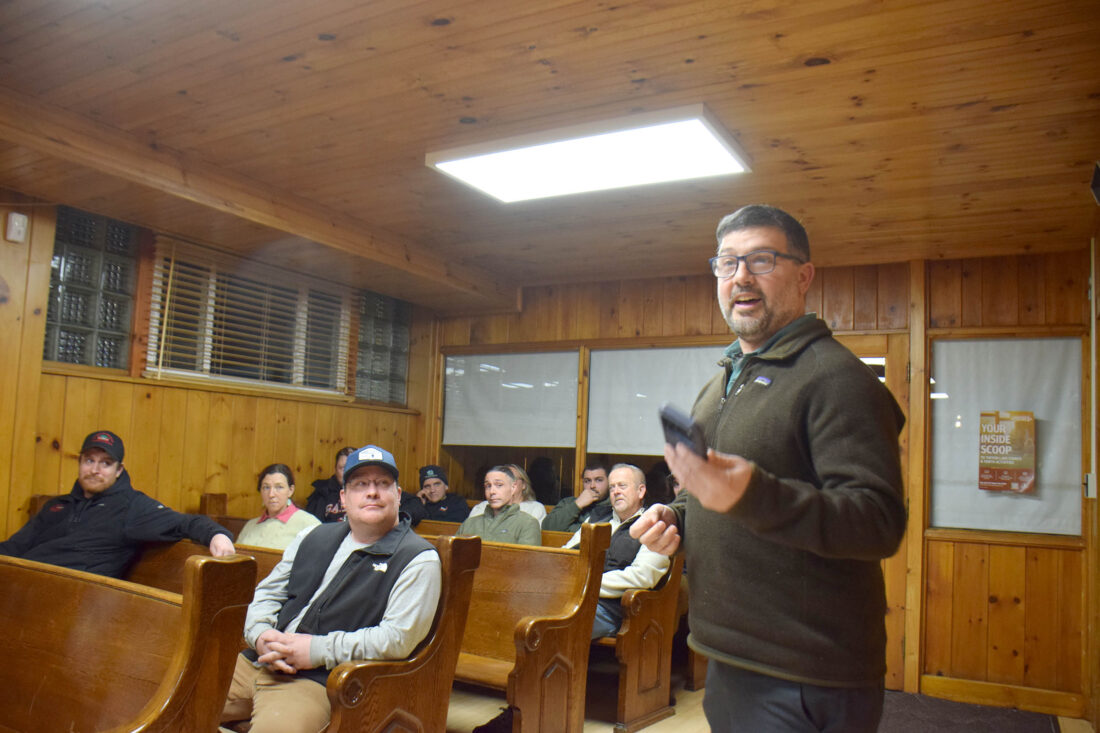
Downtown businessman Steve Jellie addresses the Tupper Lake Town Board at its Monday meeting. Jellie raised education, public safety and assessment concerns, and reiterated his call for town Supervisor Rickey Dattola to resign. (Enterprise photo — Chris Gaige)
Jellie then addressed his third issue of the night, property assessments. He called for a townwide revaluation — or reassessment of the values of all of the properties in the town — which hasn’t been undertaken in Tupper Lake since 2017.
“I’ve said it before and I’ll say it again: we are so far out of bounds,” he said. “I don’t know what it’s going to take to get us back, but it would start with a townwide (revaluation) of all property. We’ve got some way up, and some way down, and most of it just in between — and I’m not somebody who’s in here saying, ‘I think my property assessments are too high.’ I think that frankly, mine are too low.”
He said that low property assessments are not a recipe for keeping taxes low.
“You all finding ways to run efficient government (and) keep the tax rate low is how we provide less taxes,” he said. “But artificially holding the tax rate down, because that might benefit some of us personally, is not the way to do it.”
He concluded his initial remarks by accusing Dattola of using the office for personal gain.
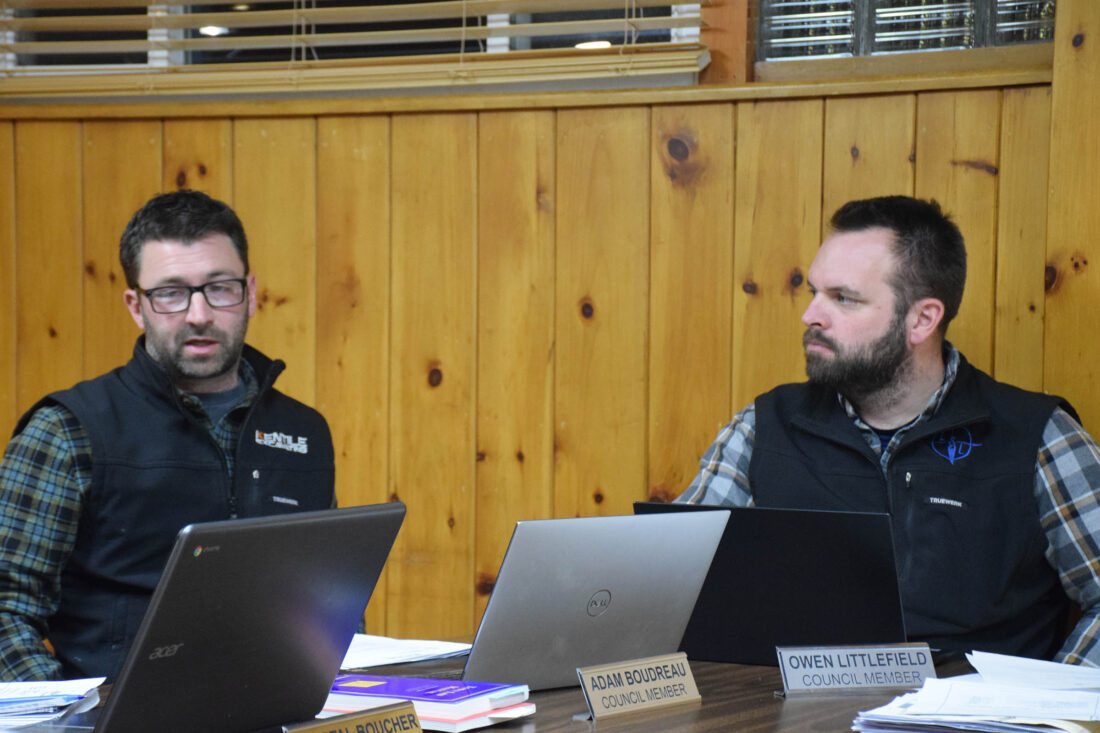
Tupper Lake’s two newly-elected town councilmen Adam Boudreau, left, and Owen Littlefield, are seen at the town board’s meeting on Monday. (Enterprise photo — Chris Gaige)
“For the entire term, first term, of Rickey Dattola’s term as supervisor, it’s my opinion he’s done his best to use all the tenents of his office for personal gain,” he said. “I ask all of you, please, to look into the events of the last 24 to 36 months. The use of employees for personal gain — employees that are his employees, personal and here. Use of the town attorney, who is not an impartial party when he’s working for the supervisor personally. How can we let these conflicts of interest continue? I don’t understand how we can have confidence in our government. I don’t understand how anyone’s going to have trust when those sort of things go on.”
Jellie added that even if there has been no wrongdoing, he feels there’s a perception of it.
“Maybe the issues are alright, maybe there have been no mistakes made, maybe there’s been no improprieties — why not lay it all on the table?” he said. “Why keep covering it in the backroom? Why not put it all out where people can understand exactly what is going on?”
Town Attorney Kirk Gagnier has also represented Dattola in some personal matters, including land transactions. Dattola told the Enterprise on Thursday that prior to assuming office, he checked with the New York Association of Towns concerning the ethics of using of a town attorney as a personal attorney as well and said he was told that it was permissible, provided that matters involving conflicts of interest are disclosed and avoided.
Dattola denied any wrongdoing in his position as town supervisor.
Gagnier said on Thursday that attorneys are bound by strict professional ethical standards concerning this, and he has always abided by those in serving as the town attorney and representing Dattola personally.
“They’re completely different,” he said. “My representation of an individual in a private land transaction is different than a town matter. And I have disclosed when there’s any conflict of interest or anything like that.”
Gagnier was emphatic that no conflict or favors were being done. He said it was unfortunate that there was misinformation circulating to that effect on social media and other channels.
“There’s not a conflict, and I keep town business separate and distinct,” he said. “If there’s any type of conflict — and this goes both privately and publicly — you disclose it and generally you have to take a pass on the deal.”
–
Code enforcement
–
LaScala was the second person during the public comment period to address the town board. He accused part-time town and village code enforcement officer Pete Edwards of not doing enough to correct a retaining wall adjacent to his and his wife’s property on Woulf Avenue.
“I’ve had to get special permits for putting a building in a floodplain,” he said. “Yet, I have, across the creek, a probably 300-foot illegal retaining wall that’s been collapsing into the floodplain, more so in the last six months than it has in the two years since we’ve been there.”
LaScala said it was an urgent matter. He said the retaining wall’s collapse not only creates a hazard for his property, but those around him.
“It needs to be taken care of,” he said. “It’s an emergency.”
Edwards disagreed with LaScala’s assertion that he was being lackadaisical in this matter. He said that the retaining wall’s owner had been served a notice in an appropriate timeframe. Edwards stated that there’s a 30-day period of grace for enforcement, and after that lapsed, he was served a court appearance. That’s slated for Feb. 4 before town Justice Leonard Young.
Edwards added that some additional time was needed to complete a survey of the land, as he wasn’t initially certain if there were adjacent owners, given that the creek borders properties.
“(The surveyor) explained that when there’s a situation like that, both owners usually own to the middle,” he said. “The owner that we thought, that we served, more than likely owns the retaining wall. I ended up issuing him an appearance ticket for court.”
Edwards said the process needs to play out, and the next step is getting the matter in front of the court. He agreed that the retaining wall was in a poor condition and believed it was approximately 50 years old.
“The next step is the court, and we’ve done the appropriate action,” he said.
Based on previous code enforcement cases, Edwards said the court usually asks what the person’s timeline is, considers the circumstances, asks the person who’s been served what their plan of action is and schedules a reappearance, usually within 30 days, to see if the situation is being remedied.
“If they’re doing a good job moving forward, he’ll work with them on a timeline,” Edwards said.
–
Back to the board
–
After discussing his retaining wall concerns, LaScala circled back to Jellie’s points, stating that he concurred with his point on public safety, referencing his earlier time on the village board.
“To your statement about the police department, I was a village trustee. I fought with these guys,” he said. “Matter of fact, I tried to get people to pay their fair share and they just vilanize you around here. ‘Oh, you’re a piece of s*** because you want everybody to pay their fair share,’ and you’re absolutely correct about (Dattola’s) first term. This is going to go down as the worst, worst town supervisor in history. That’s all I have to say.”
But LaScala wasn’t done speaking. He then accused Dattola of holding “secret meetings” at his house.
“Before you got into office, you had your little private meetings down in your basement. I was in office, you invited me down there. What’d I tell you? I didn’t want any part to do with it. Because I knew what you were up to. It was no good, Rickey — and now it’s all coming to light. All your little secret meetings and conniving — it doesn’t do this community any good. Just be straightforward. Just say what you want to do, and do it. Don’t hide and don’t connive, because that’s what you’ve been doing — and it’s old. That’s all I’ve got!”
LaScala then walked out of the meeting. Dattola thanked him for his time and LaScala told the board to have a good night.
Dattola denied any wrongdoing in holding meetings at his house. He addressed
the room toward the end of the board meeting, stating that he holds plenty of meetings at his house, but he’s never had three town board members meeting in one spot, other than an official meeting, that he’s aware of since assuming office, which would likely be a violation of the state Open Meetings Law.
“I do want to set the record straight from what Mr. LaScala said about secret meetings because I want to defend the previous board,” he said. “The town board has never had a secret meeting. It’s never happened. I have a tremendous amount of meetings at my house, and they’re all Tupper Lake Business Group meetings and I invite lawyers, I invite a lot of people — but it’s never three town board members, and it never was.
“And I know all of this board right here would never do that either,” Dattola continued. “So I just want to set the record straight — but I do have a lot of meetings at my house. Some of them we watch football, some of them we get some work done, but we do have meetings.”
–
Assessment concerns
–
After LaScala left, local residents Chris Dewyea and Mike Kohan took turns speaking about what they felt were inconsistencies in tax assessments for properties surrounding a parcel they had recently purchased.
“When I had got my new tax bill, I’m scrolling through the tax map, just to see what I’m paying for taxes and what others across the street are paying for taxes,” Dewyea said. “And I don’t want to say conflict of interest because who knows if it is or isn’t — but the assessment values are all over the ballpark in that neck of the woods.”
“‘Death and taxes,’ you go, ‘Well, they’re going to go up and we’re all not going to be here in a while,'” Kohan said. “That’s just the way it goes, we all get used to it.”
Kohan told the board that, a couple of years ago, he had gone to review the tax rolls here for himself. While this was not the most recent roll, Kohan said he didn’t walk away with a good feeling.
“But it’s funny, when you look at certain names and certain properties, and you go, ‘Coincidence? I don’t know,'” he said. “I hate to say it like that, but I think as we move forward, transparency would be … helpful, even if it doesn’t do anything other than make people feel like they’re more engaged with the process. Because right now, I can tell you, everybody talks about it, and it’s the ‘good ol’ boys club,’ and again, it is what it is, but I’m just throwing it in there from a personal experience point of view.”
Boudreau, who had spoken earlier about a desire for a more public-facing discussion and description about how properties are assessed townwide, said Kohan’s concern is what he’s trying to overcome. He said this isn’t a grievance day — where individuals can raise concerns they have about their assessments — but a broader process.
“I think it would help everyone move forward,” Boudreau said. “If we can show quickly and easily the equations that are used on the assessments, we can move on from this, because I have heard from a huge amount of taxpayers that there is a concern regarding this.”
Dattola said he had no problem with what Boudreau was calling for.
“I think you could pull out a section and say, ‘How did you come to this?'” he said. “There is a formula that they use and I have no problem with that. I mean I’m not here saying, ‘Don’t do that.'”
“I think if we spent a little time, it would put a lot of people at ease,” Boudreau said.
Larkin emphasized that the town board doesn’t have the power to change assessment values. Boudreau and Littlefield said that’s not the aim here.
“That’s completely independent of this position anyway,” Boudreau said. “It’s simply explaining to the taxpayers how the assessments were arrived at, so that we don’t hear about the collusion or the potential corruption or the potential conflicts of interest — put it all to bed.”
“Alright,” Dattola said. “I have no problem with that.”
–
Clerk addresses meeting
–
After that exchange, town Clerk Mary Kay Strack stepped forward, briefly stepping away from her role as recording secretary to let the community know that it should always feel comfortable coming to the town office to ask these questions and get answers.
“We are here to get your answers,” she said. “That’s what we’re here for. That’s what the assessor is here for. That’s what the town clerk is here for. That’s what the bookkeeper is for. But I’m going to have to say: we don’t see it. We’d love to see people some days in the office. Please, come in and talk to us. We will explain. We will get your answers. If we don’t know it, we’ll find your answers. We have people that we can reach out to. That will get you your answers.
“I sit, and I listen to this, and I just want the community to feel comfortable,” she said. “Come into our office. There is no one in our office that is going to turn you away, OK? That’s all I need to say.”
Boudreau affirmed Strack’s remarks, stating that his communications with the office in days leading up to the meeting were answered promptly and professionally. He said it’s just that these sorts of questions haven’t been asked publicly, and by doing so, his hope and belief is that the town board could demonstrate this to the community to boost confidence in the government.
“Everything was immediately answered; it didn’t even take them 24 hours,” he said. “I think that’s why it’s important.”
Kohan spoke again, stating that the town office employees have been helpful to him.
“I think that’s a point that was much appreciated,” he said. “That’s been my experience. Anytime I’ve gone upstairs … it’s not like they’re trying to keep you out.”
Kohan added that he understood it could be frustrating to, hypothetically speaking, hold some announced public event to address concerns on a lot of people’s minds, only to have a small handful actually show up. He acknowledged that while difficult to facilitate such an event, he felt it could go a long way to combating appearances of impropriety.
“It certainly would take a lot of the wind out,” he said. “There’s a lot of incorrect information out there. Some people just don’t know, some people have never looked.”
–
Revaluation discussion
–
Jellie spoke again, offering more depth on his earlier call for the town to conduct a revaluation. He cited the recent drop in the equalization rate to 70%.
An equalization rate is a percentage used by the state to measure how close a municipality’s assessed property values are to the current market value. A lower equalization rate means that since there hasn’t been an assessment in some time, the home’s value on the tax roll is likely undervalued compared to its fair market value. The equalization rate is meant to keep taxes fair, since full-market value sales are likely to be higher.
“The way that the assessment roll works is that those neighborhoods are assessed based on what their valuation is, and so it’s a 70% assessment rule when you’re putting a $300,000 house that just sold for $300,000, you’re not assessing it at $300,000, you’re assessing it at $210,000 because it’s 70% of the fair market value, and that falls in line with where the other assessments are,” Gagnier said.
Jellie asserted that the drop in equalization rates amounted to a penalty on home transactions. Gagnier said this was a misunderstanding of the law, and what equalization rates are. He said this “Welcome Neighbor!” situation — whereupon an assessor jacks up a home’s assessment rate based on a recent sale, which is usually, and sometimes significantly, higher than the assessed values of the surrounding properties — is illegal in New York state.
Gagnier said that instead, assessors must either suppress the sale price to a degree to be in line with other surrounding properties or raise other properties’ assessed values to be in line with the sale — the latter of which helps keep equalization rates closer to 100% for an extended duration after the last revaluation.
“If you took a roll from 70% to 100%, in theory, the taxes themselves shouldn’t change that much because it would just bring the roll up to 100%,” he said. “Obviously, some of those assessments are going to change during that reevaluation process because some of the properties are going to have changed.”
Gagnier added that, despite this, he didn’t disagree with Jellie that it’s time for a revaluation. He did, however, caution that such a move is significant for a town with limited resources. Revaluations aren’t cheap, Gagnier said, and undertaking one takes “many months.” It’s a decision that must be made prudently, and only after the town board has thoroughly determined that the benefits outweigh the costs.
Larkin said that the previous board had looked into a revaluation, but was turned away by the price tag, which was around $500,000 — though the town would likely receive some state aid.
–
Going forward
–
Boudreau told the Enterprise on Thursday that the he wants the town board to continue looking into ways to provide the taxpayers “an exceedingly transparent government,” and that they are owed nothing short of that. He said it’s easy for small towns to simply say “that’s the way it’s always been done.”
“I really want to set the gold standard for strong local governance, transparency, central planning and I’ve had some great discussions with some town employees recently, basically saying the same,” Boudreau said. “Let’s consult with organizations, whether it’s the New York State Assessors Association or anybody else, get their input, see what the gold standard is — what we should be doing — and let’s implement it, even if we’re the first ones doing it,” he said. “It’s important, and it also proves to the state of New York that we are trying to do things the right way and that we want to be open and eligible for state funding.”
He said he wants to see a public disclosure of town board members’ financial partnerships well documented, and easily accessible, adding that this would further the town’s position to put its best foot forward going into a summer that Boudreau said should offer a lot of positive developments for Tupper Lake, such as the recent completion of the Adirondack Rail Trail to Tupper Lake, the completed train station renovations and multiple new exhibits at The Wild Center.
“There’s all these great things that we’re right on the doorstep of,” he said. “We want the entire community behind us, unified, rolling our sleeves up and welcoming this. We don’t want infighting. We don’t want any questions of transparency. We’ve got much bigger fish to fry.”
Local News
Transparency takes center stage at heated Tupper town board meeting
TUPPER LAKE — Several residents at Monday’s town board meeting raised concerns about the town’s ...

Saranac Lake village board trustee race now contested
Transparency takes center stage at heated Tupper town board meeting
Verizon outage disrupts calling and data services
NEW YORK (AP) — Many Verizon customers encountered a widespread outage on Wednesday, disrupting calling and ...
North Country Children’s Museum in Potsdam opens DRI-funded exhibits
POTSDAM — The North Country Children’s Museum’s second-floor expansion, partially funded by the village’s ...