Stec spotlights Tupper water crisis
DEC leader’s response light in details, still manages to praise Hochul
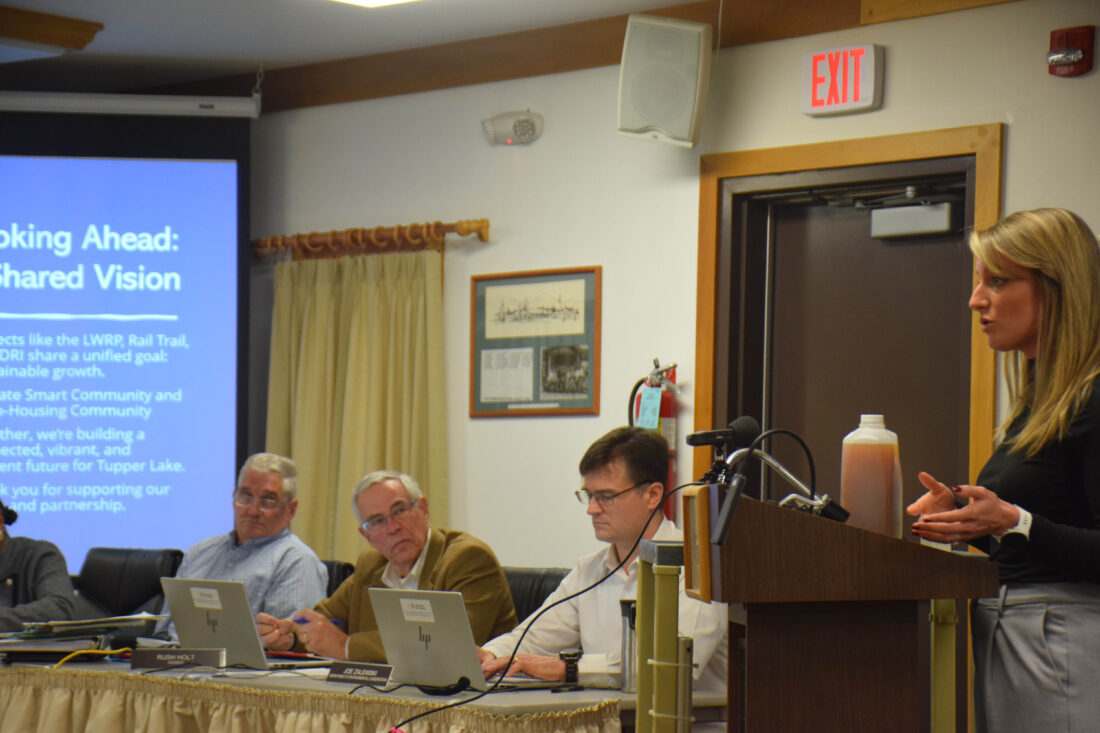
Tupper Lake village Mayor Mary Fontana showcases a jug of iron-laden tap water at the Adirondack Park Agency’s October meeting, demonstrating what some residents there have been facing for years as a result of inadequate filtration at its wells. (Enterprise photo — Chris Gaige)
ALBANY — Tupper Lake’s water crisis was at the top of state Sen. Dan Stec’s mind at a Wednesday state environmental conservation budget hearing.
Stec, R-Queensbury, said he could have gone on for hours about the litany of environmental and infrastructure issues throughout the state’s 45th Senate district, which encompasses 84 towns, 20 villages and two cities.
Per the hearing rules, he only had five minutes to address state Department of Environmental Conservation Commissioner Amanda Lefton.
Stec chose to put Tupper Lake front and center.
“The village of Tupper Lake has been struggling for several years with a water problem,” Stec began. “They have 2,000 customers and their recent estimates are they either need to spend $25 million on more wells or $40 million on (a) surface filtration plant. If they went with wells, the cheaper option, they’re looking at $200 or more a month water bills.”
He told Lefton that the village has asked “everyone they can find in the state” for grant assistance with these plans, to ease the burden on ratepayers, including the state Environmental Facilities Corporation, state Department of Health and the DEC, and are running up against a wall.
“They’re saying that they’ve maxed out all their grants, that they can’t get any more grant funding,” Stec said. “What is the plan for taking care of (that)?”
Without addressing Tupper Lake’s situation specifically, Lefton began by contending that the money slated specifically for rural communities is an acknowledgment of the financial challenges faced by communities with small customer bases, given that so much of these infrastructure upgrade costs are fixed, making it easier for larger communities to spread those over a larger ratepayer base.
“I think in part, the reasoning for ensuring that there is money specifically slated for rural communities is a recognition of the unique challenges in the Adirondack Park and other places across the state in which you do have a small rate base that can’t afford to take on a large infrastructure project,” she said.
Lefton then thanked Gov. Kathy Hochul.
“I really applaud Governor Hochul’s leadership in recognizing this and ensuring that we’re increasing our water funds in the state because we know just how critical these are and with this additional funding, hoping that can actually unlock some of the key projects that will support Tupper Lake as well as other communities,” she said. “We can certainly circle back on how we can continue to focus on delivering there, and I’d be glad to continue to work with you on that.”
Stec told the Enterprise that, though he had hoped for it, he wasn’t surprised by the lack of specificity here. It was, after all, a nearly three-and-a-half-hour hearing, with state senators and assemblymembers raising a myriad of issues from their districts.
“I’m trying to be tight and make a point,” he said. “A lot of this isn’t necessarily asking a question and seeking an answer. I mean, sometimes that happens — but this is also making points and staking out positions. Everyone’s watching, the governor’s people are all watching, so this is an opportunity to make a point and maybe get some future action.”
–
A bleak spreadsheet
–
Tupper Lake village Mayor Mary Fontana said she’s been told by the state that the community has maxed out its grant eligibility for further water improvements. She noted that between 2022 — when the village shifted its focus to either how it was going to treat the wells, or look for a different water source — and 2024, Fontana said the village has received about $7.43 million in various state grant funding for its water improvements, much of which has been put toward research and development for finding future sources.
The village is currently saddled with about $7 million in debt from its Pitchfork Pond well project — which proved in hindsight to be a spectacular failure at delivering clean, clear water to the community. This is on top of what Fontana said is about a current $12.5 million minimum funding gap, with the existing grants factored in, for the cheapest possible future water improvements.
All told, she said there’s at least $19.5 million that Tupper Lake needs to come up with to move forward with water improvements, though she said the $25 million figure that she provided to Stec is well within the realistic price range, when inflation and other contingencies come into play, given how early in the planning things remain.
“We’re anticipating having to bond for that,” Fontana said. “If we’re no longer eligible for additional monies through these programs, I will begrudgingly say, ‘I understand and I accept,’ but what I’m asking New York state to consider is reviewing the eligibility guidelines for the communities in New York state that are facing, or will be facing, similar problems. It’s absorbing an unsustainable level of debt.”
Stec said he wasn’t giving up on the state changing its guidelines to make Tupper Lake eligible once again for assistance with water infrastructure.
Earlier in his hearing remarks, Stec said what’s earmarked for water improvement projects, $750 million statewide, won’t likely be able to meaningfully address Tupper Lake’s water situation — a combination of inadequate filtration of iron-laden groundwater from the Pitchfork Pond wells, as well as potentially carcinogenic water from Little Simon Pond.
Tupper Lake uses a blend of the two sources, though different parts of the community receive different blends, depending on their proximity to each source. The potentially cancer-causing surface water stems from naturally occurring organic matter that, while not harmful in and of itself, reacts with chlorine used to treat the water to produce the potentially carcinogenic byproducts.
Fontans said that the underlying premise — well-serviced groundwater instead of potentially carcinogenic treated surface water — was not wrong nor misguided.
“If the Department of Health is adjusting its threshold and its guidelines for safe drinking water, I support that. I’m a mom before anything else,” she said. “But you have to make these programs accessible, and the mechanisms and the resources that enable these communities to access these programs.”
Getting the assistance to make that effective, though, is the issue. Fontana said getting through to the state over the last few years often feels like screaming into a black hole.
“We’re unique in our character and our resilience,” she said. “But our financial capacity is not, and other communities in New York state are feeling this same strain. I need the state to reevaluate its priorities and its programs and answer the calls of its communities.
“I really hope that New York state just hears us,” the mayor said. “And if it doesn’t benefit Tupper Lake, well then I hope it benefits Saranac Lake, Long Lake, Indian Lake, Speculator — you name it.”
Stec said he understands Fontana’s bind and applauded her advocacy.
“I know she’s all over this, I know she knows what she’s doing,” he said. “I was a town supervisor, so I know what she’s dealing with. She’s catching it from the residents, she’s trying to deal with the state, she’s trying to deal with engineers — I’m sure she’s frustrated, but she’s doing a good job.”
–
Priorities
–
Stec said Tupper Lake’s water crisis floated to the top of his list, not just for its severity, but for what he sees as a complete misalignment of how the state spends. He juxtaposed the minimum $19.5 million to fix the community’s water — and the $750 million tentatively earmarked for similar situations statewide — with the state’s efforts to purchase large swaths of Whitney Park.
The Adirondack Explorer’s James Odato reported in October that Hochul sent a letter to John Hendrickson’s estate, which is handling the sale, and a potential purchaser. The letter indicated that the state was interested in buying about 32,000 of the 36,486.7 acres up for sale — not from the estate directly, but from Texas-based developer Shawn Todd.
Todd’s reported $125 million offer was premised on only developing about 4,000 acres and recouping much of that by reselling the rest of the land back to New York for inclusion into its Forest Preserve. The deal collapsed when it became clear that the estate would not allow Todd to resell the land to the state.
Hendrickson was adamant that he did not want the state to acquire the land because he was upset by what he saw as poor stewardship by New York of other land that he and Mary Lou Whitney had sold to the state previously — much of what makes up the roughly 19,500-acre William C. Whitney Wilderness area, bordering Whitney Park to its north.
A last-ditch offer was made where the state could purchase a 200-year lease for the 32,000 acres, and manage it similar to how it would if it were part of the Forest Preserve — though it could not be formally added to it, given the Forever Wild clause in the state constitution governing these lands.
In a letter published by the Explorer, Todd said he personally had no qualms about selling land to New York, but that this lease was the only clear path that Hendrickson’s estate would allow him to offer. Ultimately, the state rejected the lease, deciding it wasn’t worth purchasing an agreement short of outright ownership.
With the state’s rejection, Todd said it was no longer feasible for him to purchase the property, but that he could re-engage should the estate or the state’s terms change in the future. Odato reported there was a difference in interpretations of Hendrickson’s will between Hendrickson’s representatives and Todd. The trustees said the language is clear that future owners cannot later sell it to the state. Todd contested that it only concerned who the trust could sell the land to, not future owners.
It’s unclear if there is, or will be, a formal deed restriction for the property precluding state ownership, which could be tied to the land in perpetuity, regardless of individual owners. It’s also unclear what Hendrickson’s will actually states, as it has not been publicly released.
Regardless, Stec said it was frustrating to see that the state was interested in such a purchase while Tupper Lake’s water problem lingers.
“The environmental groups, who have a lot of sway down here, are trying to squeeze and get as much out of every deal that they can,” he said. “If we’re talking about buying, at $125 million, a 36,000 (-acre property), well then we ought to get some darn credit out of it when it comes to Adirondack property swaps.
Stec was clear what he would do with the coffers if it were up to him.
“If we’ve got $125 million to just buy that Whitney property, then I want to take that $125 million and I want to spread around some water projects, starting with $20 million for Tupper Lake — right down the road,” he said.
As one of 213 state legislators, Stec said he wasn’t holding his breath on that, but that he’ll continue pushing for more assistance with Tupper Lake’s water woes.
“This is an important issue in Tupper Lake, and if I can help the mayor and the village figure this out and get moving forward — I was there, I’ve seen the water, I’m not going to argue with anybody — they’ve got a legitimate issue,” he said. “The village is doing what it can. I want the state to be as accommodating as possible, both financially and from a process standpoint.”
Local News
Saranac Lake parking lots closed for snow removal Feb. 4-5
SARANAC LAKE — The Village of Saranac Lake Department of Public Works will be closing the municipal parking lot ...
Stec spotlights Tupper water crisis

Ice, caramba!
US, Canadian citizens arrested for human smuggling in Tupper Lake
TUPPER LAKE — U.S. Department of Homeland Security arrested a U.S. citizen and two Canadian citizens on human ...

Winter Carnival suncatcher contest entries due Feb. 5