Senate Republicans outline their agenda for 2026
Discuss how they’d tackle issue of affordability
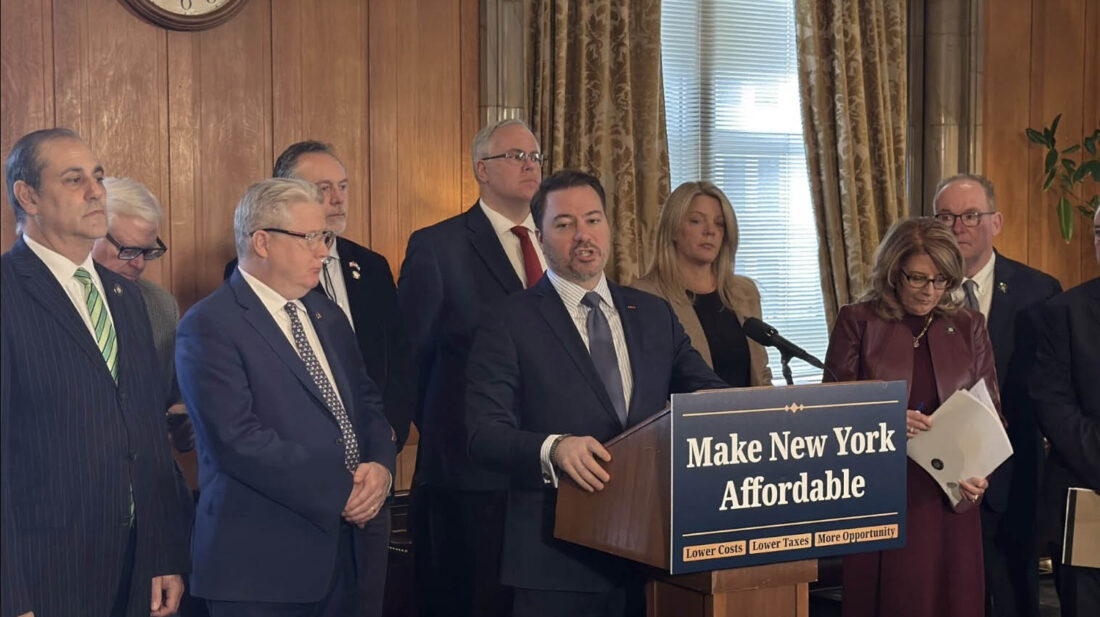
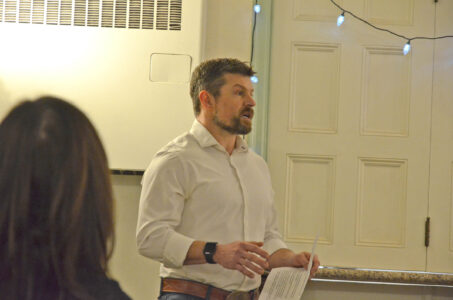
Senate Minority Leader Robert G. Ortt, III, presents the Republican agenda for 2026 from the state Capitol on Wednesday. (Provided photo — Alex Gault/Johnson Newspapers)
ALBANY — Affordability has been the word on everyone’s lip in the state capitol this year, but the Senate Republican conference isn’t convinced the Governor’s proposals this year will actually solve the issues facing New Yorkers’ budgets.
On Wednesday, the Senate minority conference gathered in Albany and laid out its own map for how to save state residents money and make New York a more attractive place to live.
They focused on a few key issues, issues that aren’t dissimilar to what Gov. Kathy Hochul herself has focused on in recent years. The Senate Republicans want low taxes, real investments in child care and efforts to cut energy costs, as well as increased investment in home building and efforts to cut food costs.
They’re all tied together, said Senate Minority Leader Rob Ortt III, R-North Tonawanda.
“Most New Yorkers, they’re not dealing with these things by themselves, they’re dealing with them at the same time, and it’s a real affordability crisis,” he said. “It’s why people are leaving the state, and why this state will lose more Congressional representation in Washington D.C.”
Ortt said the recommendations put out by the Senate Republicans on Wednesday were driven by roundtable meetings that conference members have held with their constituents across the state in recent weeks; the only roundtable not reflected is one to be hosted by Sen. Mark Walczyk, R-Sackets Harbor, which was rescheduled due to inclement weather.
He said those discussions, which saw Republicans, Democrats and independent voters participate, showed that Democrat-led efforts at affordability have missed the mark, and that many people blame state officials at least in part for the high cost of living in New York.
“At the exact same time they’re talking about affordability, and saying the word as many times as they can fit it into a sentence, they are continuing to push things that are either not changing the dynamic, or that are actually undermining and driving up the costs and making life less affordable,” Ortt said.
Senator Pamela Helming, R-Canandaigua, outlined a platform of bills that would address some of those state-leveraged costs. One bill the Republicans are backing would allow homeowners to update their properties, make renovations and repairs without triggering a property tax review that would drive their taxes up. Another bill would allow homeowners to build their projects following the less restrictive energy code the state followed in 2020.
The conference also wants to repeal the 2019 Climate Leadership and Community Protection Act that set an aggressive decarbonization schedule for the state, and also have a bill that would return $1 billion in taxpayer dollars set aside for that decarbonization back to ratepayers.
Senator Steven D. Rhoads, R-Bellmore, outlined Republican bills that would enact a three-year freeze on property taxes, and another to revoke a series of healthcare taxes used to support the Medicaid system. He also teased Republican action yet to come that would enact a $30 billion tax cut statewide, targeted to lower and middle income earners. The plan would exempt the first $50,000 in income for individuals and $100,000 in income for families from state income tax.
“That’s a 10-year phase-in, and the median income in New York is about $89,000, when fully phased in the average taxpayer in the state of New York will pay no state income taxes,” he said.
And Senator Robert Rolison, R-Poughkeepsie, outlined a plan that would address child care needs across the state, by fully funding the state’s existing child care assistance programs and supplementing the child tax credit. Additionally, the Republican plan would permit the state Office of Children and Family Services, which oversees child care centers, to allow the owners of centers to provide care when a teacher is unable to come in to work.
“When child care providers and experts tell us the system is pushing them to the brink, we have a responsibility to act,” he said. “Staffing shortages are driving up costs, forcing classrooms to close, and threatening the survival of child care centers that families depend on. This bill provides practical, temporary flexibility, so centers can stay open, control costs, and continue serving families without fear of citations or insurance cancellations.”
Local News
Saranac Lake Republicans choose Stiles, King for trustee
Senate Republicans outline their agenda for 2026
Saranac Lake Republicans choose Williams to run for mayor
Reception for Leifheit’s newest exhibit slated Feb. 6
SARANAC LAKE — NorthWind Fine Arts Gallery will host an opening reception for member Diane Leifheit’s February ...
Tupper Arts launces rehab of Adirondack State Theater
TUPPER LAKE — Tupper Arts recently announced it has officially launched the rehabilitation of the Adirondack ...