Howitzer hearing delayed until Feb. 25
Dueling motions for disqualification considered, Jay town board adopts resolution opposing project

APA Deputy Director for Regulatory Programs John Burth presents on the proposed howitzer testing range in the town of Lewis in November. The APA board subsequently voted to send the project to an adjudicatory hearing, which is set to start on Feb. 25. (Enterprise photo — Chris Gaige)
RAY BROOK — The Adirondack Park Agency’s adjudicatory hearing for a proposed howitzer testing range in the town of Lewis has been delayed to 10 a.m. on Feb. 25 from its previous start date of Feb. 4.
The hearing is still expected to take place in person at the APA’s Ray Brook headquarters, with remote viewing options. Information for viewing options is expected to be released closer to the hearing.
This delay comes as the hearing officer, Administrative Law Judge David Greenwood, considers a motion by the legal team representing the Adirondack Council, a green group. The motion requests that the project sponsor’s attorney, Matthew Norfolk, be removed from the case unless he can remedy the stated conflict of interest concern.
Norfolk said the motion is “bogus,” his firm never acted improperly and that Adirondack Council does not have standing to make the motion. Norfolk has also filed appeals to disqualify Greenwood and Adirondack Wild, another green group with party status to the hearing. Those are both before the APA. The Jay town board adopted a resolution on Tuesday formally opposing the project. Jay borders the town of Lewis.
–
Adirondack Council’s motion
–
Adirondack Council contends that Norfolk has not produced evidence indicating his firm followed the required processes meant to safeguard against conflicts of interest in representing the howitzer sponsor.
Adirondack Council is one of four conservation advocacy organizations that are parties to the hearing. All four are opposed to the howitzer range, which is sponsored by Michael Hopmeier, through his company, Unconventional Concepts, Inc.
The potential conflict, in this case, stems from Norfolk’s firm, Norfolk Beier, hiring attorney Sarah Reynolds in mid-May. Reynolds had previously worked as an associate counsel for the APA and had been involved with the agency’s handling of the project sponsor’s application. Adirondack Council, in its motion for disqualification, did not allege that Reynolds was “involved” in the case while working for Norfolk Beier, but stated that there was potential for that, and furthermore that the firm’s apparent failure to seek the required waivers was enough to warrant its disqualification.
Reynolds left Norfolk’s firm in mid-December. Norfolk told the Enterprise that her departure was for personal reasons and was wholly unrelated to the howitzer case. In its motion, Adirondack Council contends that even if Reynolds has subsequently left, it doesn’t change the matter at hand.
“Even if Ms. Reynolds has recently left Norfolk Beier PLLC, the conflict pursuant to Rule 1.11(b) (the relevant state code governing professional conduct for attorneys) remains for the firm based on her having been there for whatever period of time she was there while the firm was still continuing its representation of the Project Sponsor in this matter without, upon information and belief, any compliance with the requirements of Rule 1.11 or waiver of the conflict by APA,” the motion states.
The motion adds that Adirondack Council, as a party in the proceeding, could be harmed if other attorneys from Norfolk Beier gained or may gain factual, legal or other information from Reynolds, either directly or indirectly, based upon her prior involvement in APA staff’s review of this matter during her tenure with the agency.
“This could even include information about the opinions of APA staff, APA executive staff or even APA Board members or designees regarding the Project Sponsor’s application,” the motion states. “Any such information gained by lawyers at Norfolk Beier PLLC regarding this matter, without other parties to the hearing having the same information, has the potential to undermine the integrity of the hearing because the parties would not all have the information gained by Norfolk Beier PLLC through its Senior Counsel, Ms. Reynolds.”
Norfolk called the motion “bogus” and a “weak argument.” He said that the Adirondack Council doesn’t have standing to make this kind of motion.
“As an initial matter, I’m flattered Adirondack Council does not want to go against me in this administrative proceeding,” he wrote. “Adirondack Council does not have standing to pursue a claim that there is a conflict of interest.
“Adirondack Council is not my client presently, and I have never represented the organization,” Norfolk added. “If a conflict of interest existed, only my clients, Mr. Hopmeier and Unconventional Concepts, Inc., and possibly the APA may raise an objection. Neither my clients nor the APA objected.”
Norfolk cited 2015 case law stating that “a former client who is entitled to object to an attorney representing an opposing party on the ground of conflict of interest but who knowingly refrains from asserting it promptly is deemed to have waived that right.”
“Any alleged conflict of interest has been waived,” Norfolk stated.
Norfolk added that at no point during Reynolds’ tenure with his firm did she involve herself with the case, or otherwise act improperly.
“Attorney Reynolds and my firm followed the law governing what former government employees may and may not do,” he wrote. “Attorney Reynolds had no involvement in the matter while she was employed at my firm. The file was not discussed with Attorney Reynolds and she did not work on the file in any way.”
APA spokesman Keith McKeever said the agency has no comment on the matter right now, but will release more information next week.
Protect the Adirondacks! Executive Director Claudia Braymer said that as one of the other parties in the hearing, Protect! supports Adirondack Council’s motion, and believes that there are grounds for the firm’s disqualification here.
Adirondack Council spokesman John Sheehan said the organization didn’t have any further comment beyond its motion at this time.
Greenwood gave all parties until 5 p.m. on Feb. 3 to submit materials in support of or against Adirondack Council’s motion. He said he would issue a ruling by Feb. 10.
Other disqualification appeals
Norfolk also made two formal appeals to the APA, one for the disqualification of Greenwood as the hearing officer and one for the disqualification of Adirondack Wild as a hearing party. In November, Norfolk had requested Greenwood recuse himself, citing his past employment as a policy analyst with Adirondack Council, a position that he held from 1993 to 2000.
APA Executive Director Barbara Rice responded to Norfolk’s request then, finding that his past employment with the group was not sufficient to remove him. Norfolk said that the order was inoperative, as his request was to Greenwood directly, not Rice, as it was a voluntary request, not an official motion.
His formal challenge, which is now before Rice, is not substantively different than his previous request, with Greenwood’s 1993-2000 employment with Adirondack Council being the thrust of the argument, coupled with evidence of the Adirondack Council’s opposition to the project. Norfolk contends that it creates “an undeniable appearance of impropriety.”
It’s unclear when Rice will decide on this.
Norfolk’s other appeal is that Adirondack Wild, one of the four green groups that received party status to the hearing, should not have been granted it, as its petition was materially deficient, “providing only barebones and unsubstantiated information.”
Norfolk raised several concerns in his appeal, arguing that the petition fails to demonstrate Adirondack Wild’s capacity to participate and supply information or expertise for the hearing, fails to demonstrate it has a material social, economic, or environmental interest that is likely to be affected by the APA’s decision concerning the project and that Adirondack Wild’s concern on state land management is outside the scope of this hearing.
It’s unclear when a ruling on that is expected.
–
Jay town board opposes project
–
As the legal maneuvering continues to play out, the Jay town board voted 3-0 to adopt a resolution opposing the project after hearing a presentation from Hopmeier, as well as public comment.
Town Supervisor Matt Stanley and council members Olivia Dwyer and Tom McDonald voted in favor. Town councilman Steve Forbes abstained, citing a conflict of interest. Town Councilman Knut Sauer was absent from the meeting, though he indicated his opposition to the project at the board’s Jan. 8 meeting.
“We felt there were enough comments from our constituents opposing the project that we felt like we had to take a stance, to be a bigger voice for the residents of the town of Jay,” he said.
The letter is more of a declaration by the town board that a significant number of its residents don’t want the howitzer range near them. It doesn’t carry any regulatory power, and Stanley emphasized to constituents that the actual decision rests with the APA board. Still, though, he hoped a town board taking formal action, and the volume of public comment in opposition to the project, would be taken into consideration by the powers that be.
“All we can be is a strong voice for our residents and the surrounding towns, and we’ll support (the resolution) so we can be that voice,” Stanley said.
Stanley said that even though the firing would be one town over, he believes the noise and environmental effects would be felt in Jay. He added that he was not convinced by Hopmeier’s presentation that there wouldn’t be undue adverse environmental impacts.
“We don’t know how it’s going to affect the Adirondack Park,” Stanley said. “There were a couple of really good points made. People come to the Adirondacks to get away from that kind of stuff.”
There was also a comment made that there a lot of veterans that reside in the town of Jay. Stanley said there was concern that the noise could provoke post-traumatic stress disorder symptoms. He added that there are already better testing sites outside of the Adirondacks.
Adjudicatory hearings are the only avenue through which the APA board can deny or substantially modify a project application that is deemed complete. It may also approve the project after the hearing. The APA board’s decision can be appealed to state Supreme Court.
For more information on the hearing from the APA, including all of the above-referenced filings in full, tinyurl.com/mpdramry.
Local News

Crossing the line
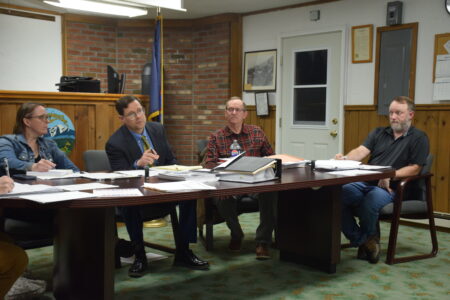
Wilmington board passes set of zoning amendments

Corned beef and bowling

Having the time of their lives
Saranac Lake trustee candidates speak at forum
SARANAC LAKE – Three of the candidates running for two open village trustee seats on the March 18 ballot – ...