
Hochul prepares for rough fiscal seas ahead in 2027 state spending plan
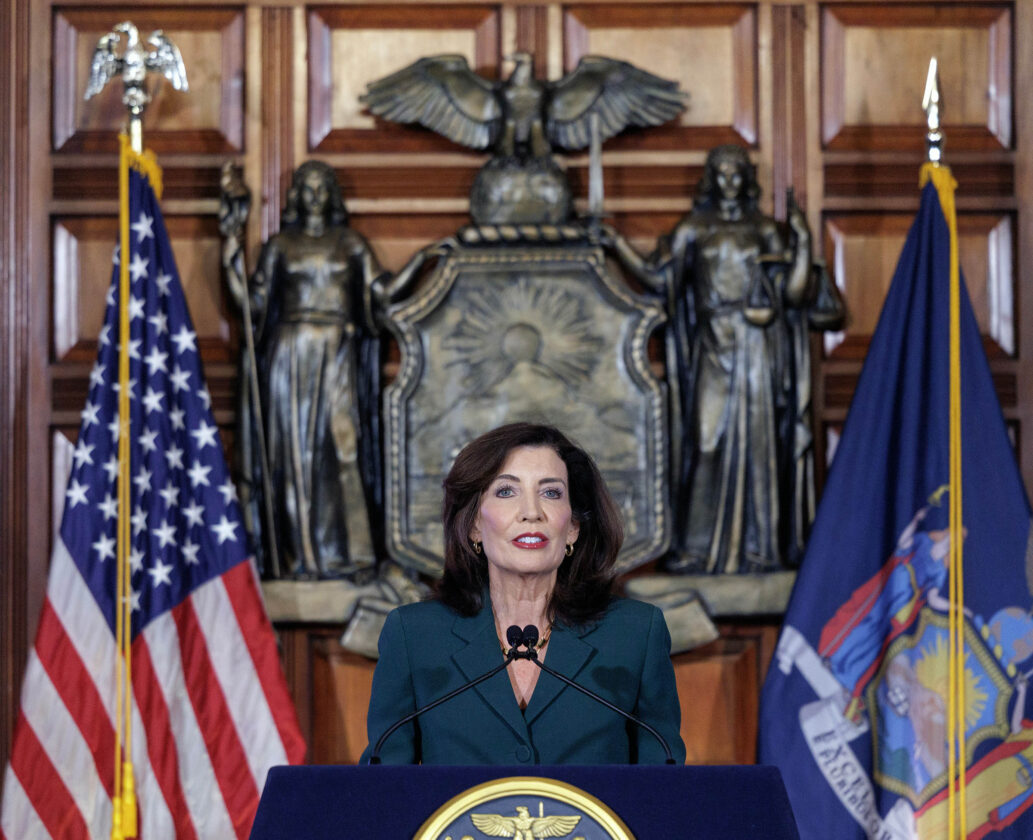
Gov. Kathy Hochul presents the fiscal year 2027 executive budget Tuesday in Albany. (Photo courtesy Mike Groll/Office of Gov. Hochul)
ALBANY — Gov. Kathy Hochul wants New York to be ready to weather any financial storm, a message she’s pitching as she presents her executive budget request for the upcoming year.
On Tuesday afternoon, the governor stood in front of top lawmakers, government staff and a few dozen reporters to outline her budget plan for the state’s coming fiscal year, which starts April 1.
For the price of $260 billion, Hochul outlined a plan that maintains the most of the existing government operations, services and benefits offered to New Yorkers, as well as a variety of new investments aimed at making life more affordable, easier to balance and adjusting state laws in response to changes in federal law.
“A budget is more than figures on a page,” Hochul said. “It’s a statement of priorities. A test of discipline. And this year, with so much uncertainty coming out of Washington, it must be a plan that can hold up under pressure.”
Hochul’s budget plan this year largely maintains current law and expense plans. It includes far less public policy than previous budgets she has advanced, but it still lays out a fiscally focused approach to achieving goals the governor has identified.
The keystone of this year’s plan is an investment in child care. The governor plans to make good on years-old state promises to fully fund pre-K education for 4-year-olds statewide, while providing millions in investment for pre-K for 3- and 2-year-olds in New York City. The total investment comes to $1.3 billion.
A pilot program with three upstate counties in western New York, the Hudson Valley and the Southern Tier will expand existing 3-year-old pre-K programs there. Ultimately, all 4-year-olds across New York should have access to affordable pre-K by 2028.
Funding for this plan is only for a few years as of now. New York City gets support until 2028 for programs there. Hochul was frank, saying no official can predict what enrollment, utilization or federal policy will look like in the near future.
“We’re doing what responsible government does,” Hochul said. “We’re using existing resources today and building toward long-term sustainability. Our commitment to our kids doesn’t end when they age out of child care.”
The governor is also, for a fourth year, planning to fully fund the foundation aid formula that provides state dollars to local school districts. In 2023, she pitched a wide range of changes to the formula she later walked back, making only marginal updates to the formula last year.
But Hochul noted that money alone doesn’t make education strong.
“That’s why we’ve paired historic investments with common-sense reforms like getting cellphones out of classrooms so kids can start paying attention to their teachers and returning to make-to-basics instruction in reading, an approach we’ll expand to math this year,” she said.
Her plan also includes an investment of $15 million in the Dairy Modernization Grant Program, designed to provide money to dairy farmers who spend money to update and improve their farms. Another $30 million is going to a wider tariff relief program aimed at all farmers in the state, providing direct grant money to offset increased expenses due to federal import taxes imposed last year.
While Hochul has described those tariffs as one of the biggest headwinds challenging the state’s agricultural economy, the budget plan notes that those tariffs have not been as big of a problem for the state as originally feared.
Hochul said that the state has found those tariffs have cost about $4,200 per family, and said that their impact is still significant.
“I’m anticipating more of the collateral damage of the Trump administration,” she said.
Blake Washington, director of the Division of the Budget in Hochul’s office, said that while tariffs have not been as markedly bad for the economy as they appeared they could be when first enacted, the impact hasn’t fallen as hard on the state’s budget as it has on farmers and consumers.
“While they’ve moderated dramatically, it still has a net effect on government,” he said.
The single largest increase in state spending in the next year is Medicaid and public health spending, an issue that largely can’t be negotiated. Driven by the highest enrollment numbers for Medicaid and the state Essential Plan, the state will spend 11.4% more on subsidized health insurance than it did last year, a $38.2 billion increase.
An aging population means more people are on the plans, but Hochul said an expansion of benefits for prior-year coverage, plus increases in reimbursement rates to medical providers all mean the program is only getting larger.
“We have increased enrollment for advanced, long-term care and the aging population, but we’re also putting resources in capital funds for our transformation fund,” Washington said at a technical briefing later Tuesday. “We provided $1.2 billion in MCO, we enacted an MCO tax last year.”
That tax is meant to pay back into the program, which now carries more than 9 million subscribers across various iterations statewide. Of the roughly $85 billion in annual funding New York gets from the federal government, 77% of that, $65 billion, is for Medicaid.
The budget is also facing a drop in federal support: expiring federal COVID-19 pandemic programs and a roughly $3 billion cut to Medicaid support are totaling $10.3 less in federal government support for the year.
That’s buoyed by an unexpected $17 billion in additional revenue, largely from income tax on high-income earners from Wall Street, that Hochul is driving into needy state accounts. Gaps in existing plans, as well as in out-year budget plans, are being plugged by better-than-expected income lines from last year.
“That’s the money we will use to protect New Yorkers from federal dysfunction and fund our bold agenda for the year ahead,” Hochul said.
The governor seemed to initially defend her budget from critics who could say it didn’t do enough, describing it as a “disciplined” spending plan in the face of difficult conditions on the wider scale.
“This is not an austerity budget,” she said.
“Looking at this budget, you can see it reflects discipline, momentum, ambition and readiness for a more uncertain world,” she added later.
But she spoke frankly after questions from reporters, admitting that New Yorkers shouldn’t expect the entirety of her presentation to become law later this spring. She spoke of 30-day amendments, wherein she can amend her budget proposal by Feb 19, and of the negotiations that often raise new or altered plans before final passage.
“We have our negotiations, that start in earnest, and those of you who are observers of the process know that the budget we put forward today is really a starting point, it lays out our priorities, but then listen to the legislature about their priorities, and they’ll have a chance to weigh in on this as well,” she said.
The process means that the legislature will start considering what Hochul has presented, with hearings, meetings and closed-door deliberations among lawmakers. The process is supposed to be finished by April 1, the official new year in the state’s financial calendars, but that hasn’t happened in recent years. On Tuesday, Hochul seemed to suggest the legislature was responsible for those missed deadlines.
“We don’t get (the legislature’s) version of the budget until two weeks before it’s due,” she said. “I don’t know how anybody ever thinks that it can be done on time, I don’t understand the premise behind that.”
Local News

Hochul prepares for rough fiscal seas ahead in 2027 state spending plan

What’s up, ice block?
Artists Guild celebrates Carnival
‘It is a massive job’
SARANAC LAKE — The state Department of Motor Vehicles is preparing to update its archaic software to end the ...

ArtWorks presents ‘Carnival Chronicles: Winter Carnival Through the Ages’
New fund helps food pantries scale up
LAKE PLACID — Adirondack Community Foundation announced last Friday the establishment of the Small Grants for ...