
Four green groups join howitzer hearing
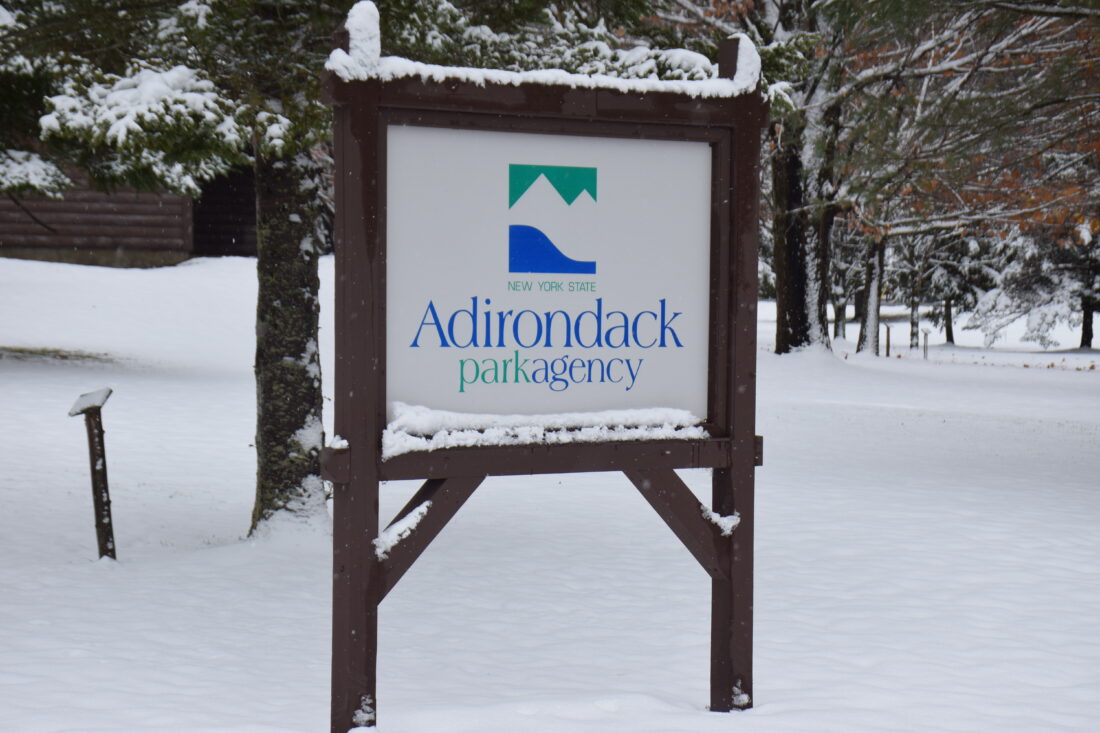
The Adirondack Park Agency photo is seen at its Ray Brook headquarters in November. (Enterprise photo — Chris Gaige)
RAY BROOK — All four environmental advocacy groups that filed petitions to join the Adirondack Park Agency’s adjudicatory hearing for a proposed howitzer artillery gun testing range in the town of Lewis will be allowed to participate.
In a ruling issued on Monday, Administrative Law Judge David N. Greenwood granted the four applications for party status, which were submitted by the Adirondack Council, Adirondack Wild: Friends of the Forest Preserve, Protect the Adirondacks! and the Sierra Club’s Atlantic Chapter. The groups oppose the proposal.
Greenwood wrote that each group had filed petitions that satisfied the five elements laid out in the state code to successfully join an adjudicatory hearing. He is overseeing the hearing, though the APA board will determine the proposal’s fate after the hearing has concluded.
Adjudicatory hearings are the only avenue through which the APA board can deny or substantially modify a project application that is deemed complete. It may also approve the project after the hearing. The APA board’s decision can be appealed to state Supreme Court.
The howitzer testing range is being proposed, or sponsored, by Michael C. Hopmeier through his company, Unconventional Concepts, Inc. He is represented by Lake Placid-based attorney Matthew D. Norfolk. The burden of proof throughout the hearing rests with the project’s sponsor.
While the adjudicatory hearing is public, it’s only the parties that can actively participate. This includes presenting evidence and testimony from experts, as well as cross-examining those of other parties. The scope of participation by any one party may, however, be limited to certain issues within the hearing by the administrative law judge.
Greenwood’s 12-page ruling summarized the merits of each group’s petition and found that those were satisfactory.
Protect the Adirondacks! Executive Director Claudia K. Braymer and Adirondack Council communications director John F. Sheehan applauded the ruling.
“We’re gearing up and excited to participate in this hearing to show APA that it has the basis that it needs to ultimately deny this unprecedented proposal that has no place in the Adirondacks,” Braymer wrote.
“We are pleased that we were granted party status and will be allowed to participate in the hearing,” Sheehan wrote. “We are discussing next steps with our legal team and don’t want to discuss our strategy in advance of the hearing.”
Greenwood’s ruling addressed a challenge submitted by Norfolk, that one of the groups, Adirondack Wild, should be denied. There were no challenges made to any of the other groups, which Greenwood invited as part of his consideration in advance of his ruling.
Norfolk contended that Adirondack Wild’s petition was “materially defective.” He raised five areas of concern. One was that the group failed to provide sufficient information about its history of formation and legal nature. Another was that no charter, bylaws, constitution or similar documents were submitted in the application.
The third challenge was that the group did not demonstrate an ability to provide information or participation that would advance the adjudicatory hearing’s purpose. The fourth challenge was that it didn’t demonstrate material social, economic or environmental interest in the project’s ultimate decision.
The final challenge was that the group’s stated interests around defending the “forever wild” character of the land, should the project’s impact exceed the nearby Forest Preserve’s carrying capacity and visitor use management practices under the Adirondack Park State Land Master Plan. Norfolk wrote that these concerns are not appropriate to address at this hearing — as it concerns the development of private land — and should instead be addressed by the state Department of Environmental Conservation.
Greenwood found that the petition provided sufficient information on the nature, purpose and history of the organization, and that a copy of the bylaws had been submitted by the group. In its petition, Adirondack Wild said those documents were available and could be furnished as required.
Greenwood disagreed with Norfolk’s claim that the group could not meaningfully participate in a way that would advance the hearing. Greenwood also cited language in the submitted bylaws that points to the group having a material interest in the project.
“(T)he organization has demonstrated a ‘strong interest in defending the ‘forever wild’ constitutional protections and wilderness values of the Forest Preserve,'” Greenwood wrote. “Additionally, and relevant to a contrary argument asserted in the Sponsor’s Opposition, Adirondack Wild’s By-Laws contain a mission statement that declares its mission is to ‘advance New York’s ‘forever wild’ legacy and Forest Preserve policies … and promote public and private land stewardship that is consistent with wild land values through education, advocacy and research.’ “The Adirondack Wild Petition demonstrates that Adirondack Wild has a material social and environmental interest which is likely to be affected by the Agency’s decision concerning the Proposed Project,” Greenwood wrote. “In light of the above, I find that Adirondack Wild’s Petition satisfies the requirements for intervention set forth in State regulations … and that granting party status to Adirondack Wild would further the purpose of the hearing.”
Adirondack Wild Managing Partner David H. Gibson told the Enterprise on Wednesday that the ruling stands for itself. Norfolk expressed dissatisfaction with the ruling.
“Adirondack Wild’s petition to intervene was wholly deficient,” Norfolk wrote. “We raised several reasons why Adirondack Wild’s petition should be denied. One of them was Adirondack Wild’s failure to demonstrate it can supply information or expertise related to the project and issues to be considered at the hearing. Adirondack Wild merely alleged that it participates somehow in APA proceedings, but none were identified, that it submits public comments on APA project applications and amendments to the State Land Master Plan, and participates somehow in some undisclosed APA legislative hearings.
“When I read its petition and then ALJ Greenwood’s ruling, I scratched my head and wondered to myself, ‘how in (the) hell is Adirondack Wild going to contribute to a hearing on assessing sound and its impact? Is Dave (Gibson) going to drive up from his home, which is outside the Adirondack Park, and make a few comments?'” Norfolk wrote. “This whole proceeding is being controlled by past and present members of influential environmental organizations. The proposed testing project will amount to 7.5 seconds of sound over a period of five years. No alteration of land, no disturbance of wetlands, no adverse impacts on water or air quality. There’s got to be something somewhere in the Park the environmental groups can focus their attention on that will benefit the environment and have real meaning.”
–
What will the hearing seek to address?
–
In voting to send the project to an adjudicatory hearing, the APA board identified three issues that need to be answered through evidence produced during the hearing.
¯ Issue 1: Is the proposed howitzer testing range compatible with the Adirondack Park Land Use and Development Plan? This includes whether the howitzer testing range is compatible with the purpose of ensuring overall conservation, protection, preservation, development and use of the unique scenic, wildlife, recreational, open space, ecological and natural resources of the Adirondack Park, per the APA Act.
¯ Issue 2: Is the proposed howitzer testing range a compatible use within the “Rural Use” land area classification that the site would be on? This includes whether it is compatible with the character description and purposes, policies and objectives of the Rural Use land area classification, such as whether the proposed use should be considered a “commercial use,” and if not, whether the proposed howitzer testing range is a compatible use.
¯ Issue 3: Would the proposed howitzer testing range have an undue adverse impact upon the natural, scenic, ecological, wildlife, recreational or open space resources of the park? This is further detailed in eight separate sub-issues concerning such matters as noise, residue pollution, effects to animal habitat and migration and public safety related to the use, storage and transportation of the military equipment intended to be used at this hearing.
In its petition, Protect the Adirondacks! sought to expand the slate of issues, stating that it intends to prove that the project sponsor has already conducted unauthorized activities at and surrounding the project site in violation of the APA Act and an existing permit issued in 2023 that allows for the construction of up to 14 storage tents at the site. That can be read in its entirety at tinyurl.com/2nm9z8df.
“The offer of proof will show that the Applicant’s compliance history is relevant to whether the Applicant can reasonably be expected to comply with permit conditions in the event the Project is approved by APA,” Protect! stated in its petition.
Greenwood said he would withhold ruling on that addition of scope until a pre-hearing conference has been conducted. He stated earlier in his ruling that APA staff had requested that any proposed issues — to the extent that they don’t concern qualifications for party status — in the petitions be considered separately.
–
Next steps
–
Greenwood wrote that he had received no other petitions for party status, nor had he received any confirmations of intent to join the hearing from any other parties of right — those who don’t need to petition to join the hearing, but also aren’t obligated to. This means those slated to be involved in the hearing include Greenwood as its officer, the project sponsor represented by Norfolk, APA staff and the four green groups.
It’s unclear when a pre-hearing conference would occur, and if that would alter the issues for adjudication or the scope of any of the parties.
The hearing is scheduled to begin at 10 a.m. on Feb. 4 at the APA’s Ray Brook headquarters, with the public invited to attend in person or remotely. Access information for those wishing to attend remotely will be provided some time later this month, according to the APA.
Greenwood’s ruling on the four green groups’ petitions, can be found under the “Hearing” tab on the APA’s webpage on the project at tinyurl.com/mpdramry.
Local News
Stocked for the weekend

Costume craziness at BrewSki
Forest ranger recalls saving hiker lost for two days in Dix Range

Back-to-back champions

LPHS to host concussion seminar Wednesday
Weekend roller coaster as mid-March warm-up looms
SARANAC LAKE — You might want to keep a few different coat options handy this weekend. A hallmark of the ...