
A school, a vote and an ‘uncomfortable predicament’
District prepares for Feb. 25 vote on restructuring Bloomingdale Elementary
-
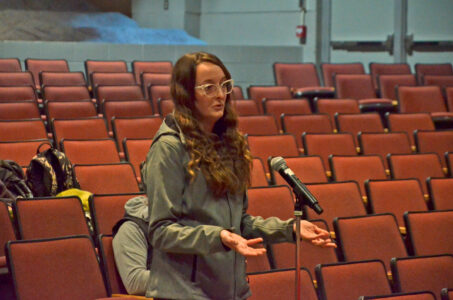
- Bloomingdale Booster Club President Shauna Manning shares concerns with the Saranac Lake Central School District Board of Education about the coming vote to potentially close Bloomingdale Elementary School. (Enterprise photo — Aaron Marbone)
-
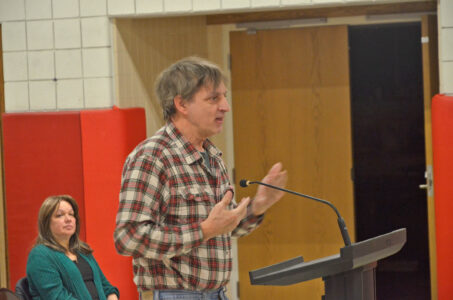
- Danny Price shares his thoughts with the Saranac Lake Central School District Board of Education at a hearing about the coming vote to potentially close Bloomingdale Elementary School. (Enterprise photo — Aaron Marbone)
-
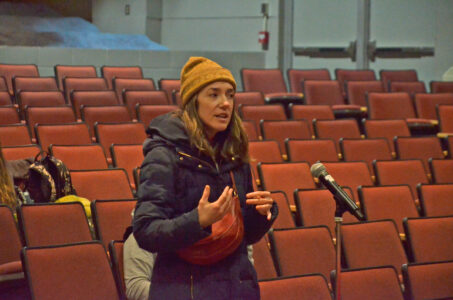
- Alison Simcox shares her thoughts with the Saranac Lake Central School District Board of Education at a hearing about the coming vote to potentially close Bloomingdale Elementary School. (Enterprise photo — Aaron Marbone)
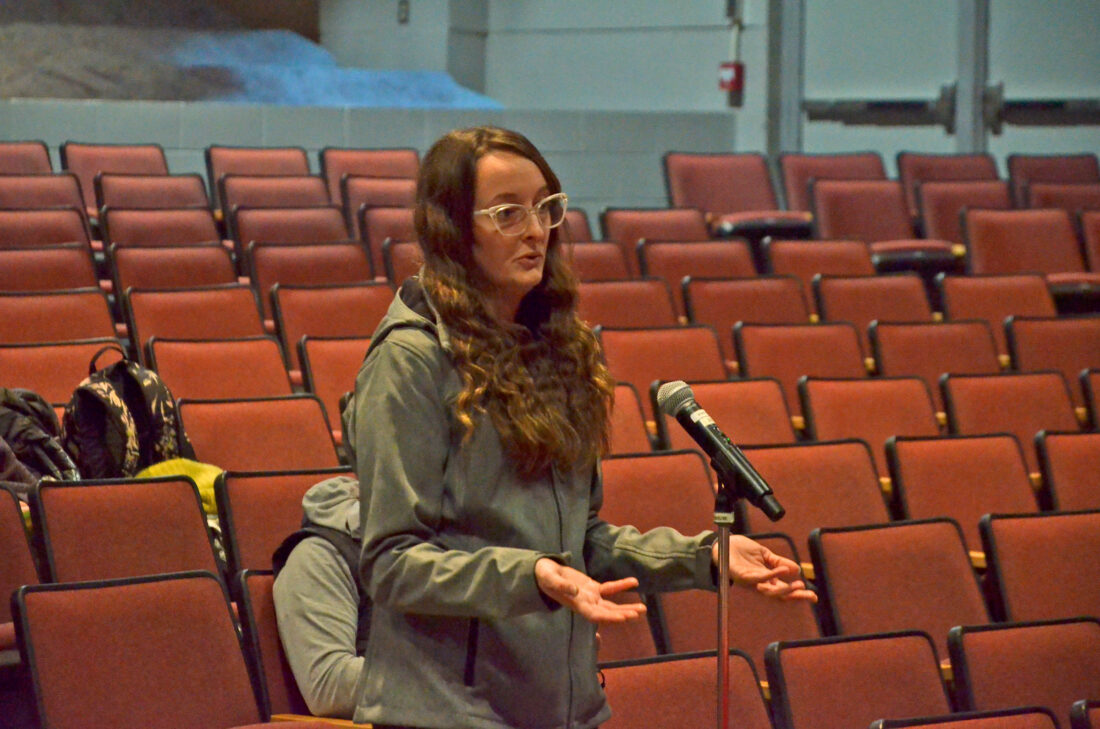
Bloomingdale Booster Club President Shauna Manning shares concerns with the Saranac Lake Central School District Board of Education about the coming vote to potentially close Bloomingdale Elementary School. (Enterprise photo — Aaron Marbone)
BLOOMINGDALE — Three nights in a row this week, the Saranac Lake Central School District Board of Education spoke about the potential closure of Bloomingdale Elementary School — twice with members of the public at hearings which covered a wide range of topics and then amongst themselves, at a meeting where they set Feb. 25 as the day they’ll vote on what they’ve called the most important decision the board will make for the next decade.
The mood of the meetings was dour. Board members and members of the advisory subcommittee each expressed that this is not a decision they want to have to make. No one wants to close Bloomingdale Elementary, they said, but they don’t see other options right now. The district’s student enrollment numbers continue declining to historic lows and the cost of running a school building rises each year.
But there was also hope, as the meetings brought together minds from government, schools and the community together to consider solutions to the issues leading to fewer children living in the Tri-Lakes. They agreed that the region is in a dire situation and drastic action is needed.
“We as a community are going to sit here and watch this community die if we don’t start making bold decisions collectively,” school board Member Zachary Randolph said. “We’re losing our Adirondacks.”
This year, the district shifted Bloomingdale students in grades 3, 4 and 5 to Petrova Elementary, making the Bloomingdale school a K-2 building. SLCSD Superintendent Diane Fox said this was the district downsizing to adapt to a new reality of fewer students.
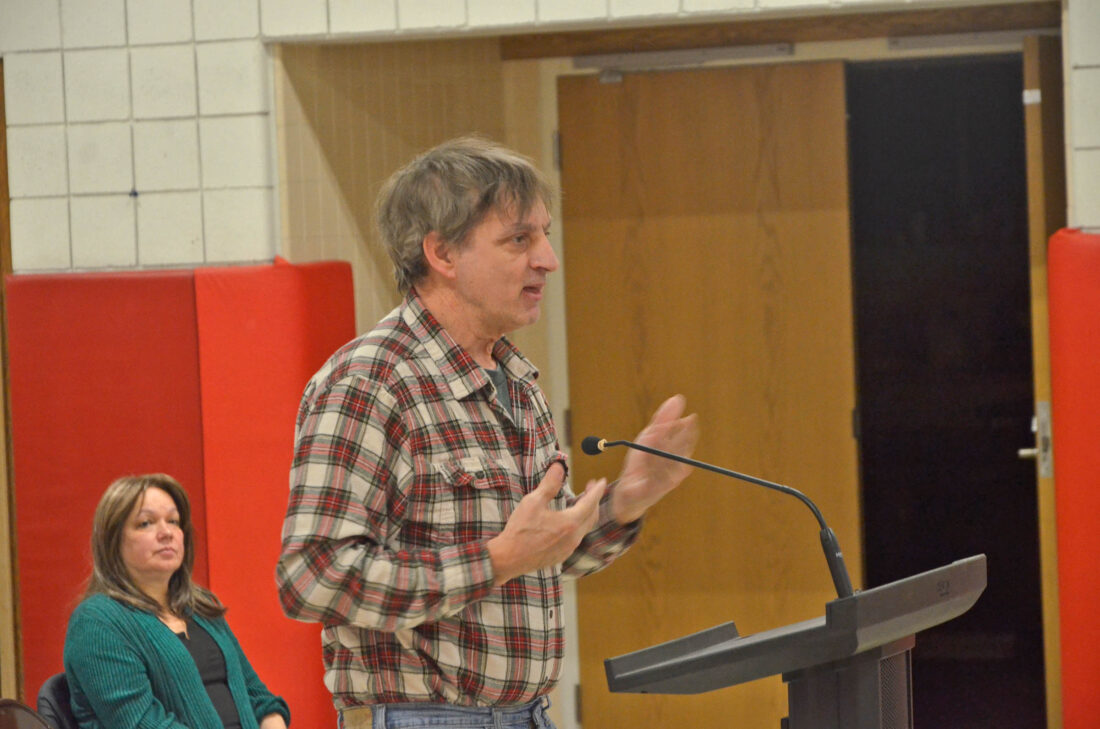
Danny Price shares his thoughts with the Saranac Lake Central School District Board of Education at a hearing about the coming vote to potentially close Bloomingdale Elementary School. (Enterprise photo — Aaron Marbone)
SLCSD student enrollment dipped below 1,000 for the first time in decades this year. Meanwhile, the cost of running schools continues to rise each year as things get more expensive and schools need to do more to meet modern education requirements.
The subcommittee was created to find options other than closing the Bloomingdale school. None have really been pitched yet.
Public questions at the hearings about the Bloomingdale school focused more on what would happen if it did close, rather than advocating against a closure.
A lot of discussion focused on the myriad problems leading to the closure discussion.
“Interesting conversation came out of (the hearings), but it didn’t really expand our options,” Fox said.
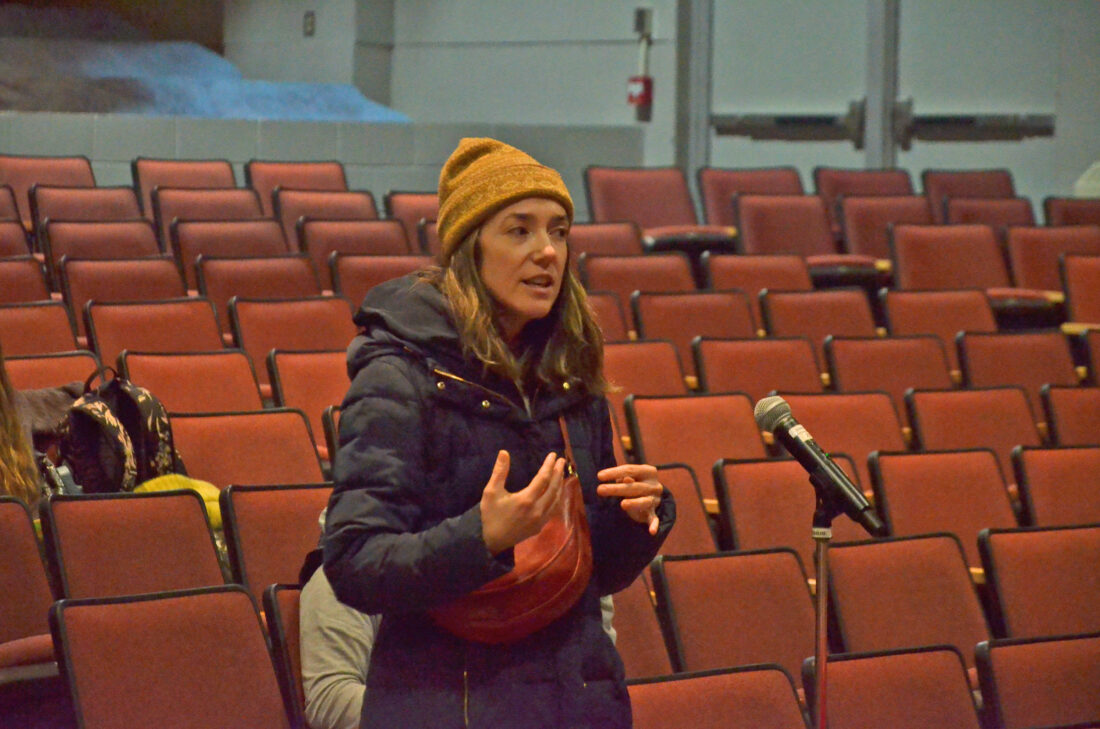
Alison Simcox shares her thoughts with the Saranac Lake Central School District Board of Education at a hearing about the coming vote to potentially close Bloomingdale Elementary School. (Enterprise photo — Aaron Marbone)
Fox said everyone wants to know what’s coming, and more time won’t change anything.
School board Chair Mark Farmer said he was proud of the hearings, but he wished they were better-attended.
Randolph said only 25 people attended the discussions on the biggest decision the school board is making for the next decade and the only elected officials there were St. Armand Supervisor Davina Thurston, a member of the subcommittee, and Harrietstown Councilman Jeremy Evans.
The subcommittee has eight members — five from the school, one retired teacher and two members from the community who were selected by the school board from a pool of around a dozen applicants. This is an advisory committee for the board. The board makes the final decision on whether or not to accept the group’s proposal.
On Wednesday, the board approved an updated timeline, which sets the vote on whether or not to close the school on Feb. 25.
The subcommittee will meet next on Jan. 21. At this meeting, committee members are expected to give their own input and draft an “educational impact statement” on restructuring for the board. The board will not be at this meeting. These subcommittee meetings are open to the public to attend and listen.
The board’s next meeting is on Jan. 28 and members will discuss the committee’s thoughts. Fox will share her thoughts on what to do at this meeting. The board then meets on Feb. 4, and Fox will share a formal recommendation of what to do.
The subcommittee will meet on Feb. 18 to evaluate the proposed reconfiguration recommendations and hold a public hearing on the recommendations. The board will attend this meeting.
Then, on Feb. 25, they are scheduled to take a vote.
The state Education Department must approve whatever reconfiguration decision the board makes. Fox said they have to tell the state of reconfiguration plans by March 1. They did not know about this deadline until recently, and it is sooner than expected.
Board member Justin Garwood said the board was elected to make big decisions. The low attendance at the hearings could be interpreted as meaning that people know what’s coming and are waiting for the board to make a decision, he said.
Board member Nancy Bernstein said the school’s been talking about this for years and there have been rumors of the school closing for years. She hopes the public trusts the board to make the right decision.
Garwood said if they have the public trust to make tough decisions, they should make those decisions as soon as possible.
Board members said they’ll talk extensively about reconfiguration at their Feb. 4 meeting.
Board member Tori Thurston urged her fellow board members to review the subcommittee meeting minutes and all the information they’ve collected to be as educated about the issue as they can.
–
Heartbroken
–
Board members and committee members all said they are “frustrated” and “heartbroken.” They don’t want to be having this discussion. But with the number of students dropping every year and the price of operating three school buildings rising each year, board members said they felt they have to for the good of every child in the district.
Davina is the only member of the committee who has flatly stated she is against actually closing the school.
“This school is the reason I moved to Bloomingdale 35 years ago,” Davina said.
Both her sons attended Bloomingdale Elementary from kindergarten to fifth grade. The thought of closing the school is painful to her.
Also, as the leader of the town that would be impacted by the closure, she said she’s opposed to a closure “on many levels.” Davina said she understands the financial constraints and the declining population of the district.
“But I’m not sold on the idea that closing Bloomingdale is the best thing to do for our students,” she said. “If there is a way to keep Bloomingdale open, I’m going to find it.”
She said the committee’s been collecting lots of information. She has some potential ideas for alternatives, which she plans to present soon. But she’s not sure they’ll be taken up.
Davina said she’s also focused on trying to fix the community’s student numbers in order to save the school.
The public can continue to submit written comments about the potential closure and other district configuration issues up until a decision is made. Comments should be emailed to the board clerk at pollockgin@slcs.org.
Farmer said the district is in an “uncomfortable predicament.”
Tori said this is going to be one of the hardest decisions any of them will make. It has kept her up at night.
Board member Joe Henderson said he’s frustrated. He doesn’t want to be having this discussion.
Bernstein, whose son attended Bloomingdale Elementary, said the idea breaks her heart, but the board needs to make the best decision for everyone in the district.
“Being on the board all of a sudden gives you a different perspective,” she said.
Karen Miemis, a subcommittee member, sixth-grade teacher and co-president of the Saranac Lake Teachers Association, said she’s seen two schools close in her time at SLCSD. It’s “disheartening” to see the discussion happening again.
“It’s hard to put your heart to the side and look at it really from a financial viewpoint,” Miemis said.
Tori said it shouldn’t come down to dollars, but it does. It’s a “horrible decision” to have to make, but she said they have to take care of the whole district.
Henderson called on local politicians to figure out a solution to the housing affordability crisis. Until that’s solved, he said the board will continue to have to make hard decisions like this.
Farmer said when people get on the school board with a goal of being more fiscally responsible, they are always disappointed to learn how little control they have over the vast majority of how district money gets spent. State regulations and mandates dictate much of the spending.
Building facilities is an area they can have control over, he said.
The board started talking about closing the school in the 2017-18 school year, he said. This discussion was stalled by the coronavirus pandemic.
Fox said the long-term trends of the region are that the population is getting smaller and older. Out-migration, vacation homes and high home prices are leading to fewer school-aged children in the district. She said the school buildings were built for a much larger student population.
Back in the 1970s, the district had twice as many students and enrollment broke 2,000. A majority of this enrollment drop has happened in the past quarter-century. At the turn of the millennium, the district had 1,743 students. In the 2014-15 school year, the district had 1,266 students. The district reported 984 students enrolled on opening day this year — 60 fewer than reported on opening day last year.
The district closed and sold its Lake Colby Elementary School in 2011 and its Lake Clear School in 2009.
Fox said “standing still” is not financially smart.
Farmer said the overhead costs of running a school building are much higher now than it was several years ago because of state regulations and mandates.
SLHS Choral Director Drew Benware asked what the cost-savings of closing Bloomingdale would be. The district would still need to maintain the property as long as it owns it.
Fox said there’s an estimated $595,000 to $602,000 in annual savings from a closure. This would not be fully realized immediately, though, as there would be costs associated with closing it.
Bernstein also noted that cost savings do not mean taxes would go down. It would just mean taxes would not rise as high as fast. The district’s costs are going up every year, she said.
Its health insurance costs are set to rise 20%, she said. Henderson said the district is going to get “crushed” by health care costs in the coming years and said it’s frustrating that the U.S. has not been able to get medical costs under control as every other developed country has done.
–
Community concerns
–
Stephanie Bolduc-Mikesell, the parent of a pre-kindergarten student at Bloomingdale, said the school’s small size helped ease the transition into public school from Northern Lights, and she wants other kids to have that opportunity.
Shauna Manning, the president of the Bloomingdale Booster Club, said she doesn’t want the organization to fold by losing athletes to Saranac Lake sports programs. If kids have friends in Saranac Lake instead of Bloomingdale, they tend to join sports teams in Saranac Lake instead of Bloomingdale.
Manning said, right now, Bloomingdale is a “tight family,” with youngsters attending school in town, playing sports in town and having many friends in town. The town has put a lot of effort into upgrading its fields, and Manning said she’d hate for that to go to waste.
Farmer said if the school closes, the district will try to help Bloomingdale keep its identity.
Alison Simcox has children preparing to enter kindergarten. She asked if families have a choice in whether their kids go to Bloomingdale or Petrova elementary this year. Simcox said more transitions are hard on youngsters.
Fox said this is sort of a gray area. Elementary school placement is partially based on where the student lives and partially based on class size distribution. Parents can make a recommendation to the district, but there’s no guarantee they’ll get the placement they ask for.
If Bloomingdale Elementary is closed, there are two options for moving students into Saranac Lake. All Bloomingdale students could be moved to Petrova Elementary, which also houses the middle school. Or, the middle school could move to the high school, making Petrova a K-6 school and the high school a 7-12 school.
Danny Price suggested that if Bloomingdale does close, the district move grades 7 and 8 to the high school building, creating a junior-senior high school. He said this would put teachers with K-6 certification all in one building and teachers with 7-12 certification all in the other. He also said people hate change, and it’s easier to make one big change than several smaller ones.
Farmer said that’s an option the subcommittee has been considering.
Currently, the district does two bus runs in the morning and two runs in the afternoon. One potential change would be to cut that down to one bus run in the morning and one in the afternoon, with all students, kindergarten through 12th grade, riding the same bus.
Jill Henck said she’s not comfortable with her 4-year-old riding the bus with an 18-year-old.
Henry Savarie, who lives next door to the school, asked what would happen to the building if the school closed.
Farmer said the district would keep it and find a use for it.
“We don’t plan on closing the doors and shutting it down and letting it rot away,” he said.
Rachel Lamb asked about potential uses for the building if it is closed.
Fox said there are ideas of using it as the bus garage for the school if electric buses are required by the state. There’s room for solar power panels on the field there.
It’s also been considered for temporary housing for people who move to the area for work but cannot find housing. She said the school and hospital run into this problem a lot.
Ellen Yousey suggested moving some of the BOCES New Vision programs to the Bloomingdale school to expand that sort of trade education programming.
The newer playground equipment at Bloomingdale could be moved to Petrova. The older equipment cannot, but could stay at the school.
Bernstein said if trends in demographics and population change the other way, there’s the potential that the building could be used for classrooms again. She said she has hope the community can rally and bring in more children.
–
Causes
–
The conversation over the three nights kept returning to the conditions that brought the district to this point. Bernstein said these are big issues the district doesn’t have control over. They are local, statewide, national and global.
“Why is housing not affordable here?” Davina said. “Because of the second homes. Because of short-term rentals.”
There are companies that own homes as investments in the Tri-Lakes.
She said she can’t blame people who turn their properties into STRs to make a little more money, but said things like that, limiting housing, is killing the region.
The Tri-Lakes are a beautiful place, she said. Of course, people want to live here. But, currently, that comes at a premium.
Davina said the state is not paying its fair share. St. Armand is 80% state land, but the state only pays 20% of the town’s taxes, she said.
The state assesses its own land, and Farmer said it underassesses the value of its own land.
Farmer said the district is considered “wealthy” because it has lots of state land and large luxury camps, so it gets a much lower reimbursement than other districts. But, in reality, the district struggles with poverty. Most of that wealth is not tied to residents.
They also noted that one-third of housing in the region is not occupied year-round.
Henderson said the quality of jobs is a problem, too. Major middle-class employers are struggling, he said.
Davina said 37% of the Essex County economy is tourism. These are not great, high-paying jobs.
Tori said there are lots of seasonal work, but not a lot of great jobs. Housekeeping, which is a common job, pays $18 per hour, she said.
“Even the good jobs aren’t making money that they could buy a house to live in, so they’re destined to be renting forever,” Tori said.
High School English Teacher Eric Bennett brought the idea of taxing primary residences at a lower rate than second homes or STRs.
“Apparently, it’s illegal to do that,” he said.
But he did mention the Homestead Tax Option, which allows governments to tax residences at a lower rate than commercial or industrial properties.
Davina said Essex County has passed a resolution requesting the governor to amend the tax code to tax STRs as a business instead of a residence.
–
Soap box
–
At the board meeting, after two days of listening to the public hearings, Randolph brought in a “legislative priority brief” he drafted to advocate for change to state leaders. It was a list of the factors contributing to SLCSD’s struggles.
The brief said Adirondack districts face “structural, state-created inequities” from “state land use policy, school aid formulas and housing market distortions” and that it’s the state’s responsibility to solve this.
It’s not just SLCSD that is impacted by these inequities, Randolph said. All local districts suffer from the same issues.
Board member Mike Martin said he liked that this was not just a list of their woes; it had items for state leaders to take action on. It calls for reform to state land payment calculations, state aid formulas, STR taxation and health insurance costs.
Tori will be bringing this document and a group of students down to Albany on Feb. 11 for the New York State School Boards Association’s lobbying day in the state capital.
“The squeaky wheel gets the grease,” she said.
She’s also pushing for other districts to join her advocacy efforts, saying there’s strength in numbers.
Tori said she speaks occasionally with state Sen. Dan Stec, a Republican who represents the area, and downstate Rep. Hakeem Jeffries, a Democrat who represents Brooklyn and is the highest-ranking Democrat in the House of Representatives.
Board members also asked local politicians to step up.
“One of my biggest frustrations with local community boards is they talk about stuff, they don’t do stuff. They talk forever about what they need to do,” Garwood said. “They just talk issues to death without taking action and years go by.”
Randolph said local boards need to get over their differences and silliness, grow up, be professional and do their best, or the community will lose its future.
Henderson said other boards aren’t having conversations like this, which he felt was a failure of leadership.
Farmer said the schools are “the canary in the coal mine” for the rest of the community.
Davina said Essex County is working on housing. Its land bank is set to have 17 new homes open by the end of 2026. It is offering $120,000 in grants for people to convert structures into accessory dwelling units.
Davina said she’s considered gathering a group of towns to petition the Adirondack Park Agency to expand the hamlets that house population centers. In the Adirondacks, hamlets are the least restrictive land classifications in terms of APA regulations. It’s where building homes is the easiest. Davina said if they could get smart expansion, it would help ease the housing crisis.
Randolph said they cannot just talk about the “death spiral” the community is in. He said they need to fight, show up and get motivated.
He’s hoping the conversations started this week will lead to more action.
Local News

Herb Brooks statue set to be unveiled in Lake Placid
Need some help making rent?
SARANAC LAKE — A local housing group will be starting up the “Franklin County Rental Assistance Fund” to ...
A school, a vote and an ‘uncomfortable predicament’

1980 ‘Miracle’ reimagined in Lake Placid
Toboggan chute opens for season
Transparency takes center stage at heated Tupper town board meeting
TUPPER LAKE — Several residents at Monday’s town board meeting raised concerns about the town’s ...