Meet the new NYSP troop leader
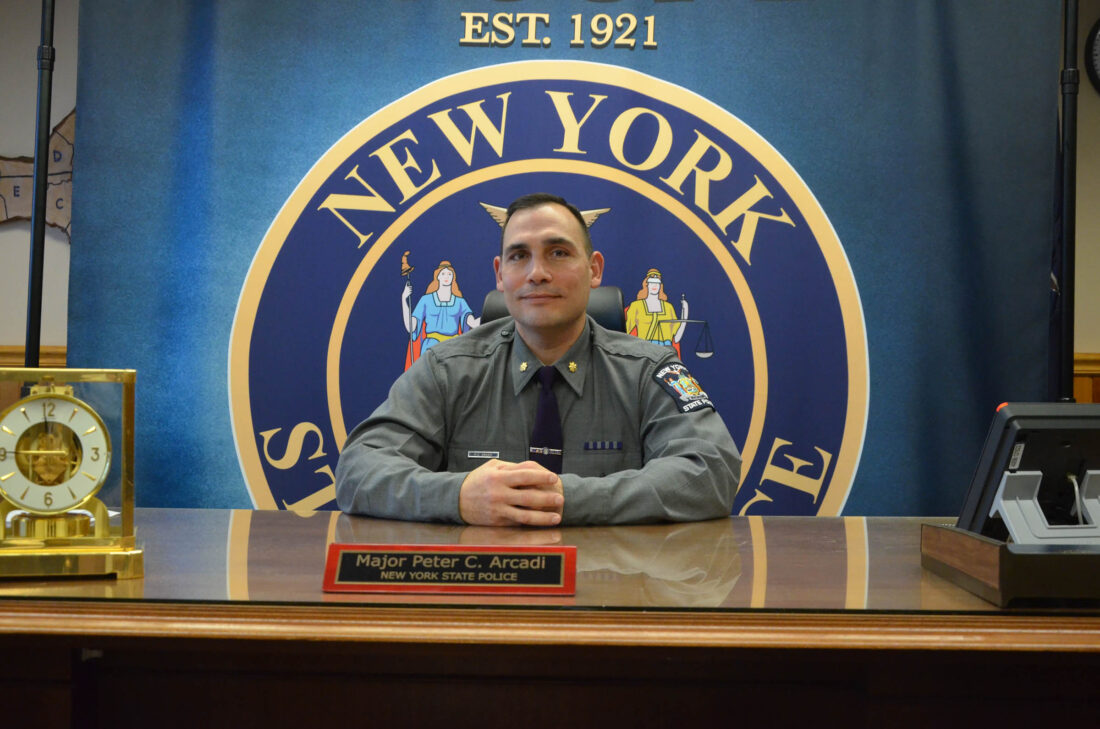
New State Police Troop B Commander Maj. Peter Arcadi sits at his desk at the Ray Brook headquarters where he oversees the hundreds of troopers who work in the North Country. (Enterprise photo — Aaron Marbone)
RAY BROOK — The new State Police Troop B commander is a lifelong North Country resident and a second-generation trooper with a love for the job.
Maj. Peter Arcadi was sworn in on Sept. 25 after former Troop B Commander Maj. Brent Davison retired to run in the special election for the 115th Assembly District.
Arcadi had previously been the captain of Zone 3, which comprises Essex County and part of Franklin and Hamilton counties, where he had been in charge of all police operations there. Becoming a commander is basically doing that for the entire troop. He now oversees 20 stations with hundreds of troopers across 8,000 square miles covering all of St. Lawrence, Franklin, Clinton and Essex counties, and half of Hamilton County.
“It’s a lot more responsibility,” Arcadi said.
Troop B is the largest New York State Police troop, geographically, but has the least amount of troopers. Troop B is unique, Arcadi said, because of how rural it is.
There are not many other law enforcement agencies here, so they don’t always know where backup is coming from. Even troopers have to worry about getting gas while driving at night, he said. And the severe winter weather keeps them busy with lots of crashes on the Northway and the back roads of the Adirondacks.
–
Home and family
–
Arcadi said he feels lucky to have been in the same troop his whole career. That’s rare.
He had initially wanted to be a scientist, a doctor or an astronaut. He graduated from Clarkson University in 2002 with a degree in physics.
He went into the Air Force, and after four years, took the trooper test. Arcadi realized he enjoys putting on a uniform and working with the public.
A lifelong resident of the North Country who grew up in St. Regis Falls, he is one of only three Troop B commanders to have been born and raised in the region. He’s the 29th commander of Troop B.
He chose to move back to his hometown region. Arcadi said people still have a lot of respect for police here.
It’s a tough job, but he enjoys it, he said.
Between domestic violence cases and car crashes, he said troopers see a lot of terrible things and tragedies. He knows this from seven years on the road as a trooper before he was promoted to supervisor. His job now is to make sure troopers are supported.
Arcadi said the hardest part of the job is informing people that a member of their family has died, especially when it’s a child.
Conversely, when they’re able to rescue someone lost in the woods or reunite families, that’s an encouraging day.
He’s a second-generation trooper. His father, Peter J. Arcadi, retired as a senior investigator.
Arcadi loved the days in school when students would bring their parents in to talk about their professions.
“I remember being really small and my dad coming to school in his uniform and being so proud of him,” he said.
He’s the oldest of five siblings — four of which are in law enforcement, including three troopers. Arcadi said their father didn’t push them into the NYSP, but wanted them to live in a way that they could pass the background test if they wanted.
His brother Nicholas is an investigator, brother Daniel is a sergeant and station commander.
His son, Peter A. Arcadi, and several cousins, also serve in state service and his uncle Charles Bishop is a retired senior investigator.
–
Changes
–
Technology has changed a lot in the job — tasers, body cameras, cell phones and social media — and it’s changed society, he feels, both for better and for worse.
Arcadi was on the road before body cameras were required. Putting one on would be tough, he said. It’s hard to adapt knowing everything is recorded. He said it’s made troopers more mindful and cautious of what they say. They can’t be laughing at a serious scene because they don’t want to end up online.
He said his father taught him to treat people well. Troopers should make sure people feel important, that their concerns are addressed. He tells his troopers to treat everyone the way they’d want a trooper to treat their family. Settling things with fists is for young people, he said — words go a lot further.
A similar mindset is applied to chases.
“When you’re a young trooper, the best thing is getting in your car and driving fast after someone,” Arcadi said. “But, unfortunately, that’s the most dangerous tool that we have, your vehicle. That’s how troopers get hurt and killed.”
They have to weigh the risk versus the reward. Things like how serious the crime that triggered the chase was — murder versus speeding — or if they have other ways to catch up to the fleeing suspect have a role in determining how immediate the arrest needs to be.
During each pursuit, a sergeant back at the station monitors the situation and makes decisions to continue or terminate the chase, acting like a third-base coach telling a runner to stop at the bag or to keep running to home plate.
Arcadi said this sergeant is removed from the emotion of the chase and will call it off if the public would be safer if they stopped.
“Since were kind of a paramilitary organization, they have to follow the orders given by a supervisor,” Arcadi said.
This can be frustrating for the trooper, he said. He’s felt that frustration before, getting called off a chase for a repeat offender who always runs. But stepping back from that frustration, he said that it’s better for public safety.
When it comes to the State Police’s role in the opioid crisis, Arcadi said they do both enforcement and education.
He said nearly every trooper has been touched by addiction in their home life at some point.
Investigators try to get intel on major traffickers to shut down distribution. For some arrestees, they try to find ways other than incarceration to get pathways back to leading a productive life.
Troopers all carry Narcan now, and use it to reverse overdoses quite often, he said — several times a month on average.
Since 2019, when the state reformed its bail system, making bail only applicable for certain offenses, Arcadi said even for higher level drug offenses, people are being released without bail.
Bail is meant to secure an appearance in court, not to be used as a punishment, he said. It should be fair, he added.
“They don’t want money to be the deciding factor on if you go back to your family at night,” he said.
He also said judges have discretion on setting bail to protect the community and troopers advocate to the judges when they believe setting bail would keep the public safe. Arcadi said they don’t want someone to lose their job because they were put in jail, couldn’t afford bail and didn’t need to be held.
But for a small amount of people, he said crime is “a way of life” and bail reform just doesn’t work for them.
“There’s certain people that are chronic offenders that take advantage of what the good intentions of the law are,” Arcadi said.
He said troopers are being used to “keep the peace” more often now. He said there are more protests, demonstrations and calls to action in Troop B in the past five years than he ever remembers before. They also get called to other parts of the state to oversee protests.
Arcadi said at large gatherings, there can be bad actors who are not always part of the organizing groups who cause chaos.
The investigative news outlet New York Focus found at least 17 cases from 2013 to 2023 of police in New York not properly charging or disciplining officers with drunk driving, saying there was a “lax approach” to officers driving drunk.
NYSP made up around half of these cases. The report notes that there were also plenty of cases where criminal investigations were pursued, but added that usually happens more when officers injured themselves or others in a crash.
“None of the officers were arrested at the scene, and only one later pleaded guilty to driving while ability impaired, a traffic violation,” according to New York Focus. “With a few exceptions, they all returned to the job following short suspensions.”
Arcadi said, in his view, troopers have to treat fellow officers the same way as citizen members of the public. He said he has arrested troopers for crimes before. It doesn’t happen often, he said, but it’s a hit to the public trust every time it happens.
As commander, Arcadi said he’s in charge of discipline. He reviews all reports of improper actions and doles out punishments when needed. This is tough to do — especially when it’s someone who he’s known for years or who trained him when he started — but he said it’s important to hold themselves to a higher standard and take accountability to keep the public’s trust.
He said the troop has posters in its barracks for a hotline to make complaints, and that he looks into all of them.
–
The future
–
In his free time, Arcadi hunts and ice fishes. He’s married with six children, all grown up now.
He’s unsure if any of them will want to become a trooper. He said he’s leaving that up to them. But if they want to join, he’ll “take them with open arms.”
Many local law enforcement agencies have struggled in recent years to maintain staffing at healthy levels. This is not a problem the NYSP has, Arcadi said. The troop is close to a full allotment of troopers, he said.
They have many retirements each year, but they also put a lot of effort into recruiting. The state has streamlined the admissions process.
The trooper test used to be way harder to take. It was held only once a year in a specific location. Now, he said people can come into the barracks and take the test on a computer any day.
NYSP is one of the largest agencies in the county, so they put a lot of money into training on everything from firearms to car crashes.
Arcadi hopes to work with other local agencies more in the future, to coordinate responses faster. If State Police get a call but another agency is closer, they can get to the scene faster.
He started the academy on Valentine’s Day in 2005 and was initially stationed in Massena. In 2012, he was promoted to sergeant and assigned to Ray Brook, where he became a station commander in 2014. He later transferred back to SP Massena in 2016 as a station commander.
In 2018, he was promoted to lieutenant and assigned to Zone 1 in Plattsburgh. In 2020, he was appointed acting administrative captain at the troop headquarters in Ray Brook. Last year, he was assigned as Zone 3 commander.
Local News

Costume craziness at BrewSki
Forest ranger recalls saving hiker lost for two days in Dix Range

Back-to-back champions
LPHS to host concussion seminar Wednesday
Weekend roller coaster as mid-March warm-up looms
SARANAC LAKE — You might want to keep a few different coat options handy this weekend. A hallmark of the ...