
Hochul signs some, vetoes nearly 50 bills amid year-end push
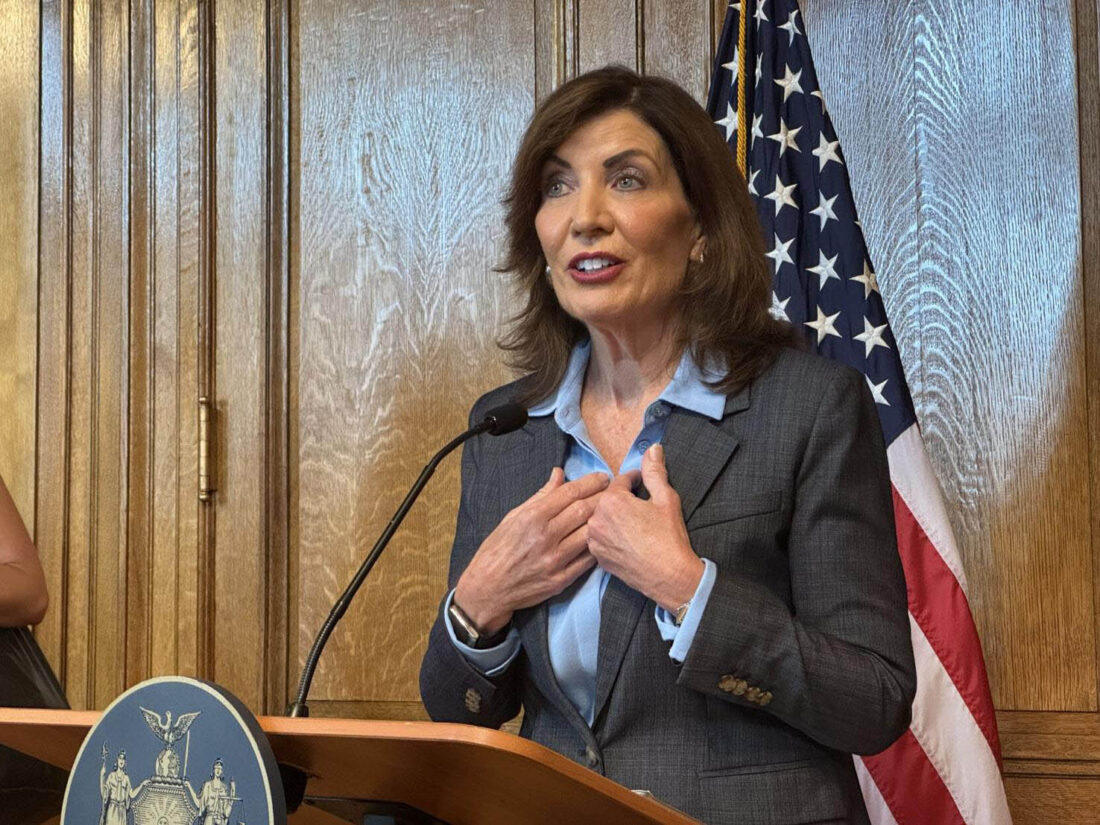
Gov. Kathy Hochul speaks with reporters in the Albany County Courthouse earlier this year. (Provided photo — Alex Gault/Johnson Newspapers)
ALBANY — Gov. Kathy Hochul vetoed 48 bills on Friday, part of a push to wrap up action on the last of the legislation passed in the Capitol this year.
Earlier last week, Hochul called for nearly 100 bills to be sent to her chamber for review; where she would take the last steps necessary to decide the fate of legislation approved by state senators and Assembly members in the six-month legislative session earlier this year.
She struck down 48 of them, some more unexpected than others, citing concerns that the bills were illegal, inappropriate, too expensive or otherwise not sufficient to become law. She outright approved a handful, and agreed to chapter amendments on others; a process that allows the executive to negotiate changes to bills already passed in the legislature without re-doing the entire process.
Eighteen bills vetoed on Friday were attempts by lawmakers to establish a number of commissions and task forces meant to investigate aspects of state government; Hochul said the total cost of those 18 different commissions and task forces would total about $30 million, none of which have been budgeted.
“Without appropriate funding, these unbudgeted costs would create significant staffing and other programmatic burdens on state agencies,” Hochul said in a blanket veto statement striking them all down.
Hochul said she had instead directed the state agencies, which all report to her directly, to take the issues relevant to the bills she vetoed and pay closer attention to them within the bounds of their current funding levels and oversight abilities.
Each year she’s been governor, Hochul has vetoed legislation aimed at creating unfunded commissions, studies and task forces. Some of the bills she vetoed on Friday have passed both chambers of the state legislature every year, just to be struck down by her.
“I expressed these concerns regarding the fiscal impact of this legislation in 2022, 2023 and 2024,” Hochul’s Friday veto message reads. “In my messages to the legislature, I repeatedly noted that these proposals would be more appropriately considered in the state budget process.”
That process starts anew in just a few weeks, when the legislature will return to Albany for another six-month voting session on Wednesday, Jan. 7.
Hochul also moved to veto legislation that would permit ambulances and fire department vehicles to access the New York State Thruway, the toll road running from New York City through the five major cities to Buffalo. Currently, when a fire vehicle or ambulance travels on the thruway, even to respond to emergencies or transport patients to farther-away hospitals, they have to pay the requisite toll, including truck-level tolls for large 3- or 4-axle vehicles.
When an ambulance or fire vehicle has to access the thruway at an emergency entrance, where a toll gate isn’t situated, they have to pay a full highway toll equal to the cost of their vehicle traversing the entire 500-mile highway. That can be reimbursed at the end of the fiscal year, restored via tax filings and a return through that process.
In her veto Friday, Hochul said any effort to make Thruway access free for EMS and fire vehicles would be duplicating the existing reimbursement model and would create audit difficulties and potentially encourage misuse.
“Though this bill is well-intentioned, the proposed requirement to issue permits for no-charge travel creates audit difficulties and may encourage use outside the scope of eligible travel and in other vehicles,” she said.
The governor also shot down a bill that would have expressly allowed the state court system to consider class-action lawsuits naming the state government as a plaintiff. The state courts have to date been unwilling to permit large class-action suits against the state, and those cases have instead generally needed to go to the federal courts for adjudication.
Among the bills Hochul approved Friday, she signed a bill that requires people selling their home to update the covenants and restrictions to remove racist, discriminatory or otherwise illegal terms from the documents when selling their homes. Although they are illegal and have been for over 60 years, some home ownership documents in New York still include covenants that restrict the owners from selling the property to Black or non-white people, gay people or noncitizens, a holdover of the notorious redlining racist segregation system that defined New York’s suburbs in the early to mid-1900s.
She also approved a bill that will require both public and private colleges and universities provide a clear calculation of a student’s cost of attendance, accounting for grants and scholarships as well as fees, planned cost increases, room, board and activity fees all in their award letters received before they commit to the school.
Hochul also signed a bill that closes a loophole in election law that blocked some villages, which sometimes run their own local elections on their own unique schedules, from letting candidates complete the ballot-access process in time to appear on the village ballot. The mismatch in time requirements in state law and some village laws left a handful of local governments to rely on write-in candidates alone. The law signed on Friday takes some of the self-scheduling power away from the villages, requiring them to align their election schedules with state election laws. While some village elections will have their schedules adjusted, it will ensure candidates will actually appear on their ballots.
Hochul also approved a “retail-to-retail” liquor sales law, permitting restaurants and bars to buy a limited amount of liquor, wine and beer from a retail store in cases where their regular orders have run out unexpectedly. Current law requires any retail alcohol seller, like a bar or restaurant, to purchase all their alcohol products from approved wholesalers with very limited exceptions.
Local News

Stocked for the weekend

Costume craziness at BrewSki
Forest ranger recalls saving hiker lost for two days in Dix Range

Back-to-back champions

LPHS to host concussion seminar Wednesday
Weekend roller coaster as mid-March warm-up looms
SARANAC LAKE — You might want to keep a few different coat options handy this weekend. A hallmark of the ...