APA’s top lawyer leaves as howitzer hearing looms
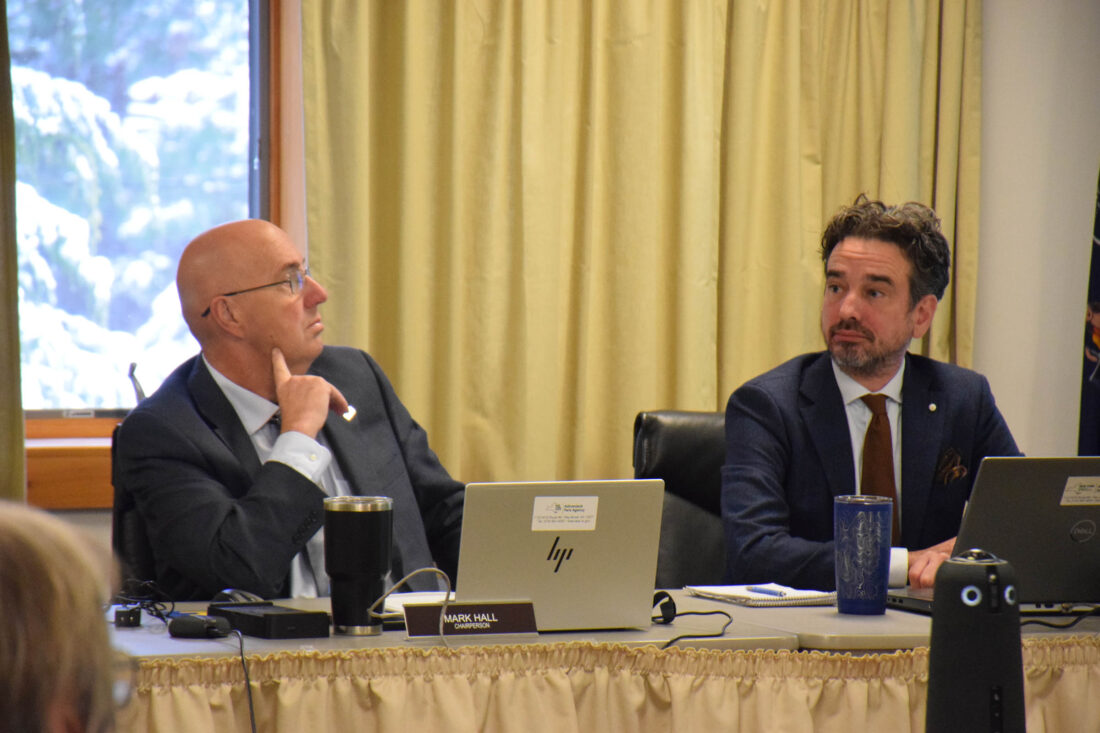
Outgoing APA Counsel Damion K. L. Stodola, right, is seen at the agency’s Nov. 13 board meeting at its Ray Brook headquarters. At left is APA Board Chair Mark Hall, of St. Lawrence County. (Enterprise photo — Chris Gaige)
RAY BROOK — The Adirondack Park Agency’s top attorney, Damion K. L. Stodola, will be leaving the agency at the beginning of the new year.
The departure comes as the APA readies for an adjudicatory hearing concerning a proposed howitzer artillery cannon testing range in the town of Lewis. The hearing is slated to be a significant legal undertaking for the agency, which hasn’t held one since 2011.
The project’s sponsor is Michael C. Hopmeier, of Unconventional Concepts, Inc. He is represented by Lake Placid-based attorney Matthew D. Norfolk of Norfolk Beier PLLC.
Norfolk told the Enterprise on Tuesday that he was not informed by the APA in advance that Stodola would be leaving the agency in January, but was advised last week that APA Senior Attorney Grace Sullivan will be handling the agency’s responsibilities in the hearing.
“That surprised me,” he wrote. “I expected Attorney Stodola to be the responsible attorney, as he is General Counsel. Regardless, I don’t care one way or another which attorney for the APA will be handling the hearing or the proceedings leading up to it, nor do I have interest in any drama within the APA. My only concern has been Director Barbara Rice’s actions in response to me making a good faith request to Administrative Law Judge David Greenwood that he recuse himself.”
The APA did not confirm who will replace Stodola as the agency’s counsel, though in a statement to the Enterprise on Tuesday, it wrote that a new associate counsel is set to begin with the agency in mid-December. They will assume Stodola’s responsibilities as the agency’s top attorney, in an acting capacity, upon his departure in January.
“Counsel Stodola will work closely with the new counsel to support a seamless transition in the legal division,” the agency wrote.
This person will be a new employee, though Sullivan will remain on the agency’s adjudicatory hearing team in her capacity as a senior attorney.
Sullivan has been a senior attorney with the APA since August, according to her LinkedIn page. Before her time with the agency, she worked as an immigration staff attorney with the Syracuse-based Volunteer Lawyers Project of CNY. Sullivan received her law degree from Syracuse University, graduating in 2022. Sullivan is a Saranac Lake High School graduate.
The APA added that it had filled the public information officer position that opened in mid-November when then-Assistant Public Information Officer Ben Brosseau left the agency to become the communications director at Paul Smith’s College. The APA did not specify who the new hire was.
Stodola was with the agency for less than two years. He was hired as the APA’s top attorney in February 2024.
“Executive Director Rice continues to address staffing needs as she works to reverse a nearly 15-year decline in staff levels,” an agency spokesperson wrote. “Executive Director Rice established the Agency’s first dedicated Human Resources Director position which will begin in January 2026 … and two engineering positions are scheduled to be filled in early 2026.”
Stodola previously served as the New York City Commission on Human Rights’ general counsel. Before that, he worked as a senior attorney for the City of New York Government, according to his LinkedIn page.
The APA’s legal team will play a consequential role during the adjudicatory hearing, representing agency staff throughout the proceedings. APA staff don’t have formal party status at the adjudicatory hearing, although they take on an active role pursuant to state law that governs the agency’s adjudicatory hearings.
The relevant law, 9 CRR-NY section 580.6(a), states that “(t)he agency staff, while not a party to the hearing, shall have the right to participate fully in the hearing and shall act as an advocate for a full and complete record upon which an informed decision can be made. The staff is not required to assume the project sponsor’s burden of proof.”
Agency staff may also be directed by the administrative law judge (ALJ) overseeing the hearing to “produce evidence with respect to any of the development considerations or other required findings,” according to 580.6(c).
Though the ALJ oversees the hearing, it’s the APA’s 11-member board that ultimately decides whether or not the project is approved, denied or approved with substantial modifications. Adjucatory hearings are the only procedural avenue through which the APA can deny or make substantial modifications to a project that is deemed complete. Throughout the adjudicatory hearing, any documents required to be served upon a party must also be served upon the agency staff, pursuant to 580.6(e).
Suffice it to say, the various obligations required of APA staff throughout the proceedings will likely require intensive legal advice and counsel to ensure compliance with all applicable rules. Furthermore, the APA board’s ultimate decision can be appealed to the state Supreme Court under what’s known as an Article 78 Proceeding, where any procedural deficiencies would likely come under intense legal scrutiny of the petitioner, and could be cause for a court to reverse the agency board’s decision.
The howitzer hearing’s first meeting is tentatively set for Dec. 22 at 6 p.m. at the APA’s Ray Brook Headquarters. The public is invited to attend either in-person or online at tinyurl.com/P2021-0276-Public-Hearing, with the passcode 160447.
State law dictates that the hearing must commence within 90 days of the project application being deemed complete. Hopmeier’s application was considered complete on Sept. 24, making the hearing start deadline Dec. 25.
This timeline, however, can be changed if the APA and the sponsor both agree. Norfolk said he would likely ask that the proceedings be rescheduled until after the holidays because of scheduling difficulties around that time.
–
Pre-hearing strife
–
Norfolk has clashed with APA Executive Director Barbara Rice over the appointment of David Greenwood as the hearing’s ALJ in a series of email exchanges. Norfolk cited his past affiliation with the Adirondack Council, a conservation advocacy group that is publicly opposed to the howitzer testing range.
Greenwood worked as a policy analyst for the group from 1993 to 2000, according to his LinkedIn page. He hasn’t had any apparent affiliations with the group since then. Earlier reports on that are available at tinyurl.com/v6mrk4cb and tinyurl.com/3txtt92y.
Greenwood did not address Norfolk or his concerns directly, but reported to Rice, while cc’ing Norfolk, that he was confident he could preside over the hearing in an unbiased way pursuant to state law.
“Prior to accepting the appointment as hearing officer in this matter I ensured that I had no professional or financial connection with Michael Hopmeier, Unconventional Concepts, Inc., Diversified Upstate Enterprises, LLC, Pulsifier Logging, LLC and James Pulsifier and determined that there was no issue of bias or other disqualification pursuant to 9 NYCRR 580.8 of the (Adirondack Park) Agency Regulations,” he wrote. “Additionally, I considered potential parties or intervenors to the Agency’s hearing on the project application and ensured that I have no current or recent professional or financial connections that might raise an issue of bias or other disqualification.”
Greenwood is one of eight state Department of Environmental Conservation ALJs, including the DEC’s chief ALJ. It’s unclear how Greenwood specifically was asked to oversee the hearing. Though it’s the APA, and not the DEC, tasked with deciding on Hopmeier’s application, the APA is “borrowing” an ALJ from the DEC, as it does not have any on its own staff role. That’s partially because the APA holds adjudicatory hearings on an infrequent basis. The last one took place in 2011. These sorts of enforcement hearings occur more regularly within the DEC.
In response to Norfolk’s request, Rice stated on Dec. 3 that she would not, at this time, remove Greenwood. Norfolk said that he did not consider it to be an operational ruling, as he had not filed a formal challenge to Greenwood’s appointment for Rice to decide on, instead asking Greenwood himself to do so voluntarily. Norfolk, however, said he would file a formal challenge if his concerns were not resolved at a pre-hearing conference meant to discuss any potential conflicts and, if possible, resolve those.
— — —
An earlier version of this article stated that it was unclear whether current APA Senior Attorney Grace Sullivan would become the agency’s associate counsel in mid-December. On Wednesday, an APA spokesperson stated that the associate counsel was someone else and is a new hire for the agency. The article has been updated to reflect this clarification.
Local News

Forest ranger recalls saving hiker lost for two days in Dix Range

Back-to-back champions

LPHS to host concussion seminar Wednesday
Weekend roller coaster as mid-March warm-up looms
SARANAC LAKE — You might want to keep a few different coat options handy this weekend. A hallmark of the ...

Saranac Lake halts controversial police cam installation