A morning with Blake Gendebien, NY-21 congressional candidate
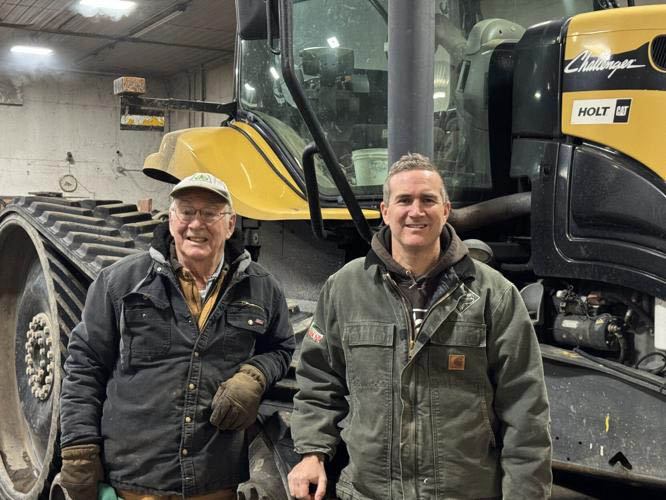
Blake Gendebien, right, and his father Peter pose for a photo in the workshop of their gamily farm in Ogdensburg on Friday, Dec. 12. (Provided photo — Alex Gault/Watertown Daily Times)
OGDENSBURG — It seemed like Blake Gendebien knew every person in the Tim Hortons on the outskirts of this city.
At a small table in the middle of the combined coffee shop, Subway and Valero gas station, between coolers of Red Bull and beer, Gendebien sat with his 81-year-old father Peter, greeting nearly every person who came into the building. They’re regulars at this particular shop, about 10 minutes from the farms they own together.
Some people who came in knew Blake from his days coaching high school basketball, others from his regularity at that store, and others from “around town.”
Gendebien, one of the four people seeking to represent New York’s 21st Congressional district in the House of Representatives, credits those deep community connections, and his upbringing, for his approach to politics today.
“I’m a real person, I have a life outside of this,” he said. “I’m not a politician.”
He’s not a politician, but he wants to be. Gendebien has been running for Congress for just over a year; he was the hand-picked nominee among the district’s Democratic Party leaders to run in an anticipated special election for the seat earlier this year. That special election never happened, but Gendebien has kept his campaign running.
He has done 17 town hall-style meetings across the district, open to the public, with more scheduled through the winter and spring. He is active on social media, runs occasional advertisements, and maintains the kind of campaign presence someone without a clear opponent would run. Gendebien is one of five announced candidates — three Democrats and two Republicans — so far who want to represent NY-21 in Congress, replacing outgoing Rep. Elise M. Stefanik, R-Schuylerville, who is running for governor of New York.
At the same time he is campaigning across the district, Gendebien is running Twin Mill Farm. His father Peter, a trained civil engineer, manages the mechanics on the farm. Blake handles the business and steps in on the daily needs. A team of full-time employees work on the farm too, and they all manage 550 Holstein dairy cattle on 1,200 acres where they also grow corn, soybeans, alfalfa, pastureland and timber woods. Blake’s wife Carmen maintains a private label soap and skincare brand, run out of a meticulously maintained workshop in the farm’s large warehouse.
Gendebien grew up outside Ogdensburg, in the town of Lisbon. He was the shooting guard for the Lisbon Central high school basketball team and helped out on his parents’ cow farm on the outskirts of the city. His parents had settled in the region in 1971 after serving together in the Peace Corps, at a time when many people were moving to the region to reconnect with nature.
Many of those who came to St. Lawrence County in that era decided to leave, but the Gendebiens stayed.
“I guess I liked working outdoors, I liked the work,” Peter, the elder Gendebien said. “I’m an engineer, and there’s a lot of engineering in farming.”
Nowadays, Peter helps his son manage their conjoined farming operation. Blake and Carmen purchased their farm, just across the road from his parents’ farm, in 2003.
“After a month of dating, I asked her if she wanted to go look at a farm in Upstate New York,” Blake said.
He’d worked in the corporate side of agriculture for a few years, including a six-month stint at the Fendt agriculture manufacturing facility in Germany and some time at AGCO’s main headquarters in Georgia. That’s where he met Carmen, a Cuban-American immigrant who had grown up in Washington Heights, New York City.
Blake said he was ready to get back to the farm, and Carmen wanted to join him.
“I missed the smell of manure,” he said, not quite as a joke.
He said he and Carmen never regretted their decision to take up farming in the North Country, not even in those first years when their house was unfinished and the going was particularly tough.
That experience has given him a unique perspective on what it means to be a representative for his community, he said.
“In farming, you have so much failure. It grounds you and builds so much resilience,” he said.
So he’s running for Congress, hoping to represent a district that stretches from the Tug Hill to Ticonderoga, covering the North Country and Adirondack Mountains.
Peter said he had some qualms about his son’s run for Congress, as it takes Blake away from home for long stretches of time, and if elected he’d be even farther away for longer stretches of time. But he said he’s proud of Blake for running, and for demonstrating what he said is a principled example of a lawmaker.
“Blake is extremely friendly, he’s disciplined, civil, he’s hard working,” Peter said.
And he said he thinks Blake has a solid understanding of the issues, what’s important to people in the district and what a lawmaker needs to be focused on. A good chunk of that, he said, is listening to constituents.
“Our neighbors are concerned about constituent services, and that’s an area where Elise (Stefanik) has failed,” he said.
Peter said that the tariffs on imported goods have gotten a lot of local people paying attention to national politics, and hoping for assistance from their elected officials. Stefanik has generally supported the Trump administration’s tariff plans, which have been blamed for driving costs up across the country. In a border region like Ogdensburg and the North Country, Peter said the tariffs have an even stronger impact on people’s wallets.
“Tariffs and labor are the big concerns, the national policies that impact people around here,” he said.
Blake can talk about agriculture for hours. Besides being a farmer, he has served as vice chairman of the Agri-Mark (makers of Cabot cheese) board of directors and has worked in the corporate side of agriculture. Many issues come back to agriculture for Gendebien, like food prices, immigration, jobs and economic development.
Gendebien said they’re all linked. When farms can’t hire the workers they need, they operate less efficiently and produce less food, which drives prices up. When food processing plants can’t hire the staff they need, they similarly operate inefficiently and prices go up. When major investments in food processing come along, as seen in a handful of groundbreaking dairy-related investments across New York, things can get even worse if government isn’t working to make sure the labor pool can support the new factories.
“Look at the Chobani plant in Rome,” he said. “That’s going to be 1,000 new jobs in food processing, but where is the labor going to come from?”
Fundamentally, farms are small businesses, and having run a farm for more than a decade, Gendebien said he has seen the way government action can complicate things for small business owners.
“As farmers, we have enough pests,” he said. “Weather, animals, bugs, you name it. We don’t want to have to deal with the government on top of all that.”
He said he’d like to see policymakers focus more specifically on helping small businesses by cutting down on costly regulations and making real efforts to help people secure a livelihood on their own two feet.
“Small business is the lifeblood of the North Country, and we need to make it easier for small businesses to run,” he said.
That extends to health care policy. Gendebien, like many farmers and small business owners, got a health insurance plan through the Affordable Care Act marketplace when the ACA was first passed into law. For the first time since he had left the corporate world, Gendebien and his wife had affordable health insurance. Now, he’s still on an ACA plan. So are some of the 13 full-time employees who work on the farm, which is too small of a group to find affordable private insurance through the business.
The anticipated upcoming increases to premiums for ACA marketplace plans will be especially painful for small businesses and farmers, he said. A tax credit for marketplace plans, which has been in place since 2021, is due to expire at the end of this year. Millions of Americans with marketplace plans are looking at massive increases to their premium costs for next year, in some cases more than 400%. Congress has thus far been unable to agree on a solution.
Gendebien said he sees the battle over the ACA as political gamesmanship, and a sign that politicians have lost track of what they’re supposed to be focused on.
“Congress members should have leadership skills. They should be accessible and work with the people they’re representing, and we aren’t seeing that,” he said.
Gendebien doesn’t pitch a very specific health care plan, unlike one of his opponents for the Democratic nomination, Dylan Hewitt, who has backed expanding Medicare to cover all Americans. Gendebien said he supports the tax credits that subsidize marketplace plans, and generally supports moves to strengthen the Affordable Care Act.
Gendebien said he wants to keep as much of a connection to “normal life” as possible if he wins this race and becomes the next NY-21 representative. He’ll still run the farm, with more help from his father and staff, relying on his phone to keep in touch from wherever the job takes him.
“I learned, I don’t need to clean every box stall, I can delegate and let the other, more-than-capable people around me do what needs to be done,” he said.
He might not be able to make it to that Tim Hortons off state Route 37 every day, but he will try.
Gendebien is one of three Democrats seeking the party’s nomination in NY-21. He is facing a primary challenge from Hewitt, a South Glens Falls native, and Lake Placid restaurant owner Stuart Amoriell. Two Republicans have also thrown their hats in the ring: state Assemblyman Robert Smullen, R-Meco, and Amsterdam businessman Anthony Constantino.
Provided that all five candidates complete the ballot access process, the primaries that decide which two go on to compete against one another in November 2026 will be held in June.