
A decade of road salt reduction
Brine, better plows, wireless surface monitoring touted as significant tools
-

- Phil Sexton, left, and Chris Navitsky speak at the 2025 Adirondack Champlain Regional Salt Summit in Lake George on Wednesday. (Enterprise photo — Chris Gaige)
-
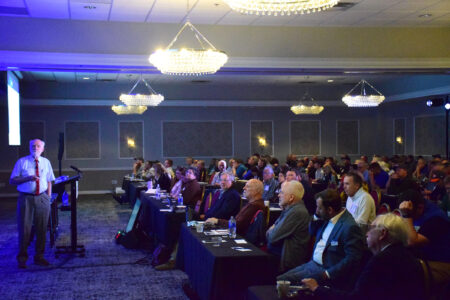
- Steve Norton, PhD. presents at the 2025 Adirondack Champlain Regional Salt Summit in Lake George on Wednesday. (Enterprise photo — Chris Gaige)
-

- State Senator Peter B. Harckham, D-South Salem, speaks at the 2025 Adirondack Champlain Regional Salt Summit in Lake George on Wednesday. Harckham, who chairs the state Senate Environmental Conservation Committee, was there to give a legislative update on salt reduction efforts in Albany. (Enterprise photo — Chris Gaige)
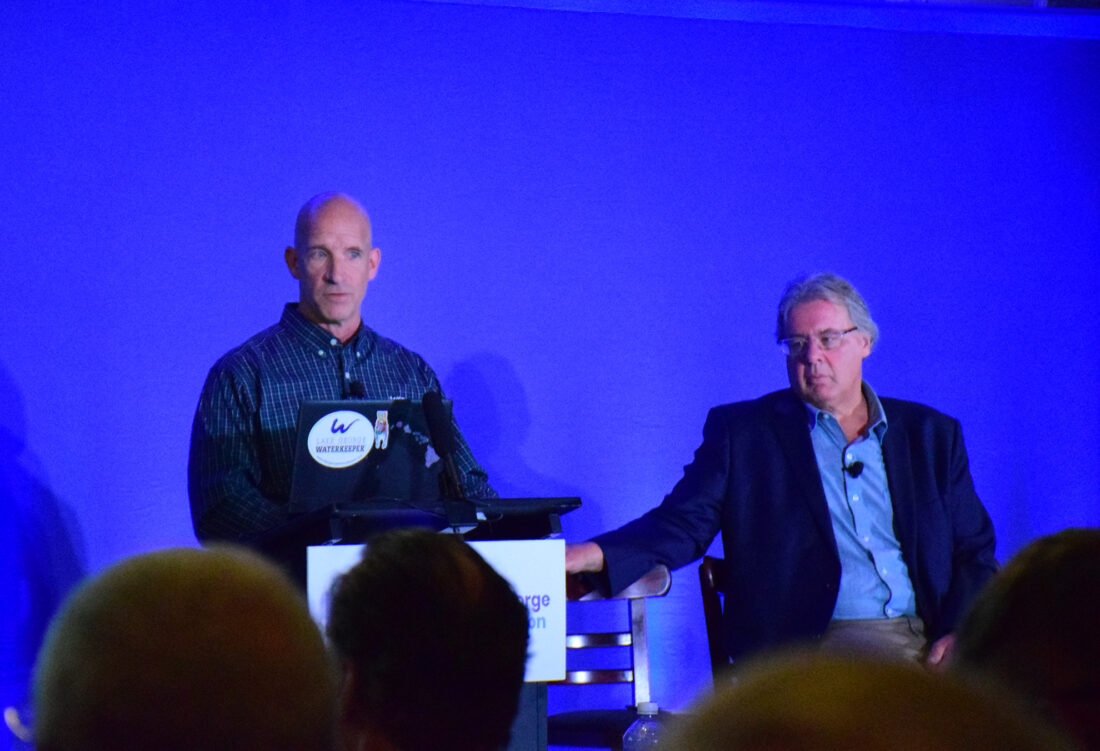
Phil Sexton, left, and Chris Navitsky speak at the 2025 Adirondack Champlain Regional Salt Summit in Lake George on Wednesday. (Enterprise photo — Chris Gaige)
LAKE GEORGE — Phil Sexton remembers a time not too long ago when brine was viewed with near universal skepticism as an alternative treatment to granular salt in winter.
Speaking at the 10th annual Adirondack Champlain Regional Salt Summit on Wednesday, Sexton said things have changed a lot since then, something he is immensely encouraged by.
It was around 2015 when Sexton, a winter surfaces and landscape treatment consultant, began to advocate for the movement toward brine — a pre-mixed saltwater liquid that is applied to surfaces — and away from granular salt. In essence, the reason was that it allowed for a comparable treatment with significantly less sodium chloride, whose runoff from excessive use has been shown to have harmful effects on human health and natural ecosystems.
Despite the early pushback, Sexton knew it worked. His topline explanation is simple, and something he’s reiterated at each of the salt summits that he’s spoken at.
“For anyone who’s not heard me say this before, I’ll say it again, and I’ll say it a hundred more times if you need me to: if we’ve been using road salt, we’ve always been using brine,” he said.
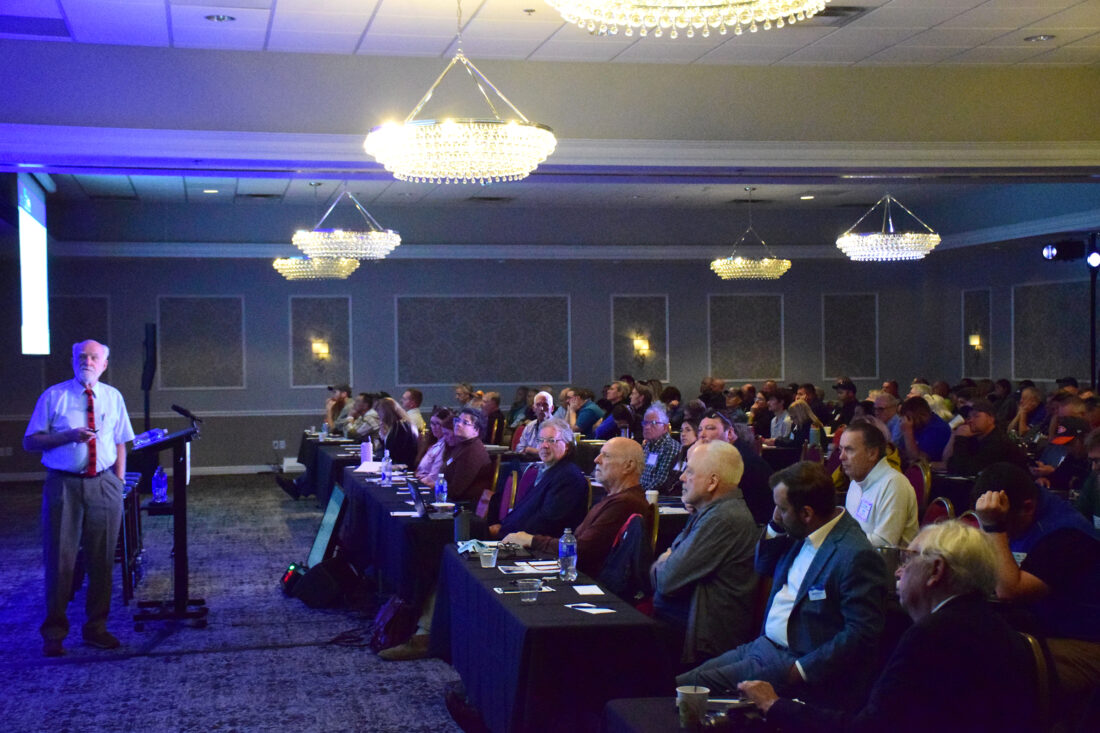
Steve Norton, PhD. presents at the 2025 Adirondack Champlain Regional Salt Summit in Lake George on Wednesday. (Enterprise photo — Chris Gaige)
Road salt — even if it is put down granularly — dissolves into a liquid when it interacts with liquid water, ice or snow. In essence, it becomes a brine. Applying it as such is just making that happen one step earlier in the process.
Less salt is used when brine is sprayed from a truck with a tank down onto the surface. Its liquid nature allows the salt to spread much more evenly and bind to the road surface as the brine dries. Granular salt, on the other hand, hits the surface as pellets, leading to a less even application. Some of it bounces off and away from the intended treatment area, a problem that brine treatment avoids.
Brine shouldn’t be the only tool in the arsenal, Sexton said, adding that there are certain situations where it makes sense “to pull the trigger” and use granular salt. But he was clear that this isn’t the majority of instances regionally, and, in a perfect world, there would essentially be an inverse of the current ratio of how often granular salt is spread as compared to liquid brine.
The trend, though, is encouraging and points to getting there sometime in the future.
“The point being is the brine stuff works,” he said. “When we’re using this type of technology, we can then prove it.”
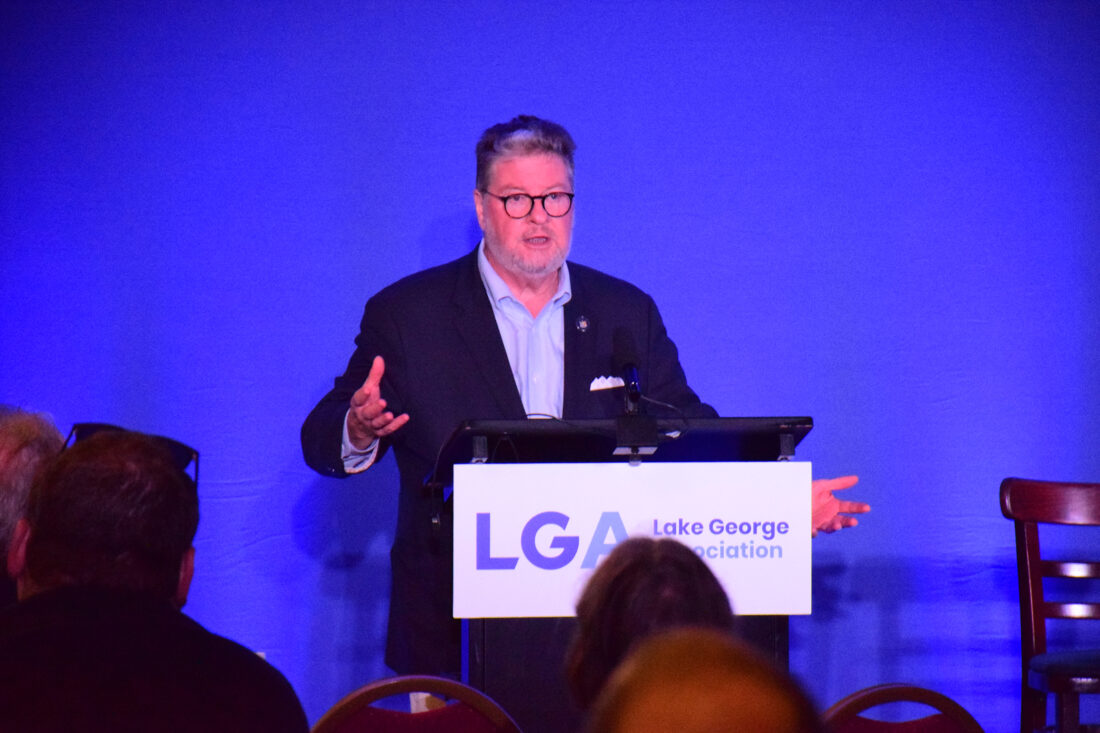
State Senator Peter B. Harckham, D-South Salem, speaks at the 2025 Adirondack Champlain Regional Salt Summit in Lake George on Wednesday. Harckham, who chairs the state Senate Environmental Conservation Committee, was there to give a legislative update on salt reduction efforts in Albany. (Enterprise photo — Chris Gaige)
Sexton noted that the most effective salinity rate of brine is 23.3%. He added that “pure” brine — that is just water and sodium chloride — begins to lose its efficacy when the surface temperature drops below 15 degrees Fahrenheit, just as granular sodium chloride does.
Though he noted that many of the heavy snowstorms — perhaps with the exception of some lake effect — tend to occur when the air temperature is between 15 and 32 degrees, as the amount of atmospheric moisture that can be held decreases with lower temperatures. Brine can also have various additives, such as calcium or magnesium, mixed in to allow it to remain effective at lower temperatures.
Brine was just one of several advancements that Sexton highlighted as ways that have made it viable for municipalities, the state and private contractors to cut down on road salt use. He said better plow technology helps specifically segmented edges that adjust and better cover uneven surfaces. This allows crews to scrape more snow accumulation away, reducing the amount of compacted snow that binds and eventually forms ice.
Another advancement Sexton touted was more wireless road monitoring stations. Rather than having crews need to physically scout their routes, he said these solar-powered, cellular-enabled cameras and infrared sensors allow crews to assess road conditions centrally and accurately through a screen. This saves time and, in many instances, sleep.
Additionally, Sexton said the camera and sensor networks allow crews to hold on to the data and go back after a storm to assess whether the treatment was effective, excessive or insufficient and build on that for future regimens, accruing a data “library” as they review different storms — with different air temperatures, surface temperatures, snowfall rates and total snowfall accumulations.
He said it was particularly heartening that many of the departments he’s consulted with are now at the point where they’re running with and tweaking their treatment approaches on their own. While excessive salt treatment was, and continues to be, a problem, Sexton said it’s not a blame game, adding that salt is applied to keep people safe, and treatment crews perform their job working graveyard shifts in extreme weather.
“I never anticipated that this problem would create this much community and this much collaboration,” he said. “But that’s sort of the key and the biggest takeaway for me from this model is, again, it goes back to people.”
He said the conference audience — which included municipal highway crews, local and state elected officials, state Department of Transportation representatives, environmental advocacy groups and private contractors — was proof of that collaborative spirit.
Kevin Chlad, the deputy director at Adirondack Council — one of the green groups in attendance at the summit — was pleased with the progress, but urged the state DOT to do more, namely, releasing more thorough public data on its salt use.
“Winter road safety is non-negotiable. But clean water is non-negotiable too. It’s a basic human need,” he said. “The state is responsible for one quarter of our roadways in the Adirondacks, but they apply a majority of the total salt applied to park roadways each year. Unfortunately, we know that much of that salt use is wasteful, harming water quality and wasting taxpayer dollars.
“We’re pleased that the state has announced plans to expand its pilot project efforts to reduce road salt overuse statewide,” he added. “But we cannot successfully reduce salt overuse unless we measure what we put down, and share that data publicly. We need accountability mechanisms for this to be successful.”
State Senator Pete Harckham, D-South Salem, chairs the state Senate Environmental Conservation Committee. He spoke at the summit and thanked the Lake George Association — which hosts the annual summit — for all of its work to push the conversation forward and working to bring different voices together, in one room, at one time.
“We come at this not from the perspective of blame,” he said. “This is about safety first and we applaud all of our road crews who are out in the worst weather when we’re all at home. This is about a teachable moment, and it’s about saving money and it’s about protecting our fragile drinking water supplies.”
Local News
Maple Weekend continues this Saturday and Sunday
LAKE PLACID — Maple producers across the Tri-Lakes area have opened their sugarhouses to visitors this year as ...
NYSPHA announces climate workshop in Lake Placid
LAKE PLACID — New York State Public Health Association’s Climate Committee will present “Climate ...

Here we go again!
State working to prevent Hudson River algae blooms
CATSKILL — Harmful algae blooms spotted on the Hudson River in early September are gone, and the state is ...
Independent candidate for NY-21 wants to expand House to 6,600 members
Brian R. Rouleau, an independent candidate who is seeking to represent northern New York in Congress, would like to ...
Two finalists in search for new SLCSD superintendent
SARANAC LAKE – There are two finalists in the running to become the Saranac Lake Central School District’s ...