Veterans Day: A frank discussion of Vietnam War in Tupper Lake
-
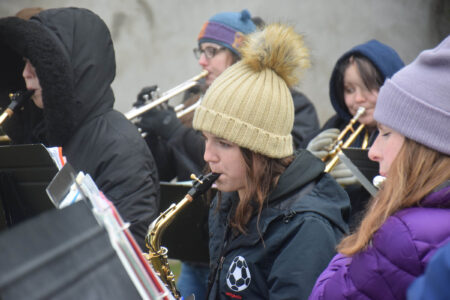
- Students in the Tupper Lake High School band played patriotic tunes at the ceremony. (Enterprise photo — Aaron Marbone)
-
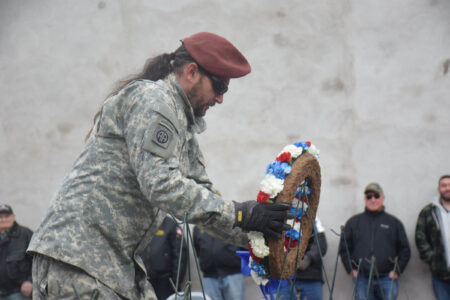
- Tupper Lakers placed wreaths at the Tupper Lake Veterans Memorial on Veterans Day, Saturday. (Enterprise photo — Aaron Marbone)
-
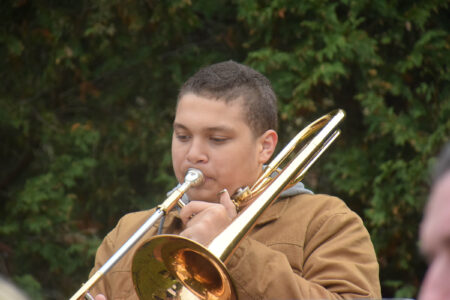
- Students in the Tupper Lake High School band played patriotic tunes at the ceremony. (Enterprise photo — Aaron Marbone)
-
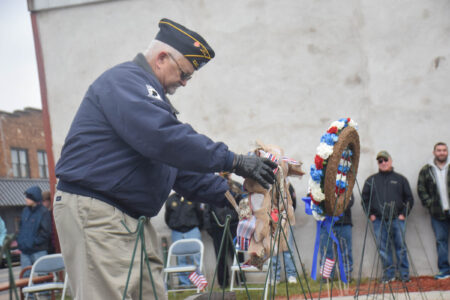
- Mark Moeller places a wreath at the Tupper Lake Veterans Memorial. (Enterprise photo — Aaron Marbone)
-
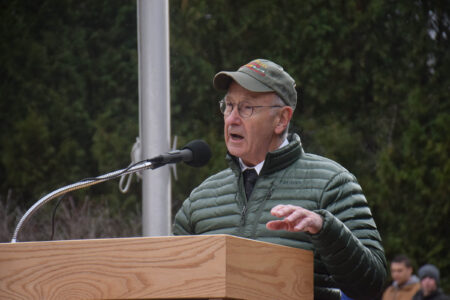
- Jim Kucipeck, a Vietnam veteran, shared his experience before, during and after serving in the war at the Tupper Lake Veterans Day ceremony on Saturday. (Enterprise photo — Aaron Marbone)

Students in the Tupper Lake High School band played patriotic tunes at the ceremony. (Enterprise photo — Aaron Marbone)
TUPPER LAKE — “It is time for a frank discussion about what Vietnam did to us,” Jim Kucipeck said at the Tupper Lake Veterans Day ceremony on Saturday.
Kucipeck, a veteran of the Vietnam War, told the crowd gathered on Park Street about his personal experience in the war. He said few veterans talk about their time in conflict. Support personnel like himself might share a story or two, but often the realities of war are discussed between veterans, not even with veterans’ families.
He’s personally spent five decades grappling with what Vietnam did to him, he said. What he shared were not “war stories,” he said, “but who we were before, during and (after) coming home.”
The people who fought in Vietnam were mostly baby boomers, children of the WWII vets who won the “Good War” — when people around the world were united against Nazi Germany and Imperial Japan.
“Certainly, no war is good,” Kucipeck said, but he added that the people who fought against these countries in this war were seen as heroes.
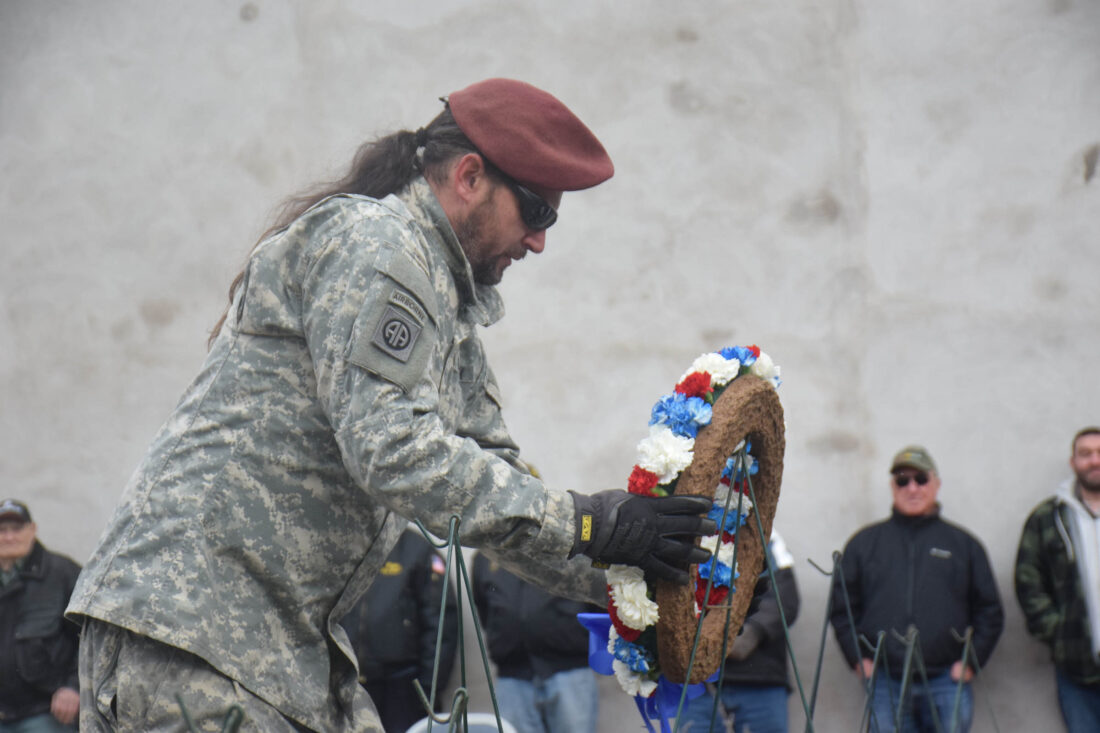
Tupper Lakers placed wreaths at the Tupper Lake Veterans Memorial on Veterans Day, Saturday. (Enterprise photo — Aaron Marbone)
When he returned from Vietnam, a much more controversial war, he was met with hostility, loneliness and confusion.
“Vietnam was a traumatic experience in our lives and left an indelible mark on our psyche,” Kucipeck said. “I have PTSD, Post Traumatic Stress Disorder, I did not know that I had it until a friend of ours pointed it out.”
Certain things will remind him of Vietnam — the sound of a “chopper,” fireworks on the Fourth of July, ’60s music like “We Gotta Get out of This Place” by The Animals, or the label on his shirt, which reads “Made in Vietnam.”
“How ironic!” he said.
He spent months in therapy learning how to manage the PTSD.
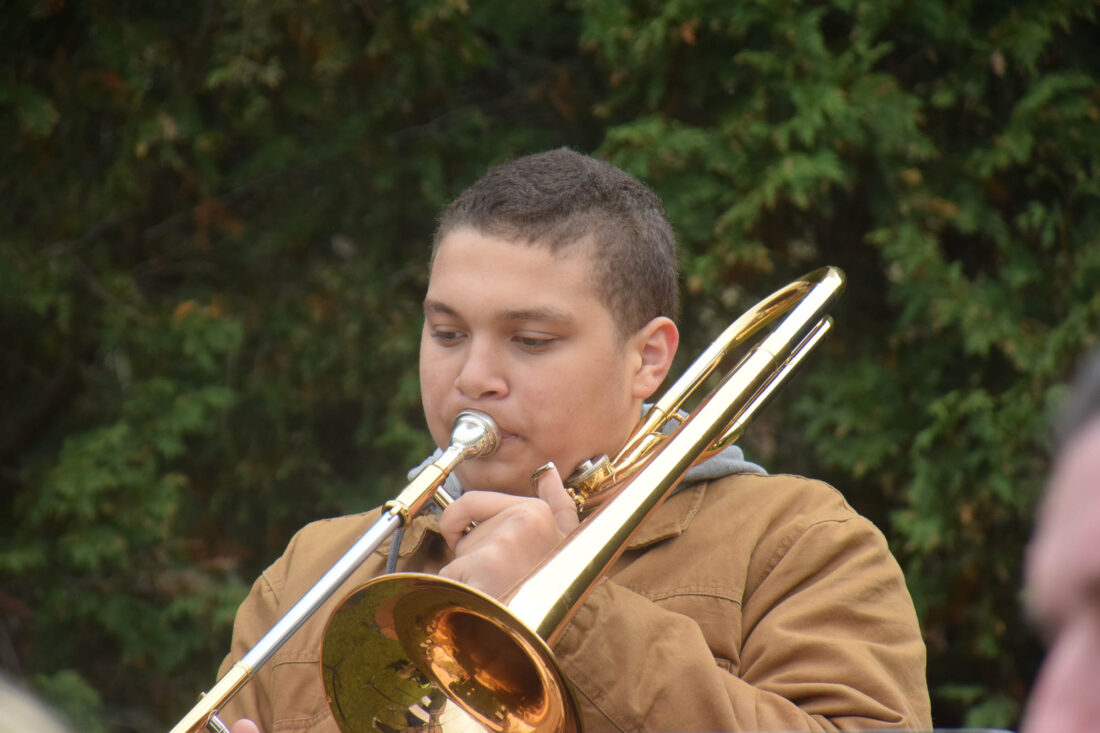
Students in the Tupper Lake High School band played patriotic tunes at the ceremony. (Enterprise photo — Aaron Marbone)
“My shrink told me that I had to talk about it, and this is part of the reason that I am doing this presentation,” Kucipeck said. “I must thank my wife of 54 years, Betsy, and my daughters Ann, Julie and Mary Kay for putting up with Vietnam. I love you.”
Kucipeck said it took him six or seven months to write his speech.
“It was honest. It was hard to write,” he said. “Revisions, revisions, revisions. Edit, edit, edit.”
He had made some changes just that morning.
“Congress never declared war in Vietnam. I have heard it said that ‘Vietnam was not a real war.’ I beg to differ,” he said. “There were 58,220 men and women who came home in coffins, with 150,000 wounded, 1,600 MIA, and all the rest of us mentally and emotionally scarred.”
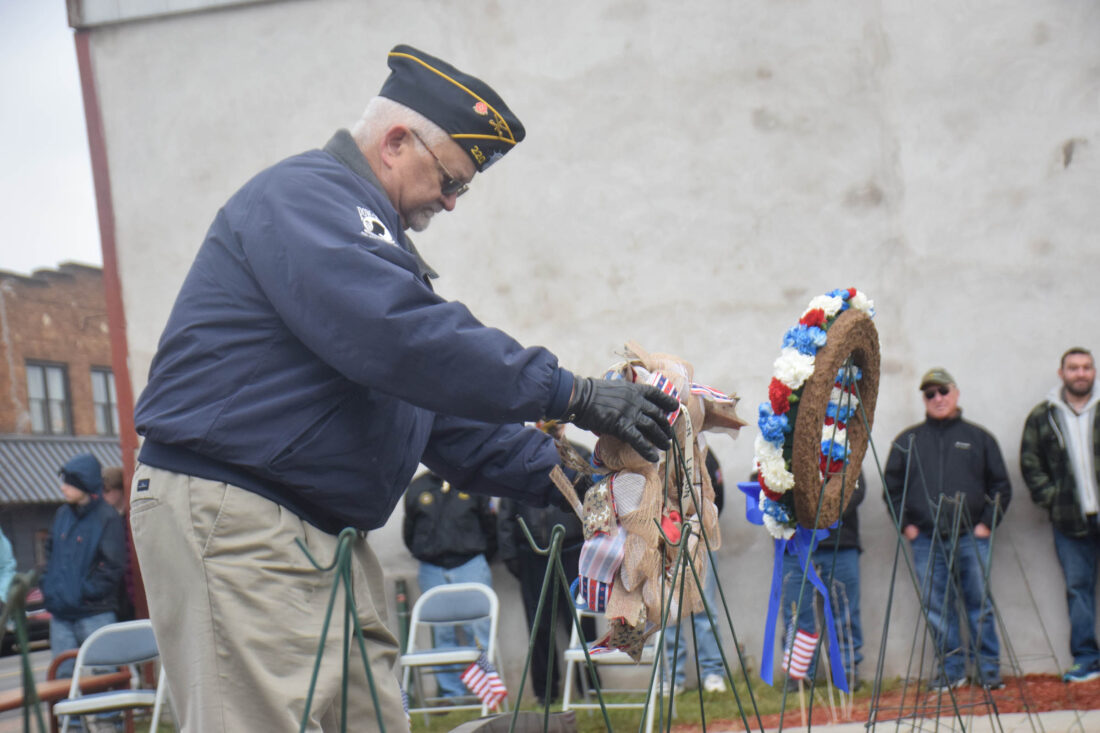
Mark Moeller places a wreath at the Tupper Lake Veterans Memorial. (Enterprise photo — Aaron Marbone)
Of the 2.7 million men and women who served in Vietnam, he said 850,000 are still alive today. The average age of a Vietnam vet is now 77, he said, and they are dying at the rate of 390 a day.
Kucipeck said the youngest man killed there was 15. He had lied about his age to enlist. He drew the audience’s eyes to the high school band behind him. That boy was the same age.
Kucipeck said high school in Tupper Lake in the 1960s had been about work and play, cars, movies, dances, the Beatles, dating and going the beach.
“All of that changed for us in August of 1964 with the Gulf of Tonkin Incident, a clash between the North Vietnamese and the U.S. Navy. The discussion of which I will leave to the historians to debate,” Kucipeck said.
Some got drafted, some enlisted voluntarily. Some avoided the draft through medical deferments, marriage, moving to Canada or simply burning their draft cards.
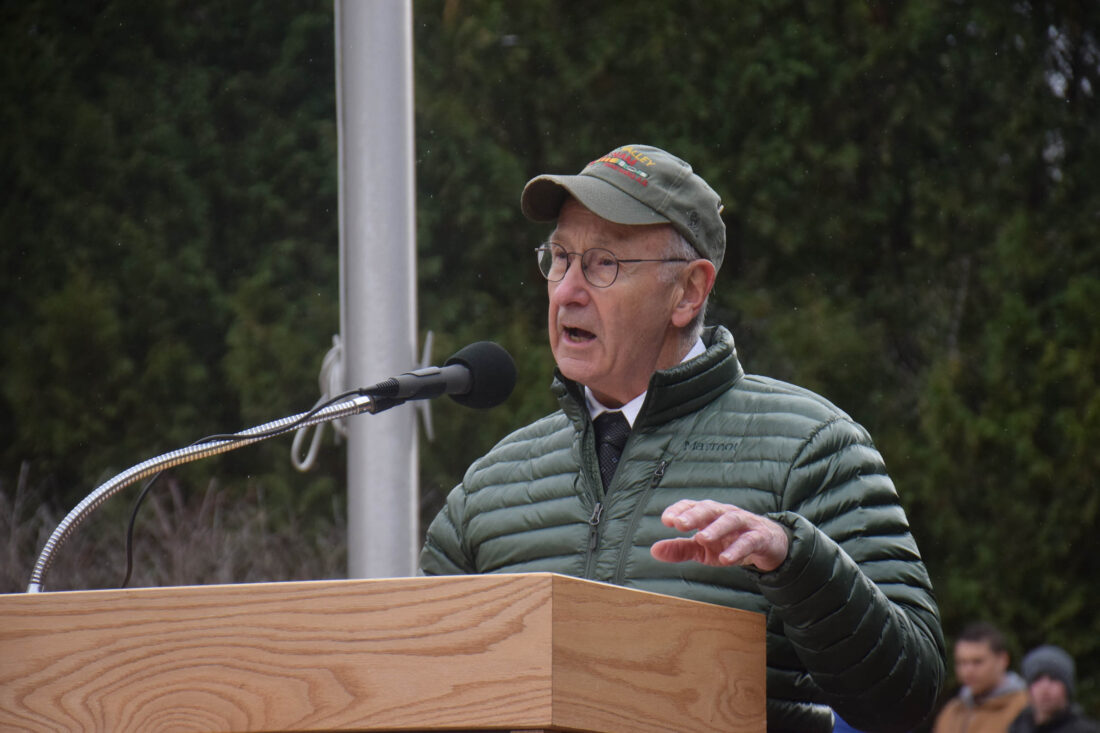
Jim Kucipeck, a Vietnam veteran, shared his experience before, during and after serving in the war at the Tupper Lake Veterans Day ceremony on Saturday. (Enterprise photo — Aaron Marbone)
Kucipeck read off some of the first names of his “buddies, school chums and co-workers” who served in the country with him, a fraction of the 184 names on the memorial next to him.
He arrived in Vietnam in June of 1967, coming directly from a 13-month tour in Korea, and worked in Phan Rang and Phu Cat.
“I was a non-combatant. I worked with explosives, rockets and napalm,” Kucipeck said. “We assembled explosives: 500-pound bombs, napalm, rockets and everything else that exploded. We worked 12 hours a day and longer if necessary.
“We bombed Vietnam and surrounding countries 24/7,” he said.
The whole country was steeped in war, he said, as were the neighboring countries of Laos and Cambodia, in which the U.S. fought a “secret war,” Kucipeck said, “unbeknownst to the American public.”
He remembers the day they got sent home. It happened fast. After getting the word, soldiers took trucks, choppers or planes to Danang, Saigon or Cam Ranh Bay for the “Freedom Bird” and home.
“One day in Vietnam and the next moment on a flight back to the ‘world,'” Kucipeck said. “Our spirits were so high that we did not need jet engines to lift off.”
But the world was not welcoming, he said.
“The Vietnam War was so controversial that we were disrespected after we came home,” he said.
When they landed in San Francisco or Seattle they were met with protesters carrying signs. They were called “baby killers” and spit at, he said. Some people threw urine and feces, he added.
He flew from Seattle to Chicago, to New York City and to Albany to catch a bus to Saranac Lake.
When he was hitchhiking home from Saranac Lake, a car stopped and he opened the door. When the driver asked him where he was coming from, he said “Vietnam.” The driver asked him: “How many babies did you kill?” the driver uttered an expletive at him and drove off. Eventually, he got a ride from an off-duty State Police officer.
The reception from family was also strange.
“I am not sure what I expected though, to be honest,” he said. “I felt as if they thought I had gone out of town for the day. I had been gone for 25 months.
“Home was not the same anymore and never would be,” he added. “No one, family and friends included, wanted to talk about Vietnam and what it was like. There was little or no emotional support from my community.”
Along with the emotional damage of the war, he said many Vietnam veterans bear the effects of Agent Orange. Agent Orange is a defoliant the U.S. sprayed over 20 million acres of Vietnam to deny the enemy of their hiding places.
“We were all exposed to it, some more than others,” Kucipeck said. “We wallowed in it. It was in the air. It was in the mud and dirt. It was in the dust. It was where we slept, and in our food.”
An estimated 2.7 million U.S. soldiers were exposed to the defoliant, the harms of which can be passed down genetically to children.
“The irony of it is the government knew early on that Agent Orange was potent and dangerous,” Kucipeck said.
He mentioned a long list of medical issues associated with Agent Orange, from cancer to Parkinson’s disease. Some, he said, he cannot pronounce. But there’s one he can — Peripheral Neuropathy. It affects his lower legs and feet with nerve damage.
Kucipeck closed his speech by reading the song “Still in Saigon,” written by Dan Daley and performed by Charlie Daniels.
He said this song “sums up the Vietnam experience for some veterans.”
Kucipeck took a few liberties with the song to match his experience and read it as a poem.
He ended by telling a friend, “Craig,” to rest in peace.
“To all of my Vietnam brothers and sisters, something that you never heard when you came home: Welcome home,” he said.
Local News
Constructing collaboration
Early-season paddlers
The pit and the potential for new housing
Authors to discuss ‘The First Adirondackers’ at John Brown Farm
Expect hunger to rise as new SNAP rules take effect