School enrollments remain low, but stable
Districts adjust to teacher shortage by bringing in trainees early
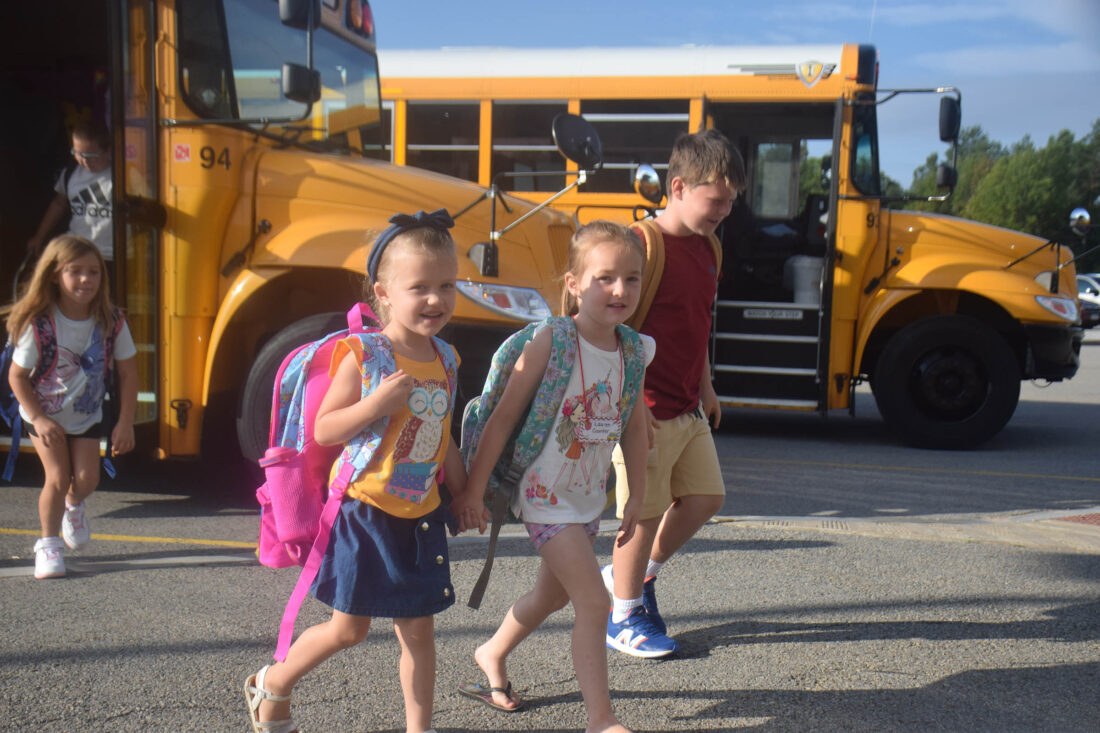
Emery Dewyea and Lauren Counter hold hands as they get off the bus and head in to L.P. Quinn Elementary School in Tupper Lake on the first day of school Thursday. (Enterprise photo — Aaron Marbone)
Schools around the Tri-Lakes region are back in session, and while almost all are seeing fewer students than they had five years ago, many districts have seen enrollment stabilize to levels that superintendents feel are sustainable.
Teacher and staff shortages are not as severe now as they have been in past years, school leaders said. But that is mostly due to several public school districts — including Saranac Lake and Tupper Lake — promoting uncertified teacher assistants who are working toward their teacher certifications before they are officially certified.
The Enterprise was not able to obtain enrollment numbers for Lake Placid Central School District, the private Northwood School or Wilmington’s Adirondack Christian School by deadline Friday. Lake Placid district Superintendent Tim Seymour said he will have enrollment numbers next week. Northwood School and Adirondack Christian School representatives did not respond for comment.
–
Saranac Lake
–
The Saranac Lake Central School District had 1,070 students enrolled on opening day, slightly lower than it’s been in year’s past when enrollment stood between 1,100 and 1,200, but three more than it had when the official enrollment was taken last year in October. Enrollment’s been on the decline for nearly a decade.
The district has two elementary schools with a total of 414 students — 315 at Petrova and 99 at Bloomingdale. The middle school has 275 students and the high school has 381.
This year, 43 children in the district are homeschooled.
Superintendent Diane Fox said the district is “fully staffed” heading into the school year through “creative” arrangements.
Some teachers starting work aren’t yet certified, but are working toward their certification. The district is bringing them on early for them to complete their student teaching experience while securing them as full-time employees at SLCSD.
“Many of these people are people who already work for us in a different capacity,” Fox said.
She said several teaching assistants have gone back to school for their teaching certification. The district knows them, the students know them. They’ve worked there for many years.
With these TAs shifting to full-time teaching, she said the district has been lucky to hire a slate of new TAs. There is a need for more teachers to enter the labor force locally, statewide and nationwide.
Fox said this comes locally in part because of a misconception in the national news on the difficulties of teaching, where there are often stories about teachers working in less than ideal working conditions for low pay while dealing with political and cultural unrest bleeding into the classroom.
“I think there is a mismatch between what we see on the news and what really happens here in our local districts,” Fox said. “I think we’re pretty lucky in our little neck of the woods.”
The community and school board are supportive, pay matches other rural New York communities, she said.
Fox’s sister teaches in the Charlotte-Mecklenburg district in North Carolina. She said from what she hears, her sister works in one of those horror stories she sees on the news — huge two- to three-dozen-student classes with no teacher’s aides, no union, years without raises, extra duties, required professional development for free.
“It’s different here,” she said.
–
Tupper Lake
–
The Tupper Lake Central School District had 722 students enrolled on opening day — lower than in past years when enrollment averaged in the mid- to high-700s and low 800s, but stable enough for TLCSD Superintendent Russ Bartlett after a gradual decline in the district’s students that’s been happening for nearly a decade.
There are 310 elementary school students and 412 in the middle and high school. The district has 32 children in pre-Kindergarten programs.
Bartlett said he feels enrollment is “stable” and that the district’s staffing levels are in a “remarkably good spot” heading into the school year.
TLCSD is using similar tactics as SLCSD, promoting some uncertified teachers to teaching positions — most of whom are in the process of finishing their certification in the next year or two.
“We are obligated to continue to search for teachers to fill those positions,” Bartlett said. “The simple fact is they just don’t exist.”
He said the people who have been elevated to teaching positions are qualified through experience, even if they are not yet officially certified. They’ve been teaching assistants in these classes for years, he said.
Everyone knew there was going to be a teacher shortage before the coronavirus pandemic, Bartlett said. Then the pandemic hastened an “enormous” exodus from the profession, with far more people retiring than new ones entering the field, he said.
Right now there are noncertified people who he is confident can do the job.
Bartlett said, in particular, the district has been in need of math and special educators. They are also looking to fill four long-term sub positions.
This year, Tupper Lake schools are able to offer free breakfasts and lunches to all students, as the district has reached a poverty threshold qualifying it for federal reimbursements for universal free meals.
Bartlett said it feels great to offer this, but he wished the state and federal governments still funded it for all districts.
For the first two years of the pandemic, state and federal governments made lunches free for students. Last year, that funding ended and without the aid, districts went back to charging for meals. Bartlett said he wished the state and federal governments had not put them in that position. It was so valuable, he said.
Last year, he said the cafeteria never denied anyone a lunch.
“We’ve never denied a kid a lunch, whether they had the money for it or not,” he said.
But the district had to find other ways to recover the charges.
This year, the district qualified to get free meals for everybody through the Community Eligibility Provision of the School Lunch Program meeting the percentage of low-income families in the district.
This year, Bartlett also said the district is moving to a single platform to communicate with parents: A program called ParentSquare. He said people should sign up for that if they aren’t already.
–
Long Lake
–
There are 56 students enrolled in the Long Lake Central School District this year, with four more in the pre-K program. This is around the same number of students as last year, when there were 60 students in the district and three in the pre-K program.
This year, 35 kids are in the elementary school, and 25 in the middle/high school.
Interim Superintendent David Snide said some people see the district’s small numbers as a negative. But he sees it as positive. The small number of students does have its “limitations,” he said, but it also allows teachers and staff to offer more individual services. In all, he feels “the pros outweigh the cons.”
The district is fully staffed this year, he said.
“Knock on wood,” Snide added.
There was a bit of turnover this year with the superintendent and a counselor taking new jobs, but he said they were fortunate to be able to hire quickly again.
Snide said the district has “some” homeschooled students but did not give an exact count.
–
AuSable Valley
–
The AuSable Valley Central School District started the year with 1,149 students enrolled, a slight decrease from last year’s 1,166, but a very stable count for the largest district — student-wise — in the Enterprise coverage area.
“Everyone wants to come to AuSable Valley,” AVCSD Superintendent Mike Francia said.
The district has two elementary schools with 642 students in total — 238 at AuSable Forks and 404 at Keeseville. The district has 507 middle and high school students. It also has 36 out-of-district students in the Champlain Valley Educational Services BOCES program and 34 homeschooled students.
Francia said the district is fully staffed, but still struggling to find enough custodial staff and bus drivers. It is using substitutes to fill shifts.
–
Northern Lights
–
This year, the Northern Lights School has 24 preschoolers and 17 infants and toddlers. Last year, the district had 23 preschoolers and 19 infants and toddlers.
NLS Administrator Polly Kelting said this is the second year the Waldorf-inspired, nature-based school has been in its new building, the former Lake Colby School building. The larger space allowed them to have more children, but now they need more teachers. She said NLS would need two more part-time afternoon teachers to support any additional students.
The school does “better than most” for staffing, but she said they always felt they need one or two more people.
–
St. Bernard’s
–
Enrollment at St. Bernard’s School in Saranac Lake is at about 90 this year. Last year, enrollment was at 75. The jump is because of a new pre-K program the school started this year, which has 15 students, according to administrative assistant Kristin Perry.
She said enrollment is around 75 again without the new additional pre-K enrollment.
Perry said school administrators saw a severe demand and need for pre-K programs in the area, so they introduced a new one and it filled up fast.
–
Keene
–
Keene Central School had 170 students on the first day of school this year, the most it’s had since the 2017-18 school year.
The district has 91 elementary school students, 79 in middle and high school, five in pre-K and two homeschooled students.
Superintendent Dan Mayberry said enrollment has been stable and he feels fortunate for that. He attributes this to Keene’s community and small school district.
Mayberry said Keene hasn’t had an after-school program since the pandemic started, and if he can find someone to run it, he’d like to bring it back.
–
North Country School
–
The private North Country School in Lake Placid has 84 enrolled students for its 85th school year, which starts on Wednesday. Last year, the school had 86 students. These two years mark an increase in students for the school.
The private school has 31 day students — 15 are children of faculty and staff — as well as 54 boarding students, 25 of which are international students hailing from China, Guatemala, Indonesia, Mexico, Tanzania, Canada, Italy, South Korea and Japan
“We’re incredibly proud of the diverse makeup of our campus community,” Communications Director Stanzi Bliss wrote in an email.
Bliss said the school has “strong” faculty retention going into this year, with a number of staff boasting one to two decades of time at NCS. The school has also added an additional school counselor this year, in response to a seen need for mental health and social-emotional learning assistance.
–
St. Agnes
–
St. Agnes School has 43 students in its K-3 program this year, with 52 in its pre-K program.
Principal Katie Turner said the private Catholic school is seeing enrollment stability, and that a large preschool population is a good sign for the future. In Lake Placid, there has been a severe affordable housing crunch for many years, concerning many residents who feared its impact on school enrollment.
“There are finally more children in Lake Placid,” Turner said.
Local News
Constructing collaboration
Early-season paddlers
The pit and the potential for new housing

Authors to discuss ‘The First Adirondackers’ at John Brown Farm

Expect hunger to rise as new SNAP rules take effect