Buried treasure
-
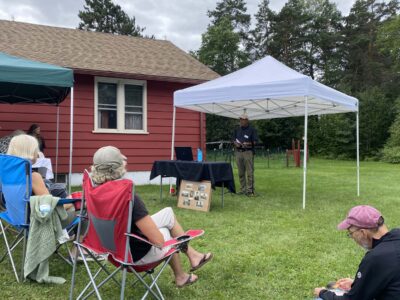
- Curt Stager, professor of biology at Paul Smith’s College, addresses Adirondack Voters for Change. His talk covered the history of 19th-century Black settlers in the Adirondacks before and after the American Civil War. (Enterprise photo — Sydney Emerson)
-
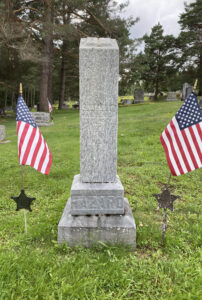
- The grave of Charles Hazard, a veteran of the Civil War and the son of two Gerrit Smith land grantees, in Bloomingdale’s Brookside Cemetery. Hazard was one of the subjects of Stager’s talk. (Enterprise photo — Sydney Emerson)
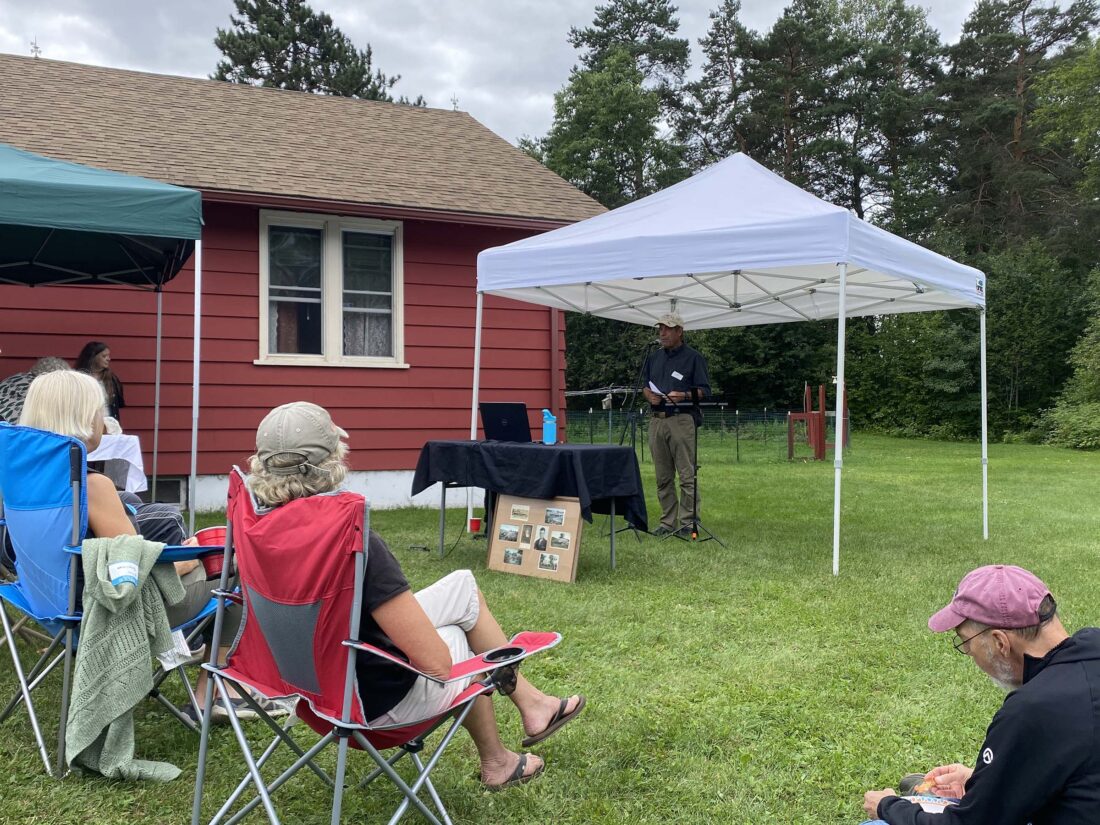
Curt Stager, professor of biology at Paul Smith’s College, addresses Adirondack Voters for Change. His talk covered the history of 19th-century Black settlers in the Adirondacks before and after the American Civil War. (Enterprise photo — Sydney Emerson)
BLOOMINGDALE — Curt Stager has spent his entire career digging for buried history.
A longtime professor of biology at Paul Smith’s College, Stager’s day job for many years has been to “reconstruct environmental history through sediment.” A few years ago, after a research trip to Walden Pond, Stager found himself more interested than ever in the people whose lives and livelihoods depended on the land. So, he started to do a new type of unearthing — this time, in his own backyard.
“The very land I live on and the neighborhoods I drive through have these incredible stories that were distorted,” Stager said. “They gave a false and weak impression of who Adirondackers are.”
On Sunday afternoon, more than 50 members of Adirondack Voters for Change brought dishes to pass around and settled into their camping chairs on Barbara and Jeff Black’s side lawn to hear Stager share some of these stories the way he believes they should be told. Kary Johnson, Stager’s wife and a board member of the organization, gave an introduction.
“(Stager’s intention) is to tell history from the truth,” Johnson said.
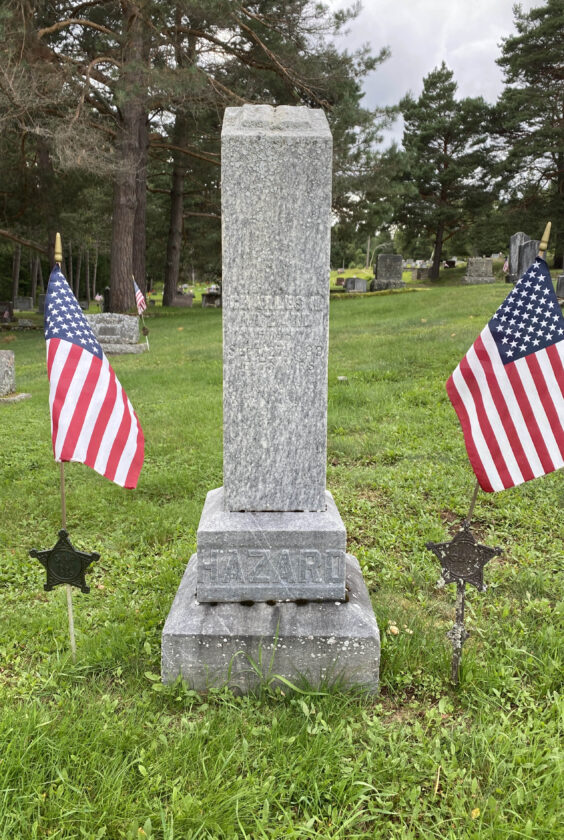
The grave of Charles Hazard, a veteran of the Civil War and the son of two Gerrit Smith land grantees, in Bloomingdale’s Brookside Cemetery. Hazard was one of the subjects of Stager’s talk. (Enterprise photo — Sydney Emerson)
Stager explained that recent cultural shifts have led to a renewed interest in critically examining local history, changing a narrative established over 100 years ago mainly by Alfred L. Donaldson’s two-volume “A History of the Adirondacks.” Far from a homogenous, largely Caucasian region, Stager’s research contends that the Adirondacks were the site of a “grand social experiment” in the mid-19th century.
According to Stager, abolitionists such as Frederick Douglass, John Brown and Gerrit Smith spearheaded a movement in the 1840s to “undermine the racism in the culture and empower people of color by making them landowners … and build multiracial communities, and therefore develop grassroot mutual respect.” Smith intended to grant over 120,000 acres in Franklin and Essex counties to 3,000 Black families, some of whom were formerly enslaved. Several dozen Black families did take Smith up on his offer and received land mostly in the town of North Elba, in the settlement of Timbuctoo, which in later years developed a “mythology that the (Black settlers) couldn’t hack it and left quickly,” he said. Stager’s research predominantly focuses on the settlers that lived in Vermontville, Bloomingdale and Saranac Lake — places where “people stayed and are buried … and were successful.”
Stager shared the story of the “gigantic” Hazard family, founded by Smith grantees Avery and Margaret Hazard. Two of their sons, Alexander and Charles, inherited the property upon their parents’ deaths. While Alexander stayed behind to farm, Charles went to the American Civil War and enlisted in the 26th United States Colored Infantry Regiment, one of three Black units from New York.
Charles was “involved in extreme action,” Stager said. “(He saw) the siege of Charleston, the Battle of Honey Hill. He helped liberate Charleston, the core place of darkness that started the Civil War, and he personally helped free enslaved people.”
After the war, Charles brought his new wife and her two daughters back to Bloomingdale and bought the farm next door to his brother Alexander’s. In the late 1890s, the two brothers died within a year of each other, and their widows continued to run the farms by themselves. Five years later, they both died within a year of one another, too. The couples, along with various other relatives, are all buried in Brookside Cemetery in Bloomingdale.
Stager also shared the story of John Thomas, who escaped enslavement in Maryland around 1840. He bought his own farm in Vermontville, which was later coincidentally named “Sanctuary Farm” by current owner and Adirondack Voters for Change member Denise Griffin before she knew the property’s history.
“Some people were very intolerant and abusive (toward the Black settlers), but some were very welcoming,” Stager said. “And one sign of that was when bounty hunters came after John Thomas, the local residents rallied and helped him drive them away.” Etched in Thomas’s headstone in Vermontville’s Union Cemetery is his birthplace: Queen Anne’s County, Maryland. Stager interprets this detail as a sign of resilience.
“(The headstone) is basically saying, ‘I was enslaved there, and this is me, John Thomas. Come and get me,'” Stager said.
Part of Stager’s recent historical rescue mission is to rename certain geographical features with derogatory names. This includes what is now known as John Thomas Brook — Stager, with the help of some “broad community support,” successfully petitioned the U.S. Board on Geographic Names to have the name changed from “N***o Brook” earlier this year. The original name of the brook, according to Stager’s research, referred pejoratively to the Black Vermontville settlers. Stager hopes that nearby N***o Hill will be the next landmark to be renamed to honor the Black settlers, despite some local concerns about changing place names being an act of “erasing history.”
“We’re not erasing history, we’re recovering history that’s been erased,” Stager said.
Stager emphasized the importance of history to not only our sense of identity, but also our survival in a changing climate.
“The best predictor of climate resilience is a strong sense of place-based community identity,” Stager said. “So, the stories we tell about ourselves are not just entertainment. I think they’re really important to develop and enrich and deepen our sense of what it means to be an Adirondacker.”
Community is something with which Adirondack Voters for Change are also concerned. In their recent first-annual “My Dreams for My Community” essay contest in partnership with the Adirondack Center for Writing, Adirondack Voters for Change asked young residents of the area to share how they define community, share what they care about and offer ideas for positive change. The winners of the essay contest will read their entries at an event on Aug. 28.
In a Q&A session following the talk, audience members had a few questions, but were mainly interested in getting Stager — who is, by his own admission, “jammed full of stories” — to explain the lives of Black settlers that populated the Adirondacks.
“What an amazing human tapestry the Adirondacks really are,” Stager said.
Local News

Constructing collaboration
Early-season paddlers
The pit and the potential for new housing
Authors to discuss ‘The First Adirondackers’ at John Brown Farm

Expect hunger to rise as new SNAP rules take effect