Adirondack air quality advisory extended through Friday
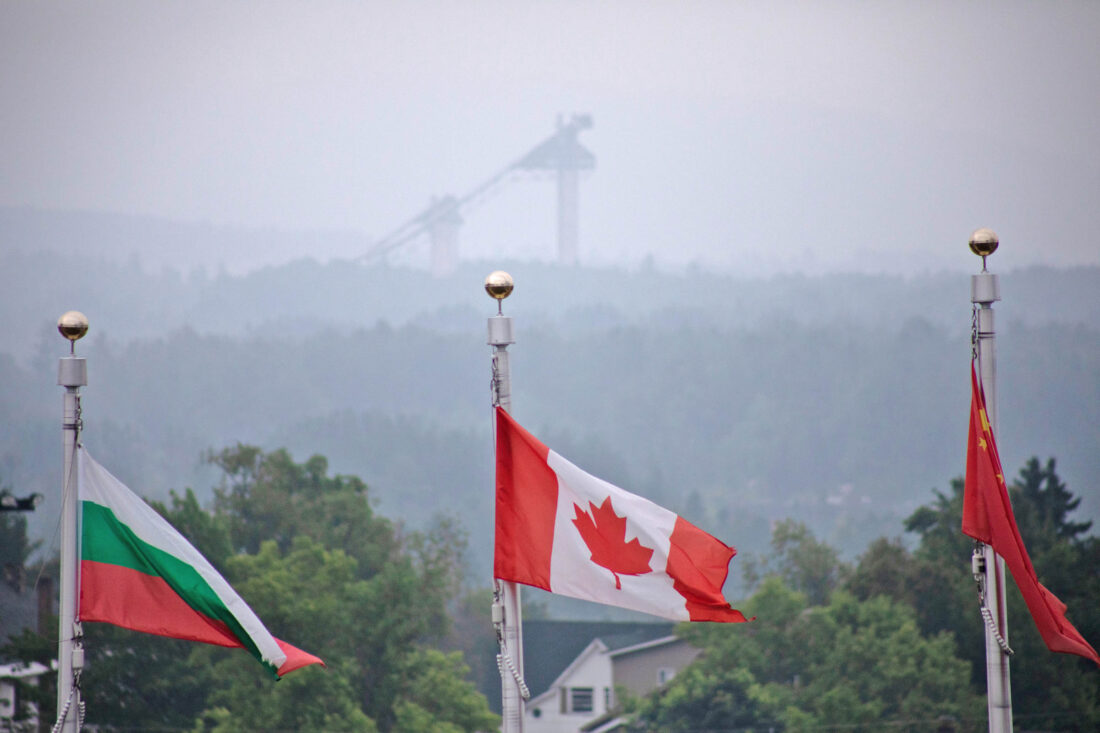
The Olympic Ski Jumps, pictured from the Olympic Center, are shrouded in dense smoke on Thursday afternoon. (Enterprise photo — Arthur Maiorella)
An air quality advisory issued for the entirety of New York state on Wednesday has been extended through Friday as wildfires in Canada rage on and air quality in the Adirondacks continues to hover around unhealthy levels.
As of Thursday afternoon, the air quality in Saranac Lake, Tupper Lake and Lake Placid was listed as “moderate,” according to the AirNow.gov Air Quality Index, or AQI, reporting tool, though levels were expected to reach “unhealthy” levels throughout the day. The state Health Department and Department of Environmental Conservation on Thursday extended a statewide air quality advisory issued on Wednesday, saying that Adirondack air could still be at “unhealthy” levels for sensitive groups into Friday. AQI forecasts predict that the smoke will diffuse and clear up by Saturday morning, according to Gov. Kathy Hochul’s office.
“Unhealthy” AQI levels like those predicted in the Adirondacks on Thursday — between 150 to 200 AQI — have the potential to affect everyone’s breathing, while AQI levels between 100 and 150 are considered “unhealthy for sensitive groups” — such as the levels predicted in the Adirondacks on Friday — and are less likely to affect the general public but still impact people with asthma, heart conditions and other pre-existing respiratory problems. “Good” air quality is considered between 0 to 50 AQI, and “moderate” air quality is between 50 to 100 AQI. As of press time Thursday, AQI levels in the Tri-Lakes hovered around 93.
“New Yorkers who are especially sensitive to elevated levels of pollutants, including the very young and those with pre-existing conditions such as heart disease or asthma, should avoid spending time outdoors, if possible, in areas where the AQI is over 100,” state Health Commissioner Dr. James McDonald said in a statement. “If you must go outdoors in areas that have air that is unhealthy or worse, consider wearing an N95 mask. Those who experience symptoms, or have symptoms that worsen, should consider consulting their health care provider.”
When outdoor AQI levels are elevated, going indoors may reduce exposure, according to the DEC. If there are significant indoor sources of smoke (tobacco, candle or incense smoke, or fumes from cooking) levels inside may not be lower than outside. Some ways to reduce exposure are to minimize outdoor and indoor sources and avoid strenuous activities in areas where fine particle concentrations are high.
While forecasts predict AQI levels “unhealthy for sensitive groups” in the Adirondacks on Friday, levels are expected to remain at “unhealthy” levels in western and central New York and Eastern Lake Ontario regions.
As historic wildfires continue to burn in central and northern Quebec, air quality here is expected to be impacted at various times throughout the summer. A record 30,000 square miles have been burned — an area almost as large as the state of South Carolina — and 235 wildfires are burning “out of control” the Associated Press reported Thursday. The wildfires aren’t just impacting New York state — smoke has drifted into Michigan, Illinois, Indiana, Ohio, Missouri, Kentucky and parts of West Virginia.
Since Jan. 1, a record-setting 29,393 square miles of land has burned across Canada, breaking a 1989 record of 19,187 square miles, according to the Canadian Interagency Forest Fire Centre.
Robert Praczkajlo, a forest ranger who works in Essex and Franklin counties and who was part of a team of rangers who volunteered to help fight the fires in Canada, described the fires he encountered in Quebec as some of the most extreme fires he’s seen in the wilderness during a press conference Tuesday.
Hochul on Wednesday announced the first-time use of emergency cell phone alerts, which will be used to warn New Yorkers if the air quality index exceeds the 200 AQI threshold for “very unhealthy” air and is sustained for longer than an hour. The alerts will be transmitted via the Wireless Emergency Alert system, managed by the state Division of Homeland Security and Emergency Services.
Local News

Paul Smith’s College Adirondack Watershed Institute urges boaters to help stop aquatic invasive species this summer

Lake Placid sugarbush sees best week yet

SUNY chancellor talks Reconnect program at NCCC
North Country students attend women in law event
WCSC awards scholarships to locals
SARANAC LAKE — The Women’s College Scholarship Club is accepting applications for $3,000 scholarships which ...