
Lobbying for lunch
SLCSD members seek to expand free school lunches
-
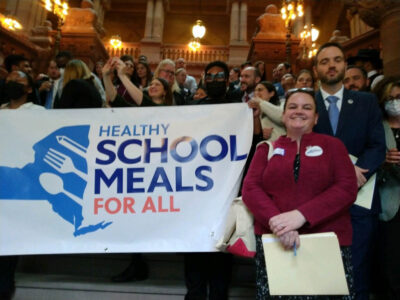
- Saranac Lake School Board members Tori Thurston and Joe Henderson, in front, traveled to Albany on Monday to advocate for the state legislature to budget for money to feed every student two meals a day. (Provided photo — Tracy Edwards)
-
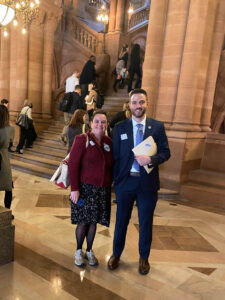
- Saranac Lake School Board members Tori Thurston, left, and Joe Henderson traveled to Albany on Monday, Jan. 9 to advocate for the state legislature to budget for money to feed every student two meals a day. (Provided photo — Tracy Edwards)
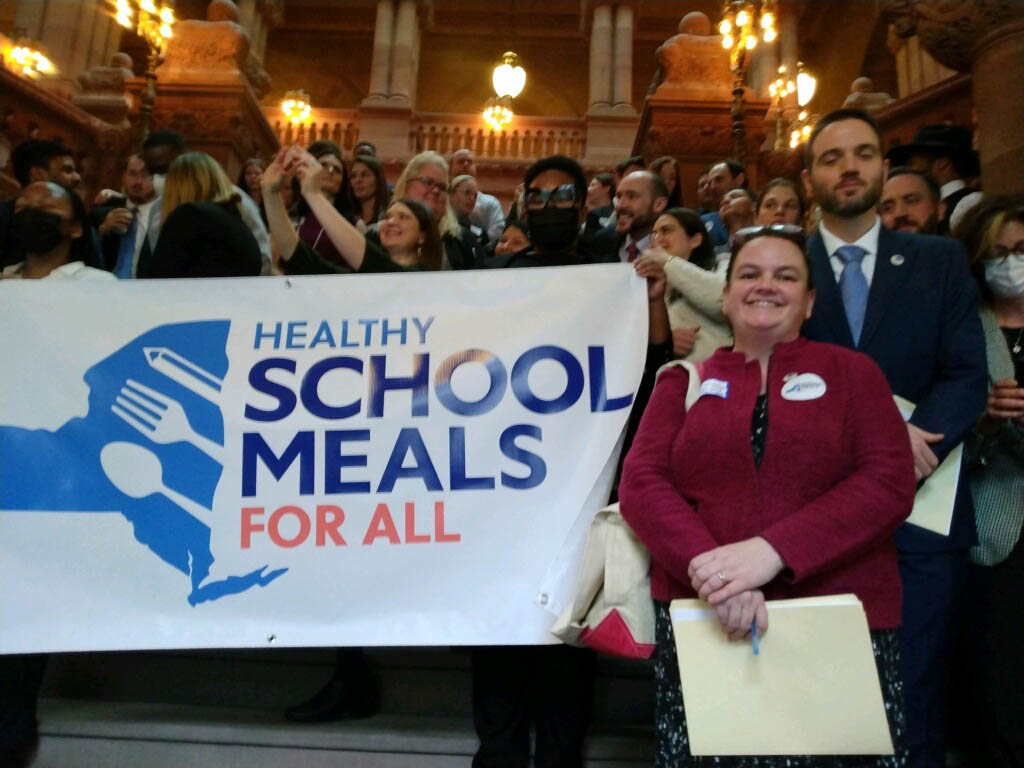
Saranac Lake School Board members Tori Thurston and Joe Henderson, in front, traveled to Albany on Monday to advocate for the state legislature to budget for money to feed every student two meals a day. (Provided photo — Tracy Edwards)
SARANAC LAKE — On Monday, the first day of the state legislature’s 2023 session, Saranac Lake Central School Board members Joe Henderson and Tori Thurston traveled to Albany to ask the state to fund universal free lunches for students across the state.
While there, they joined with other school representatives from across New York and met with North Country legislators state Sen. Dan Stec, R-Queensbury, and Assemblyman Billy Jones, D-Chateaugay, who said they were receptive to the idea. Henderson and Thurston are hopeful funding for this can be included in the state budget in the near future. The budget process is underway — Gov. Kathy Hochul’s State of the State Address was on Tuesday — and the budget is due by April 1.
But the SLCSD board is also not waiting for the state to make the change. At a board meeting on Jan. 4, members agreed to consider a potential pilot program expanding the number of families eligible for free breakfasts and lunches within the district. That change could be implemented as soon as February, and would be funded through remaining money from a $3.5 million coronavirus aid package the district received through the American Rescue Plan.
New York schools offered free meals to all students during the coronavirus pandemic through an influx of federal funds supporting higher reimbursement rates for districts. But that program ended in September.
In the months since then, there has been a large effort to renew this funding through the state. Thurston and Henderson were invited by the New York State School Boards Association to go to the state capital on Monday and jumped at the opportunity to advocate for a cause they feel is very important.

Saranac Lake School Board members Tori Thurston, left, and Joe Henderson traveled to Albany on Monday, Jan. 9 to advocate for the state legislature to budget for money to feed every student two meals a day. (Provided photo — Tracy Edwards)
“As a parent, it was great. I didn’t have to worry about it. And my family is lucky to have the means to do it,” Henderson said.
But many others, he added, are not so lucky. He said he grew up relying on cheaper school meals, and knows how important they can be.
Thurston said that when reimbursement ended she heard from teachers, parents and administrators that kids who weren’t having behavioral issues started having behavior issues. She said they started realizing it was because they were hungry.
Thurston said she’s spoken with teachers who buy granola bars with their own money to keep in the classroom to feed students who are hungry.
“We all know what it’s like to be ‘hangry,'” Thurston said. “We all know what it’s like to try and focus when you’re hungry. It’s impossible.
“It’s an investment, really,” she added. “It’s less time spent on discipline, less time spent on mental health. If kids can sit and focus because their bellies are full … then they can focus on their actual education.”
Thurston said SLCSD School Lunch Manager Ruth Pino told her “kids don’t have to pay for math books but they do have to pay for lunch.”
Pino said it has always been frustrating for her that this is the case. She’s gone down to Albany to advocate for this funding with the New York School Nutrition Association in previous years. In her kitchen position, she said she thinks all the time about the fact that some kids go hungry.
When the universal free meal funding ended, Pino said the number of students getting meals from the cafeteria dropped. Henderson fears that when kids know their families don’t have the money, they don’t buy lunch.
–
Local solution
–
The federal Community Eligibility Provision allows districts with high poverty rates to provide free meals to all students. But Saranac Lake is under the 40% poverty threshold for this program. Pino said SLCSD has around a 31% poverty rate.
“This is a weird thing to say, but if we had just slightly more poverty we would qualify for all of the students to have free and reduced lunch, which is not a great position to be in,” Henderson said.
Henderson said it’s too much money for the district to offer free meals to all students, but the board is seriously considering changing the income qualifications for free meals. Instead of basing it on the state’s metrics for free and reduced lunches, the district would base it on ALICE — a metric used by the international nonprofit organization United Way which stands for “Asset Limited, Income Constrained, Employed.” Basically, a working family who is above the federal poverty line but who still struggles to get by and pay for all the necessities of life.
“We have so many of our families in the district who are kind of on the bubble. They don’t meet the guidelines or they’re just over,” Thurston said.
Some families make just over the state’s maximum monthly income to qualify by as little as $75, Pino said.
Henderson said for a family of three to buy breakfast and lunch, it costs $67 a week. That’s a lot for many people, he said, especially as wages have been stagnant through inflation for many.
At the next school board meeting on Jan. 18, members will discuss this change and vote on it. SLCSD Superintendent Diane Fox said the program could start as early as Feb. 1.
Fox said the application would be easier than the one for free and reduced lunches. She said the program would be private, using the cafeteria’s point-of-sales system.
Fox said it is difficult to determine how much this free meal expansion would cost, but she gave her best guess. She said in October 2021, 18% of students in the district who usually paid full price ate breakfast at school and 35% of full-pay students ate lunch at school — an average of 116 breakfasts and 229 lunches a day for full-price students. She took a “shot in the dark” and guessed that 75% of the full-pay students qualify for ALICE.
With a cost of $1.65 for breakfast and $2.85 for lunch, she estimated that it would take $75,000 to finish out the school year — 90 days left in school — with this program.
Fox said Pino has a list of families who applied for free and reduced lunches and didn’t qualify. This would be the first group to reach out to.
Pino said there were 99 total applications this year. Of the ones that were denied because the families’ incomes did not meet the state’s standards, she said 10 qualify for the district’s proposed new standards. Some families automatically qualify for free meals through other programs so they don’t have to apply. Others, she said, know they don’t qualify for the current standards, so they don’t even apply.
This would be a test run with the federal funds. Those funds are a one-time use, though. The board could choose to continue the program by adding it to the budget next year if it thinks it was worth it.
Since it’s a local program, Fox said they can always change figures and adjust accordingly — they could lower the limit anytime the meet every two weeks.
Board members all said they all liked this idea, saying the love to feed students and help families.
–
State funding
–
The state is being asked to make meals universally free for all students at school.
The nonprofit organization Hunger Solutions New York estimates that it would cost $187 million to $200 million to feed every student in the state breakfast and lunch every school day, which the organization says is 0.1% of the state budget. The organization estimates that this could support meals for around 700,000 students in New York, many of them in upstate.
Henderson said North Country legislators felt that’s not a lot of money in the grand scheme of things.
“I found them both to be very supportive,” Henderson said.
Thurston said she was concerned at first with Stec, but when they got down to the numbers and bureaucracy of the current system and its administrative costs, she felt he agreed. Stec did not immediately respond for a request for more information on Tuesday, the day of Hochul’s State of the State address.
Both Henderson and Thurston hope that money for the state to provide universal free meals for students is included in the state budget this year.
“Politically speaking, it’s a pretty easy one,” Henderson said. “Right? Like, you’re feeding kids.”
Henderson said he grew up in a working class family and was on the free and reduced lunch list throughout school. One of the key points of this funding, to him, is that it would eliminate the stigma of being in the free and reduced lunch group.
“As a kid who was on that program, I remember feeling the shame of being on that program and I don’t ever want our kids to feel that,” Henderson said. “I remember feeling ‘different.'”
He said he knew he got a less expensive lunch and he appreciated it a bit, but he didn’t always understand that his family didn’t have much money. He knew he felt different though. He said he’s heard from families who, because they don’t want to take a handout, for pride, don’t apply for the program. If everyone just has access to food and there wouldn’t be that social stigma, he said.
Other states are already doing this, he pointed out — including California, Maine, Massachusetts, Nevada and nearby in Vermont. He said this shows it is feasible to do. Henderson also said big school districts in the state, including the New York City school district, already do this for themselves, but small rural schools struggle to finance it.
Pino said she has always felt she got a better response from Jones than other legislators. Many support the funding, she said, but it hasn’t happened yet.
“New York state has historically not given that much towards the lunch program,” Pino said. “The federal really takes the lion’s share of it.”
On Tuesday, Jones said the advocates’ message was “well taken” and he called it a “valiant effort” that he supports. Jones said funding for universal free lunches is something that should be “sustainable.” He said he wouldn’t want it to be funded for a couple months or years and then dropped.
He is unsure if funding is feasible to be included this year. The budget is in its early stages still, he said.
–
Rising food costs and child debt
–
Pino said food and ingredient prices started rising drastically during the coronavirus pandemic. Now, the price of a carton of milk has nearly doubled from 22 cents to 42 cents. The price of a case of lettuce has risen from $45 to $100.
But Pino said she still wants to give the students quality food. She tries to incorporate “farm to school” and said she won’t take the cheapest ingredients because she wants the kids to enjoy their meals and be healthy. It has been “incredibly hard” to keep meal prices at a rate she feels OK charging children.
Pino said the federal government mandates the cafeteria to increase its meal prices each year, to make sure it does not get more in subsidy than it charges full-pay students. She said this is typically a 5 to 10 cent increase each year.
She said if the state gives all students free meals, that would also allow the district to get a more full reimbursement on food costs from the state and federal governments. If a student gets free meals, the district gets a $4.33 reimbursement from the federal government and $0.07 from state. If they are a full pay student, she said the district gets a $0.77 reimbursement from the federal government and $0.06 from the state.
Henderson said when families can’t afford to pay for the meals their student buys at school, they accrue debt.
“We don’t got after them. We absorb that debt,” he said. “Someone has to pay eventually.”
Other states are more punitive — replacing meals purchased on debt with less enjoyable and less healthy options, or withholding diplomas if a student reaches graduation with meal debt.
Pino said students in the district currently have around $2,000 in food debt. She sends out letters to families notifying them. Many pay it off, but some don’t. Pino said the district gets lower reimbursement on food debt, so eliminating debt would allow the district to get more reimbursement.
At the last board meeting, the district’s Community Schools Liaison Erika Bezio said the Saranac Lake Turkey Trot raised $39,000 for the school this year. Henderson said this money is used, among many other things, to pay down food debt or purchase after-school snacks. If these are not needed, that money could go to other things, he said.
Henderson said kids are getting fed, but someone’s got to pay. He said this universal free school meals would “eliminate all the chaos and just make food available.”
Local News
SUNY chancellor talks Reconnect program at NCCC
North Country students attend women in law event
WCSC awards scholarships to locals
SARANAC LAKE — The Women’s College Scholarship Club is accepting applications for $3,000 scholarships which ...
ANCA’s 2026 Climate & Energy Conference gathers innovators and communities in Lake Placid

SL Civic Center receives Stewart’s Holiday Match grant support
Tupper Lake VFD, neighboring departments put mattress fire to bed
TUPPER LAKE — Quick action in the dead of night by Tupper Lake volunteer firefighters and several neighboring ...