
Loon rescued from First Lake
-
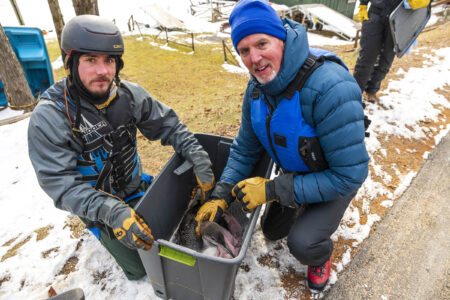
- Cody Sears, left, and Don Andrews pose with a young loon they rescued from First Lake this past Thursday. (Photo provided — Kurt Gardner)
-
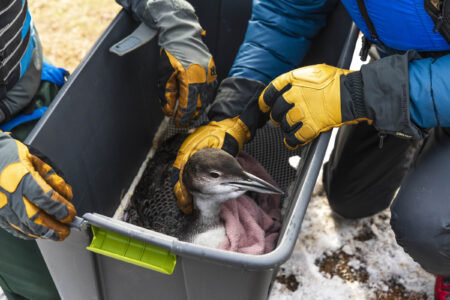
- A young loon. (Photo provided — Kurt Gardner)
-
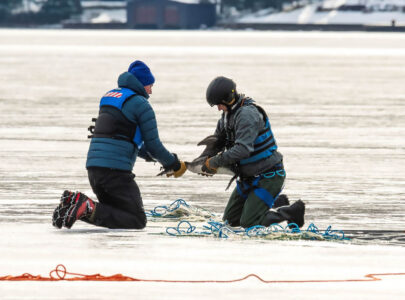
- Don Andrews and Cody Sears rescue a loon from First Lake this past Thursday. (Photo provided — Kurt Gardner)
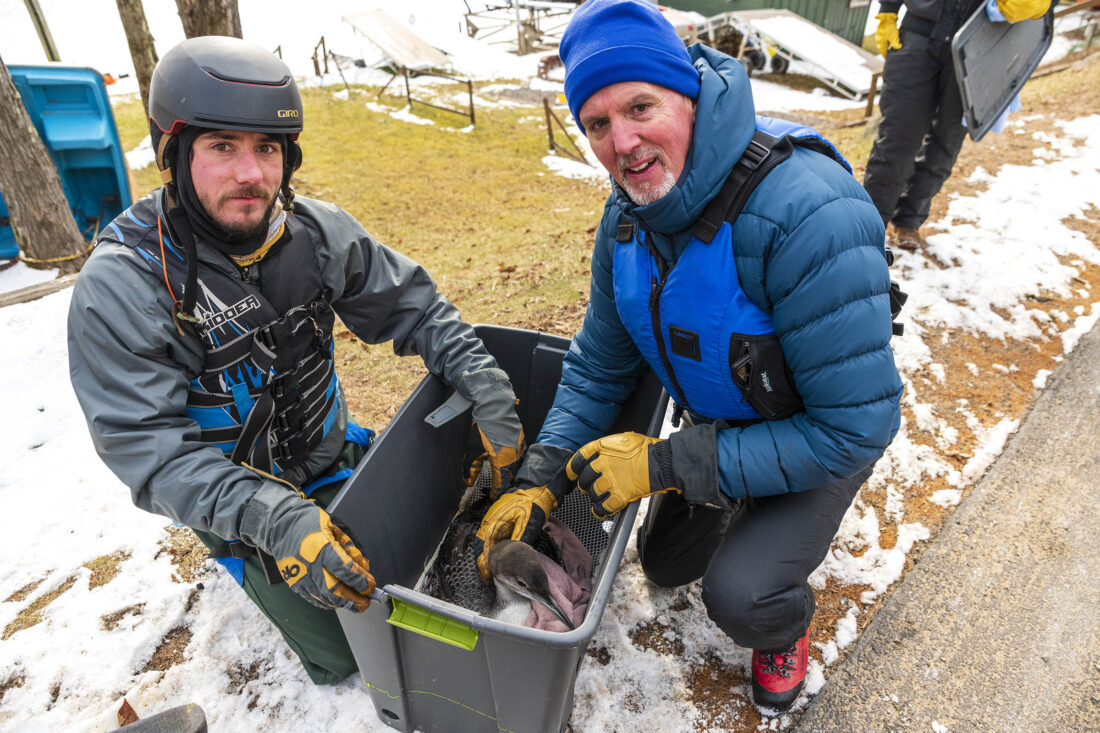
Cody Sears, left, and Don Andrews pose with a young loon they rescued from First Lake this past Thursday. (Photo provided — Kurt Gardner)
WEBB — A young loon got iced in on First Lake last week and was rescued by staff and volunteers from the Saranac Lake-based Adirondack Center for Loon Conservation.
As the weather turned colder last week, loons on small bodies of water around the Adirondacks had limited time to take off and migrate to larger or warmer waters.
“The lakes were open. It was fairly warm. And then we had some very cold nights all in a row,” ACLC Communications Coordinator Jennifer Denny said. “It seemed to be the perfect set of conditions to trap juvenile loons.”
Nina Schoch, the executive director of the Loon Center, said the loon stuck on First Lake was reported by two residents in the area on Dec. 14.
On Dec. 15, ACLC staff and volunteers, including ACLC Wildlife Technician Cody Sears, ACLC Financial Director Jay Locke, ACLC summer field staff Gary Lee and Don Andrews, and local resident and photographer Kurt Gardner, set out on a rescue mission.
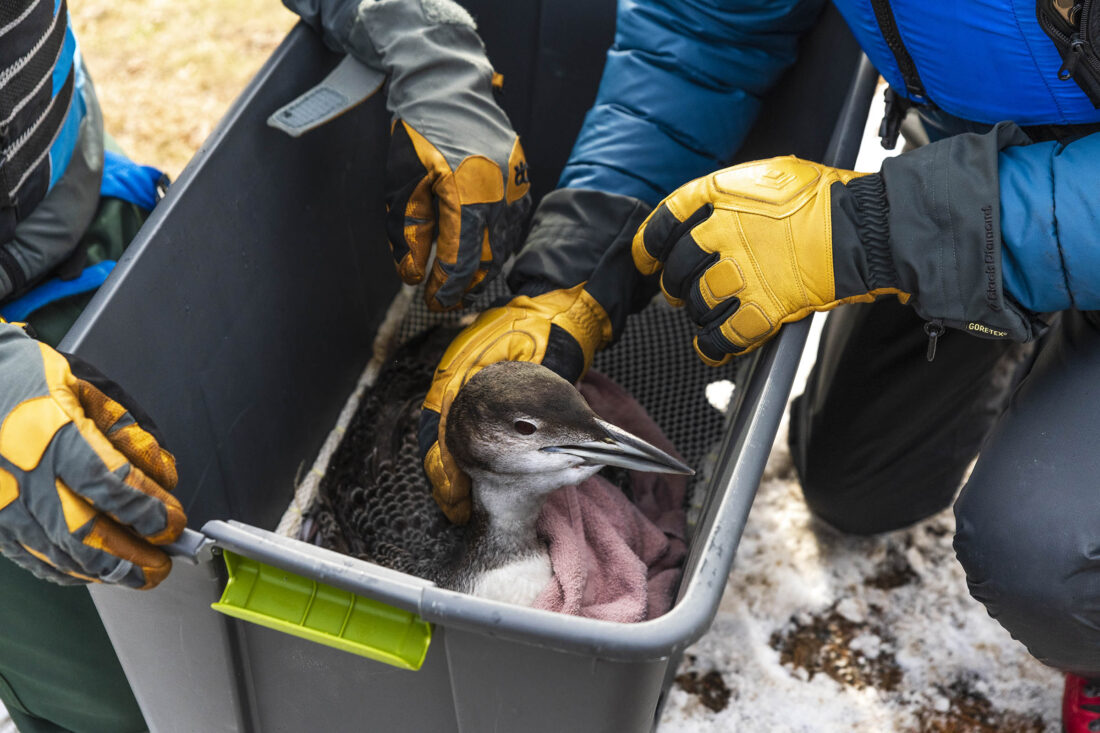
A young loon. (Photo provided — Kurt Gardner)
–
Rescue
–
It’s still early in the season, so ice on the lake is not as thick as it typically gets in January or February.
Locke said they had several lake residents with them who were experienced on ice safety and knew where the safe areas were, so he felt confident being on the lake this past Thursday. Denny said Sears estimated that the ice was around four inches thick.
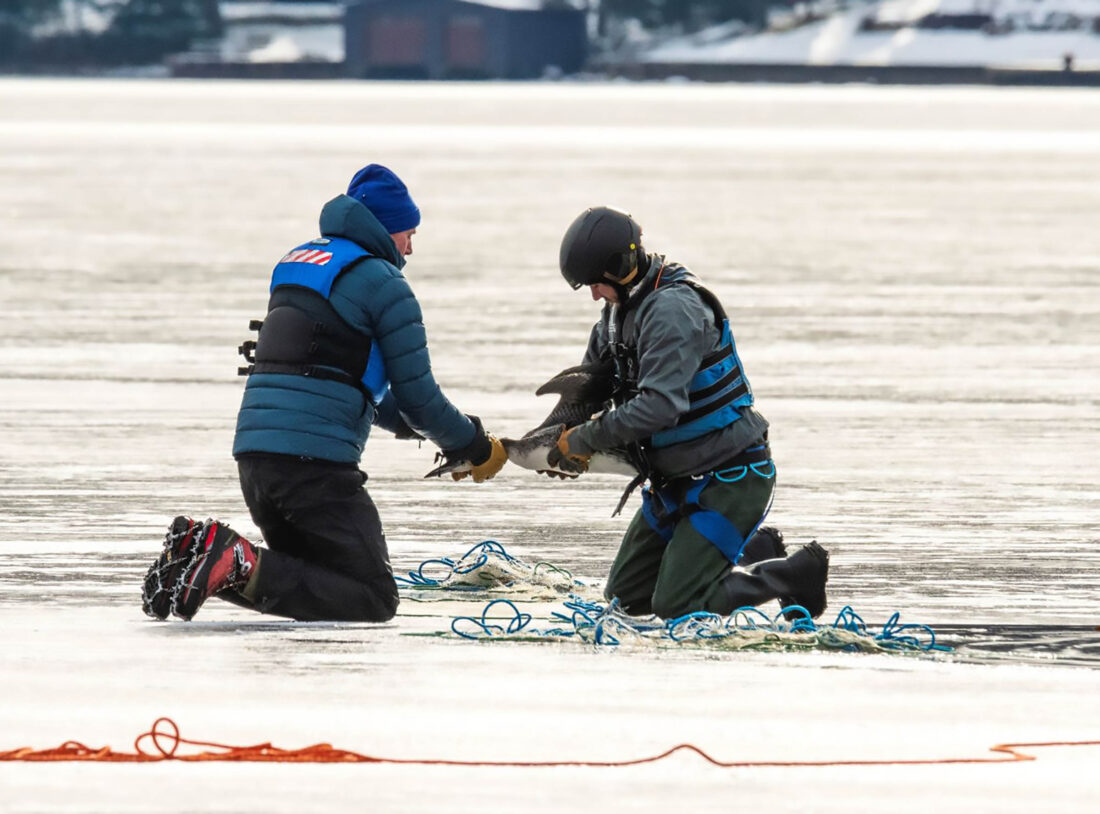
Don Andrews and Cody Sears rescue a loon from First Lake this past Thursday. (Photo provided — Kurt Gardner)
A small pool of water in the ice on First Lake was enough for the trapped loon to swim and dive for food, Denny said, but not a large enough area to take off. Loons require a “runway” of open water to gather the necessary speed to get their heavy bodies — which weigh around as much as a bowling ball — airborne. Denny added that loon anatomy sets them up to swim, not to walk.
“To save the loon, it was necessary to take quick action,” she wrote in an email. “As the hole in the ice grew smaller due to cold temperatures, it became more likely the vulnerable loon would get attacked by an eagle or other predator.”
Locke said the hole was not large enough for take-off, but large enough that the loon could evade its rescuers effectively.
Using a pole net and gill net, the tools of the loon rescue trade, he said they chased the loon around the water in canoes. Loons don’t distinguish ACLC as friends, not foes, Denny said.
Eventually, ACLC staff and volunteers captured the loon, a juvenile they found in good health. Denny said this was the loon’s first winter. It hadn’t had experience migrating before. Schoch said it’s more common for young loons to get iced in at this time of year.
The loon was released on Blue Mountain Lake, a much larger lake nearby that had plenty of open water, giving it another chance at migration.
“It seemed really active and was diving a lot,” Locke said. “It took off immediately and didn’t seem lethargic at all. It seemed in good shape.
“It’s really a privilege for me,” he added. “I work on the finance side, so to be able to participate in this part of our work and to rescue loons, to be involved in hands-on work … it’s a good way to engage the public, too.”
–
Migration and climate change
–
Denny said loons do not stay together as a family unit after the warm season.
“Juvenile loons often stay on Adirondack lakes after their parents migrate, until decreasing day-length and freezing temperatures encourage them to seek open water on the ocean,” she wrote.
But, as climate change alters typical rhythms and patterns in the environment, Schoch said loons struggle to keep up with the mixed messages.
“Climate change-related impacts confuse loons,” Schoch said in an email. “When lakes stay open later than historically typical, loons miss seasonal cues to migrate. When we get a really cold night and loons are still on the lakes, it is likely some will get iced-in.”
The earliest she remembers responding to a loon ice-in was her first year in the business in 2013, when a Thanksgiving cold snap froze in several loons.
Denny said she thinks more loon rescues may be coming soon. The center has its eyes on a couple other loons, she said they are waiting to see if they need assistance.
Schoch said she also saw loons starting to get iced in Kiwassa Lake and Lake Colby in Saranac Lake last week. On Dec. 13, the Saranac Lake Volunteer Fire Department and Rescue Squad went out with her to check on the birds, but they had gotten out on their own.
Schoch said loons can get airborne on ice, but they don’t like to. It’s hard on them, she said.
To report a loon in distress, contact the Adirondack Center for Loon Conservation by calling 518-354-8636 and email a photo of the loon to info@adkloon.org.
Local News
Youth art contest accepting submissions through Sunday
SARANAC LAKE — The Saranac Lake Local Development Corporation is running a youth art contest for ages 4-18 ...

A new approach to ‘tough kids’
Dryer fire at Gold Medal
LAKE PLACID – A clothing dryer at the Gold Medal Laundromat in Lake Placid caught fire Friday morning, leading to ...

Winter Carnival themes rolling in
Annual Adirondack Day in Albany slated April 27
LAKE PLACID — The Regional Office of Sustainable Tourism will be attending Adirondack Day on Monday, April 27. ...
Grace Pantry awarded $1,000 grant
SARANAC LAKE – The Saranac Lake Ecumenical Council recently announced that its Grace Pantry ministry has been ...