Leadership changes, fewer students and a merger. What’s happening at Paul Smith’s College?
-

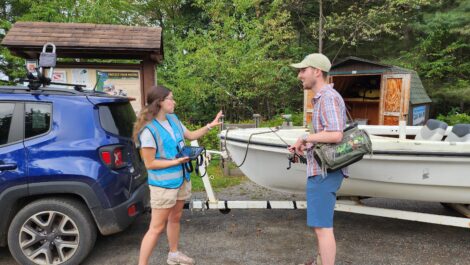
- Paul Smith’s College is one of the leading employers in a remote part of Franklin County. (Provided photo — Emily Russell/NCPR)
-
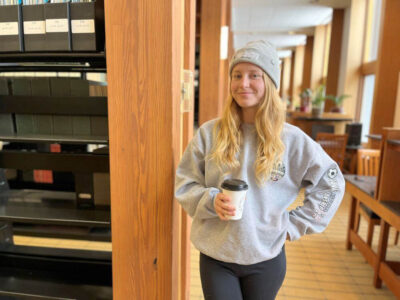
- Paul Smith’s College senior Anna Thrasher has seen the school cycle through four presidents. (Provided photo — Emily Russell/NCPR)
-
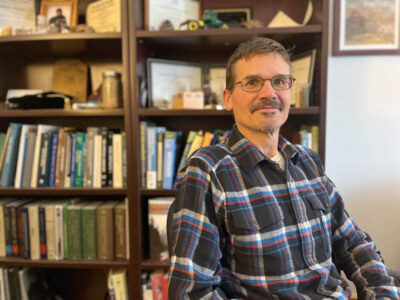
- Interim President Dan Kelting has taught at Paul Smith’s College for nearly 20 years. (Provided photo — Emily Russell/NCPR)

Paul Smith’s College is one of the leading employers in a remote part of Franklin County. (Provided photo — Emily Russell/NCPR)
PAUL SMITHS — Paul Smith’s College sits on the edge of Lower St. Regis Lake and is in the middle of miles of Adirondack wilderness. There are tall pine trees that tower over campus walkways and, on this day, it’s snowing.
Inside the school’s library, senior Anna Thrasher is sipping a warm cup of coffee and wearing a gray Paul Smith’s College beanie.
“I love Paul Smith’s,” Thrasher says. “I love the campus. A lot of the faculty are awesome, even though some have come and gone during my time here.”
Thrasher has seen the school cycle through four presidents and says that’s been tough. “It’s a lot to take in. Half the time we don’t even know who’s running the school.”
That turmoil began when the school’s president of more than six years, Cathy Dove, retired in 2020. Then the college hired Scott Dalrymple, who was from central New York, in 2021. He lasted less than a year, saying he was leaving the school to spend more time with family.

Paul Smith’s College senior Anna Thrasher has seen the school cycle through four presidents. (Provided photo — Emily Russell/NCPR)
After that, the school’s provost, Nicholas Hunt-Bull, was appointed president earlier this year. He also lasted less than a year. Today, Dan Kelting leads Paul Smith’s as interim president.
Kelting has taught at the college for nearly 20 years. He also led the school’s Adirondack Watershed Insitute.
Paul Smith’s is one of the leading research institutions in the Adirondacks. But right now, Kelting says, the school is facing some uncertainty.
“Paul Smith’s College is like many other colleges in the country; [it’s] in a challenging position.”
Colleges have struggled in recent years, especially during the pandemic. Around the United States, 60 schools have either closed or merged in the last five years, according to the education journalism outlet The Hechinger Report.

Interim President Dan Kelting has taught at Paul Smith’s College for nearly 20 years. (Provided photo — Emily Russell/NCPR)
Kelting couldn’t provide specific financial details on the state of Paul Smith’s, but the Adirondack Explorer recently reported that the school had about a $600,000 deficit in 2020. The school is also at about half capacity, struggling to keep the dorms and classrooms full.
So a couple of years ago, the college went looking for help. “We reached out to the greater world and Fedcap answered and agreed to be our partner,” Kelting explains.
Fedcap is a nonprofit based in New York City. It started out as a job training program after the Great Depression.
Today, it’s essentially a parent company of smaller nonprofits, serving a quarter of a million people. Its financial reports show that Fedcap averages about $300 million in annual revenue. It’s never partnered with a college before, but Kelting says he’s excited about the potential.
“Their mission is to eliminate poverty. That’s a pretty awesome mission and the way they do that is through workforce development, through health care initiatives, through economic development and education.”
Bethany Garretson says, at first, she was optimistic about the merger. Garretson is a graduate of Paul Smith’s College and was hired in 2014 to teach environmental studies.
“I was excited about it because, ‘Hey, maybe then we would actually make a living wage.'” According to Garretson, during her eight years on staff at the college she never received a raise. She says $40,000 a year just wasn’t cutting it.
“I had to ask my parents to help me pay a heat bill this past winter because I wasn’t making enough, I had no savings.”
Garretson ultimately left the college this fall. So have about a dozen other faculty and staff in recent months, including staff from human resources, campus safety, student wellness and admissions.
Kelting says turnover is part of the reality at a place as big as Paul Smith’s. She says it’s not easy to offer competitive pay.
“Wages are certainly a challenge. They’re a challenge not only for faculty or employees at Paul Smith’s. I think wages are a challenge for all employers in the Adirondacks. So that’s not a surprise that someone would have that as an issue.”
Kelting says the goal, after merging with Fedcap, is to raise wages for everyone. He hopes that can happen in the next few years. The way to make that happen is by expanding programs and upping enrollment.
Fedcap has a technical school in New York City. Kelting says they want to offer college credit to students there, which would then serve as a pathway to Paul Smith’s. Kelting lays out a kind of best-case scenario for the college’s future.
“This campus will be thriving. All the dorms will be full, the classes will be full,” he says. “We’ll have the thriving branch campus functioning in New York City, maybe have programs in Boston, who knows, maybe even in Europe. I’m very optimistic about the future of this institution.”
In a statement to NCPR, Fedcap mirrored that enthusiasm, describing the partnership as a win-win. “The partnership between The Fedcap Group and Paul Smith’s College will improve opportunities for students and enhance the long-term sustainability of this jewel of a college in the Adirondacks. We know the importance of, and are deeply committed to supporting Paul Smith’s role as a key driver in the economy culture, and social fabric of the region and New York State.”
State and federal accreditors are reviewing the merger. It’s unclear when a decision on that will come.
For now, students at Paul Smith’s say they’re focused on their classes, their friends and their lives here on campus. Jamie Hintz is a second-year here. He’s wearing a green Paul Smith’s College hoodie and is hanging out in the student center.
“I’m here to learn, have fun and have a meaningful experience,” says Hintz, “and it’s up to other people to make sure that the college is viable and working long-term.”
Hintz really likes Paul Smith’s and wants to see it thrive. While it’s not his problem to solve, Hintz sees merging with Fedcap as a good way forward.
“With every change at Paul Smith’s College, I hope for a better, more educational, and diverse place and I think that what is being planned with the merger is part of that.”
Part of a solution that many hope will put Paul Smith’s back on a more sustainable track, for students, faculty, and staff at the college.
Local News

Constructing collaboration

Early-season paddlers
The pit and the potential for new housing

Authors to discuss ‘The First Adirondackers’ at John Brown Farm

Expect hunger to rise as new SNAP rules take effect