In new job, retired ranger continues call for state to add more rangers
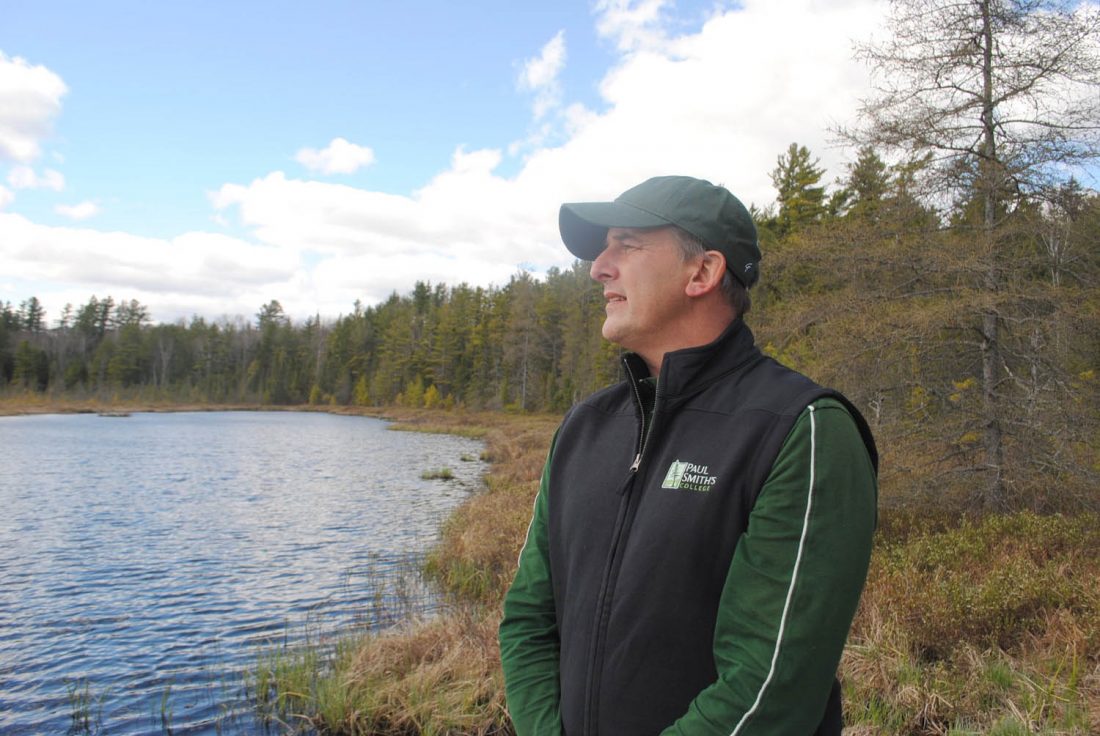
Scott Van Laer is the new director at the Paul Smith’s College VIC, a 3,000-acre campus with hiking and skiing trails. (Provided photo — Emily Russell, North Country Public Radio)
PAUL SMITHS — After two decades on the job, a leader among New York state forest rangers in the Adirondacks has retired. Scott van Laer led rescues in the mountains, fought wildfires and advocated on behalf of other rangers as their union representative. He is now starting a new chapter at the outdoor center at Paul Smith’s College.
There are some people who know really early on what they want to do with their lives. Van Laer is one of those people.
“I knew I wanted to be a ranger when I was 8 or 9,” says van Laer.
Back then, in the early 1980s, van Laer would go to work with his dad, Forest Ranger Dick van Laer. They’d go on smaller wildland fires and search and rescues. Dick taught Scott how to use a map and compass. Van Laer says that gave him the freedom to explore the woods as a kid.
“I was going on my own bushwhacks by 12, 13,” says van Laer. “We raced sled dogs in the winter, so I really had a wonderful childhood in the Catskills and the Adirondacks.”
Van Laer graduated from high school in the southern Adirondacks and moved north for college, earning a degree from Paul Smith’s College. Not long afterward he was a forest ranger.
“My first 15 days of work were on the Noonmark fire, and my next 15 days of work were after Hurricane Floyd,” says van Laer, “and the next 22 years flew by.”
In those 22 years, van Laer fought dozens of wildfires and was on hundreds of search-and-rescues. Most of the searches were successful, but some weren’t. Van Laer says the unsuccessful searches are the ones that will stay with him.
“When you find somebody deceased, you’re providing closure for a family. When you don’t find the person, nobody knows what happened; it just never ends for that family,” says van Laer. “I’ve stayed in touch with a few of those families, and the nightmare just doesn’t end for them.”
Van Laer has watched the Adirondacks change over the decades. He remembers when fall and spring were a lot quieter and when some of the summits provided a lot more solitude.
“When I started, Jay Mountain was really, really quiet. Nobody went to Jay Mountain,” van Laer says. “I could go up there on a Saturday and see three, four, five people. It was extremely pristine, and now you go there on a Saturday and there are a hundred people or more.”
As more people flocked to the Adirondacks, van Laer’s job as a ranger changed. He was focusing less on education and outreach on the trails, and more on rescues, parking tickets and crowd management.
He remembers being posted on the Adirondack Loj Road. The parking lot at the Loj had filled up early, and cars were lining the road. Van Laer would stop people driving in and ask where they were headed.
“So many people would say, ‘Oh, I was going to walk around Heart Lake,’ or ‘I was going to go up Mount Jo.’ I’d have to break the news to them. ‘Wonderful place, but you’re going to have to walk on pavement for a mile-and-a-half to do a one-mile hike.'”
“I thought to myself, ‘Oh my God, they want this, what we’re looking at right now,'” said van Laer, pointing out to the 3,000-acre campus at the Paul Smith’s Visitor Interpretive Center, known as the VIC.
“If you look in the distance, you can see St. Regis Mountain,” says van Laer. “You can see the fire tower popping up. That steel tower is 102 years old. Think about the time when they built that. It was to look for fires, but in their mind, at the time, it was protecting the Adirondacks.”
This is his new office, as the director of the VIC. Van Laer says he’s excited to be back at Paul Smith’s and to focus on what he loved about being a ranger — education and outreach.
“I’m having myself and other retired rangers to teach basic land navigation, map and compass stuff, because as a forest ranger I saw the erosion of that skill set with our hikers.”
Increasingly, more people have been relying on the maps on their smartphones to guide them through the woods. Van Laer says that means if they got lost, they often don’t have the skills or confidence to find their way out.
The number of searches and rescues has doubled in the last decade, according to van Laer, which has shifted the way he looks back on his career.
“It’s an iconic job. It sounds perfect — forest ranger. People think of Yogi Bear sometimes. You’re just walking around, every day is gorgeous, the sun is beating down on you.”
That’s true some of the time, van Laer says. But with more search-and-rescues comes more pressure and expectations. Van Laer says not a lot of people know that side of the job.
“That level of physical preparedness, equipment preparedness and mental preparedness was really draining and, quite frankly, unfair for the state to put us in that situation, and it could have been rectified. It can be rectified.”
Van Laer has spent years advocating for the state Department of Environmental Conservation to add more rangers to the force. He says he’ll keep pushing for that now as a retired ranger.
He seems at home at the VIC and is really excited for his first summer here, but he also says retirement is bittersweet.
“Ironically, I think the thing I’ll miss the most is the search-and-rescue incidents, which is kind of one of the reasons I’m retiring.”
Van Laer will miss being in the woods with the other rangers, the camaraderie that comes with such a hard but rewarding job. He says he’ll hang onto those memories for decades to come.
Local News

Constructing collaboration
Early-season paddlers
The pit and the potential for new housing
Authors to discuss ‘The First Adirondackers’ at John Brown Farm

Expect hunger to rise as new SNAP rules take effect