
Documentary on prisoner of war aims to give hope
Director hosts Q&A afterward at LP Film Fest
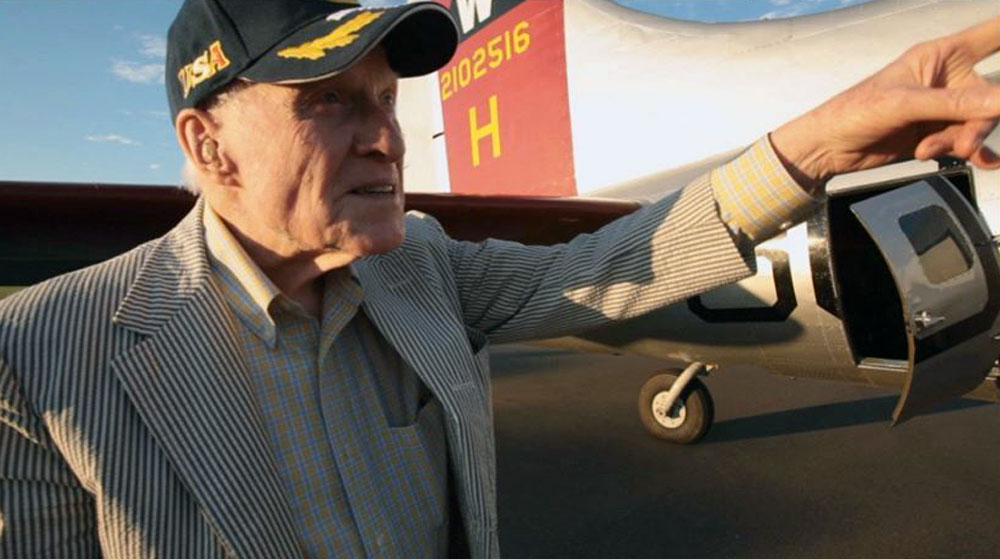
Charles Woehrle was a prisoner of war in Poland during World War II. (Photo provided)
LAKE PLACID — More than 120,000 American soldiers spent part of World War II in captivity. While many lived to see the war end and returned to long, healthy lives stateside, that time as a prisoner of war is often regarded as the single most significant experience in their lives.
Charles Woehrle was one of those POWs, and his niece Louise, a documentary filmmaker, wanted to understand that life behind barbed-wire. Her film “Stalag Luft III — One Man’s Story” will screen today at the Palace Theatre, and Woehrle will conduct a Q&A afterward. The film features interviews with her uncle, an abundance of public records and old films, and recreations of some of the most intense moments for soldiers in World War II.
“The intention was not to tribute my uncle. He represents just one of the thousands of Allied air force pilots during World War II,” Woehrle said. “Most vets can’t talk about the war. So he can speak on their behalf.”
Charles’s plane was shot down and he became a POW at Stalag Luft III, the same camp depicted in the 1963 film “The Great Escape” starring Steve McQueen, which will also screen today. In the film, a group of POWs in Nazi-controlled Poland plan an escape via three underground tunnels named Tom, Dick and Harry. It culminates in a memorable chase scene, in which McQueen’s character steals a motorcycle and attempts to jump barbed-wire fences.
This was a Hollywood movie with some big-name actors of the day including Charles Bronson, Richard Attenborough and James Coburn, so it was natural that the film deviates from the real events and romanticizes others.
“(Charles) thought ‘The Great Escape’ was a fine movie for its time,” Woehrle said, “but it showed a very clean version of the camp and glamorized a few things. However, certain scenes did happen, like when the Scotsman tries to climb the fence and is shot down. My uncle witnessed that. And there was a certain level of dignity those particular POWs were treated with. They were all Allied airmen and officers. The Germans respected that.”
Woehrle said her uncle described life in the prison camp as mainly boring and monotonous. Prisoners would do anything to try and fill the time. In one scene, Charles tells a story about a special package he received while being held. He was walking through his barracks one day and just happened to come across a coupon for a watch company. He filled out the coupon as a way to pass the time and told the maker he could pay for the watch after the war ended. Charles sent it in, knowing it was a long shot, but five months later, the watch arrived.
“It was like a dream come true. He couldn’t believe it,” Woehrle said. “All the other prisoners saw the watch, and it gave them hope.”
After the war, Charles paid for the watch.
“He was a man of his word,” Woehrle said.
While growing up, Woehrle had heard all the war stories from her uncle and father, who served in the Navy Seabees. But said she discovered a lot about her uncle in the nine years it took to create the film. About three years in, she found a box of letters Charles received from his mother during the war.
“At the time, she didn’t know where he was,” Woehrle said. “I read her letters, and I heard her voice crying out to God to please, please save her son. It was something that every mother whose son was (missing in action) would express. I never knew my grandmother, but I could tell she was a woman of great faith.”
Despite Charles’s openness, Woehrle said there are some things from the war he won’t talk about.
“Yes, certain stories are hard,” she said. “He and my dad were able to deal with a lot of the emotional and psychological experience well enough. They were lucky. Not everyone has that.”
Woehrle said the film is not a history lesson on World War II and “The Great Escape.” She said it goes deeper than that and focuses more on the personal tales from a traumatic experience.
“This is a piece of a much larger story,” she said. “I think we’re seeing a resurgence in young people taking an interest in World War II because their grandfathers and great-grandfathers who served have recently died. I think we need stories like this to remind us what a true American is and fill us with hope.
“Charles Whorle saw the worst in man and, because of it, embodied the best in man.”
Local News

Saranac Lake girls Nordic capture state title

Several village candidates just shy of earning independent ballot lines

Saranac Lake school restructuring vote coming Wednesday

Saranac Lake hoopers return to title game
Hunter education course planned
SARANAC LAKE — The Saranac Lake Fish & Game is sponsoring a New York State Hunter Education Course from 8 ...
Gendebien leads with donations in NY-21 campaign
Blake Gendebien, one of four men seeking to represent Northern New York in Congress, is bringing in the most in ...