Historic designation for church withdrawn
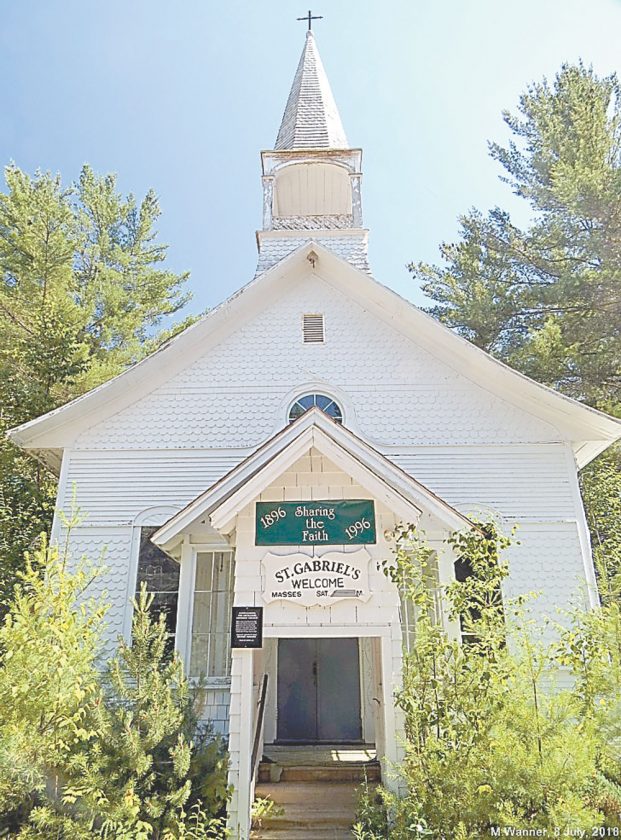
The former St. Gabriel the Archangel Church in Paul Smiths is seen in July 2018. (Provided photo — Marc Wanner, Historic Saranac Lake)
PAUL SMITHS — A church in this hamlet was recommended for placement on the State and National Registers of Historic Places by Paul Smith’s College in March, but the request has been revoked following a court’s decision regarding ownership of the property.
On March 8, the state Supreme Court in Franklin County ruled that St. Bernard’s Parish in Saranac Lake, part of the Diocese of Ogdensburg, were the rightful owners of the one-acre plot of land the Church of St. Gabriel the Archangel sits on on the corner of state Routes 86 and 30.
The church, which was built in 1896, was deeded by its owner, Paul Smith, to the Catholic Church under the condition that the building was used for religious services. The nomination stated that the church “has recently reverted back to Paul Smith’s College, which plans to restore the building for use as a performance space.”
But this was not accurate, according to a decision from the state Supreme Court.
“I was kind of surprised,” Pastor Patrick Ratigan from St. Bernard’s said. “I read (about the nomination) in the Plattsburgh paper after the court’s decision.”
Ratigan said the college was asked to withdraw the application.
The college had been a plaintiff in a court case with the church, claiming that the church had breached its conditions and the property rights had reverted back to the college. The original 1896 deed said if the church building was not used for church purposes the transfer of ownership would be void and would roll back to its previous owner.
The building became an oratory in 2002 after membership declined, and it was eventually shuttered in 2012.
The church made a counter-claim, stating that clause was void because it only applied to the Paul Smith’s Hotel Company. After the death of Paul Smith’s son Phelps, his will transferred all assets of the hotel company to the college. Judge John T. Ellis ruled in the church’s favor, saying that when this transfer occurred it “extinguished” the clause. Though the clause was violated, there was no company for the property to roll back to.
Paul Smith’s College’s Chief Marketing Officer Shannon Oborne said the college has appealed the decision.
Oborne said the historic registration was made on the college’s behalf by legal council. The application shows it was prepared by a preservation consultant from Landmark Consulting LLC in Albany.
“So in terms of who here signed off on it, it most likely was our president, Cathy Dove,” Oborne said. “(The court case) is actually why the application was made. We’re working hard to resolve these ownership issues, at the same time are very focused on protecting and preserving the structure. The idea was to have that historic preservation designation in place, but it was just premature.”
She said that if the appeal rules in the college’s favor it plans to reapply for the distinction. The registration keeps the building from being renovated in a way not consistent with its architecture and history.
Oborne said the college had a long-term vision of the building being a performing space, which it does not really have a space on campus for now. It can also make buildings eligible for public preservation programs and services such as matching grants and tax credits.
Ratigan said the church would not be reapplying to put the building on the historic register, saying he thinks the St. John’s in the Wilderness Episcopal Church down the road, across from the fire department, has more historic significance. According to Historic Saranac Lake Wiki, St. John’s was founded in 1876 by Edward Livingston Trudeau with the help of Paul Smith, where they are now both buried.
“Why does the college have such an exaggerated interest in this building?” Ratigan said. “This is nothing more really than an above-average country church.”
Ratigan said the church does not have any specific plans for the building, adding that the parish might sell it or give it away.
“We’ve been in negotiations with the college,” he said. “Even to try to give them the building.”
A memorandum of understanding, which would have transferred the property from the church to the college in December 2016, was signed by Ratigan, but not by the college’s president, Dove.
“(It) included a specification that the building would not be used for religious services, which we felt was too restrictive,” Oborne wrote in an email. “It’s important to Paul Smith’s that we honor the history and heritage of the church, and possible use of the building for religious or spiritual services would be a natural way to do this.”
Local News

Constructing collaboration

Early-season paddlers
The pit and the potential for new housing

Authors to discuss ‘The First Adirondackers’ at John Brown Farm

Expect hunger to rise as new SNAP rules take effect