Aaron Woolf is busy with local economic development, but has wistful words about the past
-

- Aaron Woolf, who ran for the 21st Congressional District seat four years ago, is an award-winning documentary filmmaker, creator of “King Corn” and “Denial,” among others. Now he’s an innkeeper. (Photo provided — Perry White, Watertown Daily Times)
-

- The tavern area at the Deer’s Head Inn in Elizabethtown includes dining with the bar, and an area with a full-sized pool table and darts. (Photo provided — Perry White, Watertown Daily Times)
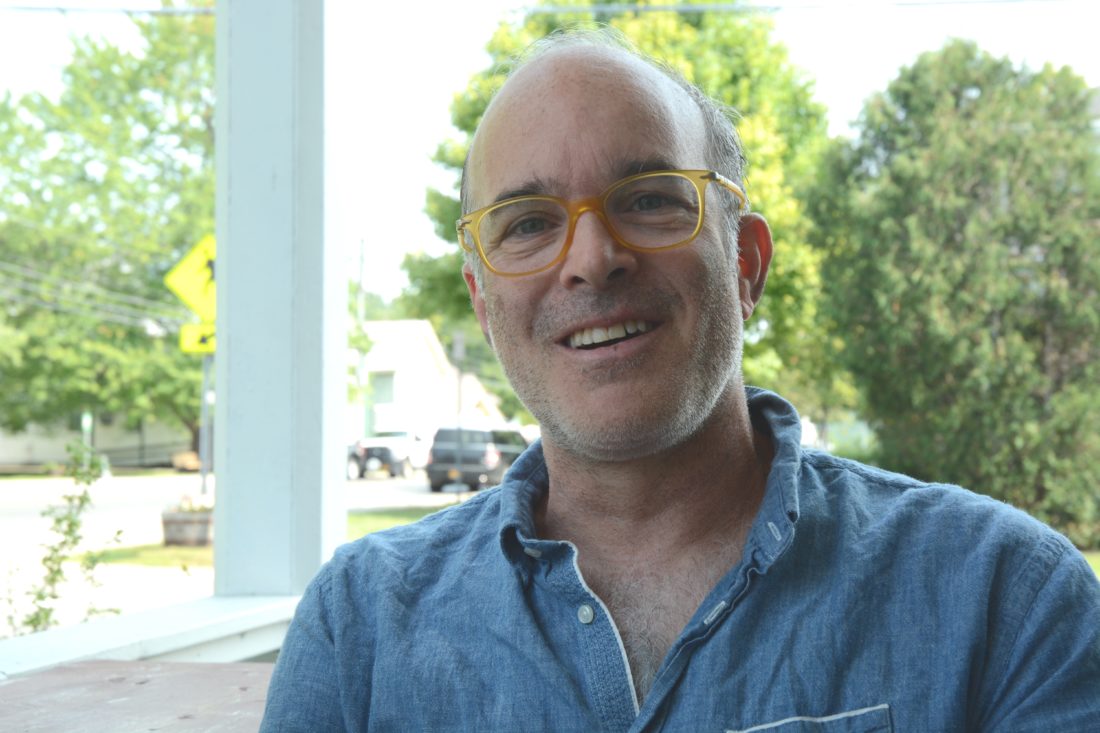
Aaron Woolf, who ran for the 21st Congressional District seat four years ago, is an award-winning documentary filmmaker, creator of “King Corn” and “Denial,” among others. Now he’s an innkeeper. (Photo provided — Perry White, Watertown Daily Times)
ELIZABETHTOWN — For seven chaotic months four years ago, Aaron G. Woolf careened around the vast expanse of Northern New York, campaigning for the 21st Congressional District seat against young, Republican newcomer Elise Stefanik.
He didn’t win.
The experience, after a period of political mourning, made him look at the smaller world around him in Essex County. After Republican taunts of “carpet bagger” during the campaign, Woolf, his wife Carolyn Sicher and their young daughter Eloise, now 7, largely abandoned New York City for their home on a mountain above Elizabethtown.
Woolf is an award-winning documentary filmmaker, creator of “King Corn” and “Denial,” among others. His wife is a psychologist and trauma specialist who gave up her practice in the city to relocate full time to the north country.
Now, they’re innkeepers.

The tavern area at the Deer’s Head Inn in Elizabethtown includes dining with the bar, and an area with a full-sized pool table and darts. (Photo provided — Perry White, Watertown Daily Times)
—
At about the time Woolf was seeking high public office, an institution in Elizabethtown was in its apparent death throes. The Deer’s Head Inn, built in 1808, closed, leaving a hole in the center of Court Street, across from the county office complex. The inn had been a gathering place for the community for more than 200 years.
The Deer’s Head Inn that exists now is a shadow of the historical inn. The first inn had 300 rooms and occupied a huge lot, Woolf said. Elizabethtown at one time sported at least two large luxury hotels, catering to clientele from the southern regions of the state who frequently took the train from New York or Albany, got off at Elizabethtown and spent the summers.
That business kept the area a-hum in activity during the summer months for many years.
But like a similar trade in the Catskills and other areas of the Adirondacks, times changed. Car travel became less uncomfortable, fewer people had the luxury of vacationing for the entire summer, patterns of vacations changed drastically. And the old hotels starved.
The Deer’s Head went through several changes of ownership. Finally, it closed.
—
Woolf, when you can get him to talk about his brief but prominent political foray, is wistful, a sense of “what might have been” always close to the surface.
He admitted that for some time after the election, he was disillusioned with the result, with the process and with the press.
Woolf was endorsed by the 12 Democratic Party county chairmen in mid-February. Then he pretty much disappeared from the stage for almost two months before finally issuing a press release and making public appearances.
For lack of information from the candidate himself, newspapers and other news media started digging up information from public and third-party sources. Now, four years later, Woolf remembers that. Acutely.
“I’m just not sure what I should have done differently,” he said. “I felt that the local press was pretty unfair.”
And yet, after the election Woolf nurtured a close friendship with former Times political writer Daniel Flatley, who now works for Bloomberg News.
He also now praises the regional press, and said that the consortium of the Glens Falls Post Star, the Plattsburgh Press-Republican, the Adirondack Daily Enterprise in Saranac Lake, and the Times and its sister papers is a good idea.
“It allows you all to keep the pressure on, to keep the candidates honest because somebody is always covering them,” he said.
Pressed on whether he will again seek public office, his head says “no” but his heart seems to say maybe.
“I’ll tell you this: it won’t happen if my family says ‘no,'” he said.
—
His wife has a less nuanced position. When told the Times was looking to do a “Life After Politics” story, she quickly said “Good! Write that story!”
Asked if the two of them played out a “Green Acres” scenario when they moved to Elizabethtown full time, she said “it started out that way, but I love it up here. I love the outdoors, all the recreational opportunities.”
She also said that while she largely enjoys being an innkeeper, it has its drawbacks.
“It’s more of a time-suck than I had hoped,” she said. “But I’m a very social person, and this is a great atmosphere for that.”
Ms. Sicher is on the Elizabethtown rescue squad and regularly goes out on ambulance calls. Her integration into the community has allowed her more quickly to escape the “she’s not from here” label frequently assigned in small-town America.
And the couple’s high-profile presence at the inn have also removed the “carpet bagger” label that Woolf wore during the campaign.
—
After the campaign was over, Woolf had a lot of time to ponder. One of the things he thought about was the inn.
“A closed business is like a cancer in the middle of a community,” Woolf said. “I started thinking about one of the main themes of my campaign — promoting local economic growth. This gave me chance to put it in practice.”
Woolf and his wife, and their partner, purchased the building, and in April 2016, Woolf started working on renovations.
“I did a lot of carpentry in here. I loved it,” he said. “Working with my hands, with wood, restores me.”
“Our goal was relatively simple,” Woolf said. “We wanted to have a welcoming space, have the lights on in a place for the community to gather.”
By August of that year, the inn was ready to open. The old tavern area became the inn’s store, with snacks, coffee, soda, soap and knickknacks. The other side of the building became a combined dining area and recreation center, with a bar, a regulation pool table and a dartboard.
Upstairs, four rooms were renovated for overnight guests, each one uniquely furnished. There is also a library with hundreds of books, which guests are encouraged to borrow, and to take with them if they wish.
—
The inn is not Woolf’s first venture into the hospitality trade. He and a partner own Urban Rustic, a grocery and deli in Brooklyn. There, as he has done with the inn, he emphasizes locally grown products wherever possible. He has introduced beers brewed in the Adirondacks and produce from the north country.
At the Deer’s Head, he has signed contracts with more than 35 local producers of food and spirits, including a list of 26 producers printed on the inn’s menu.
He has also stocked the bar with New York produced wines, craft beers and spirits. With that, he has a more varied, and arguably more interesting, drink selection than in many, much larger bars.
“I didn’t want to offer a predictable selection and I wanted to honor my commitment to regional products,” he said.
The bar is even stocked with locally grown herbs to use in drink preparation.
—
Woolf admits that when it comes to attracting clientele, the inn is still a work in progress.
With the county office complex across the street, he acknowledges he hasn’t been able to attract a steady lunch crowd from there.
“It’s a turnover issue,” he said. “We have to be able to put people through more quickly.”
On the positive side, regulars include a comfortable blend of locals, seasonal homeowners and tourists. On a Friday night, the flow of diners and later, drinkers, was steady.
The restaurant offers variety but not volume. There are only two beef items, but both feature Essex County meat. Local pork chops complement the locavore nature of the offerings, and a variety of salads all use local produce and cheese.
There are also charcuterie boards of cheeses and meats, and a mixed board — all items with a local source.
—
The inn is not, however, Woolf’s only project. He is spearheading, with other community members, an effort to make Elizabethtown the capital of mountain biking in the Adirondacks.
This is not a whimsical goal. Mountain biking is a rapidly growing sport, and it draws significant interest for metropolitan-area outdoors enthusiasts.
The town got something of a salubrious beginning when Otis Mountain Ski Area began attracting mountain bike fans to is summer slopes.
Otis Mountain, according to its website, first opened in the 1950s, joining many such family owned slopes with a simple rope-tow and little more. It stayed in operation that way until the early 70s, when it closed.
It was sold in 1994 and “has served the community as an open access, privately owned rope tow and recreation area,” the website states.
The site became host to an annual bluegrass festival in 2002 that ran until 2009. In 2013, the festival returned with more modern music that appealed to a larger crowd, and it continues today.
With a renewed emphasis on year-round use of the old ski hill, offering mountain biking was a natural. Now Woolf and his backers want to expand opportunities to more parts of the Elizabethtown area.
The plan is to purchase a large tract next to a 20,000-acre wilderness area. The Bike Ranch plans include a general recreation area, a lodge, some scattered bungalows and an extensive trails network.
In the spirit of community involvement, the organizers are selling stock in a community benefit corporation set up to own the recreational center.
“It’s not just about tourism,” Woolf said. “It’s for full community involvement. I see us going up and playing softball up there, and everyone will be welcome to join in.”
The group is seeking regional and outside investors, and will explore available grants. But a good percentage of the needed initial funds has already been raised.
—
With so much involvement in local growth opportunities, it’s hard to see where Woolf would have an inclination to run for public office.
That, of course, and his wife’s strong resistance.
“It’s not who he is,” Ms. Sicher said. “I don’t think that being tied behind a desk in Washington was even what he wanted.”
Woolf is indeed a loosely capped bottle of energy. On Friday, he talked for two hours with great animation about his projects and his experience in the political game, then greeted his mother, who had driven up from New Jersey, then took a group of potential investors to the site of the proposed Bike Ranch.
Then, at 9 p.m., after putting his daughter to bed, he came back to the inn to talk for two more hours.
Along with his local ventures, he continues to make important film documentaries and served on the board that studied high-speed passenger train service in New York state.
Will he run for office again? The encounter with cut-throat national politics in his congressional campaign to this day leaves a sour taste in his mouth.
For instance, at a campaign stop in Potsdam, he was having a pleasant discussion, in Italian, with a pizza parlor owner when a Democratic National Campaign Committee staffer burst through the door, asking him at full roar what he thought he was doing speaking Spanish. Woolf replied that he was speaking in Italian with the proprietor.
The operative screamed, “You can’t do that! The press is here!”
It was the view of the DNCC that the north country voters wouldn’t support a candidate that was too smart, Woolf said ruefully.
So, for him and his family, rural life goes on. As his daughter ages, he said, he looks forward to parenting her on into young adulthood. With everything else he is involved with, the political fire could burn out.
Which would please his wife to no end.
Local News
Paul Smith’s College Adirondack Watershed Institute urges boaters to help stop aquatic invasive species this summer
Lake Placid sugarbush sees best week yet

SUNY chancellor talks Reconnect program at NCCC
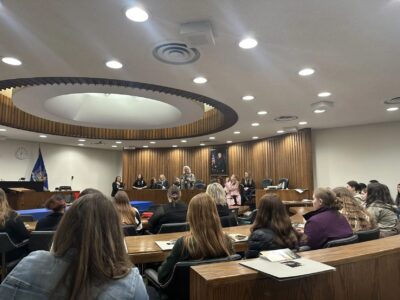
North Country students attend women in law event
WCSC awards scholarships to locals
SARANAC LAKE — The Women’s College Scholarship Club is accepting applications for $3,000 scholarships which ...