Cobb makes her case in 2018 congressional race
Democrat from Canton focuses on common ground, health care
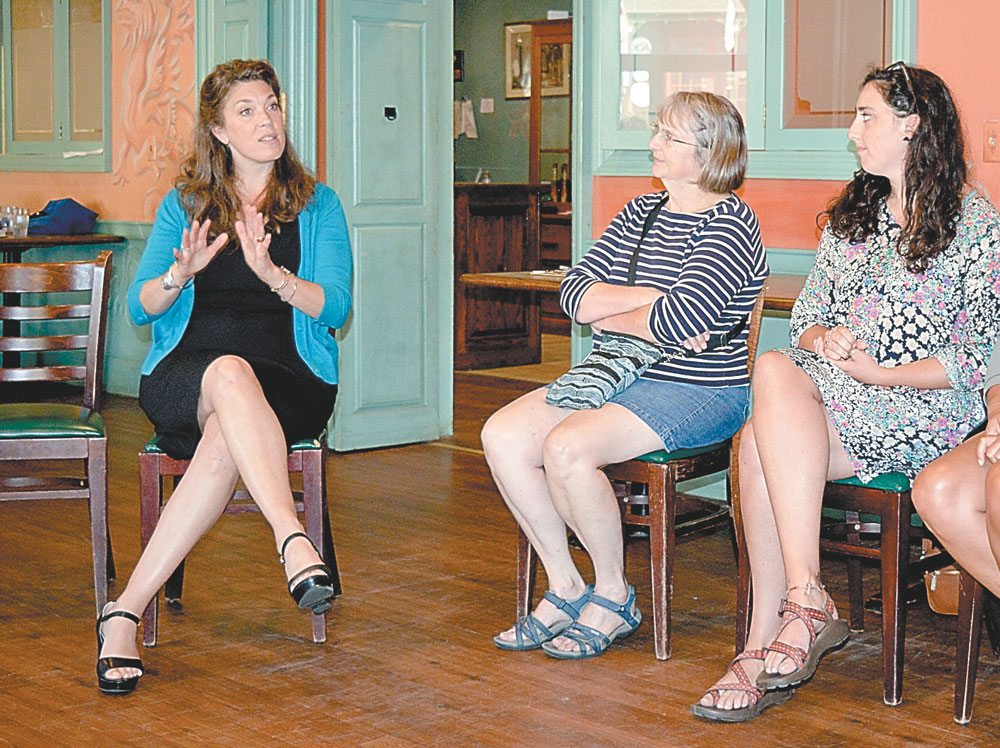
Tedra Cobb, left, speaks with some of about 30 people who attended a “Meet and Greet” event at Mr. Mike’s Pizza in Lake Placid Monday evening. (Enterprise photo — Antonio Olivero)
LAKE PLACID — Echoing her job as an English-as-a-second-language instructor, congressional candidate Tedra Cobb set up 30 or so chairs facing each other at Mr. Mike’s Pizza Monday evening.
“I teach,” the Democrat from Canton said, “so we are in a circle.”
For the next 74 minutes, Cobb opened the floor to 25 women and six men who showed up for her “Meet and Greet” event.
After 73 minutes and 30 seconds of that conversational back-and-forth, she summed up why she’s running.
Yes, she feels her legislative experience differentiates her from the four other Democrats who have announced they’re running in New York’s 21st Congressional District, which spans the North Country. But she says her experience as a constituent months ago, calling into U.S. Rep. Elise Stefanik’s office to ask about the sophomore Republican’s eventual vote on the American Health Care Act was, as she put it, “the straw that broke the camel’s back.
“So it is the vote,” Cobb said. “It is what it did to the district. And it’s the behavior surrounding it and the behavior after the fact. Put that in a package, and that is why I’m running.”
Monday evening was Cobb’s first chance in person to convince voters in Lake Placid, particularly Democrats who will vote in next June’s primary, that she is the right choice to go up against Stefanik, R-Willsboro, come November 2018.
Voters here have two more local Democratic candidates, Emily Martz of Saranac Lake and Katie Wilson of Keene. Don Boyajian of Washington County and Patrick Nelson of Saratoga County are also running. Russell Finley of St. Lawrence County plans to face Stefanik in a Republican primary.
Cobb began by stating she’d “rather just be open to questions,” opting against an opening speech while attendees picked up double-sided copies of her resume as they walked in with cups of soda and iced tea in hand.
As question after question filtered in, Cobb emphasized that she’s not running against President Donald Trump, rather Stefanik.
She stressed she thinks she’s ready for this race, thanks to experiences with the St. Lawrence County Legislature such as going through the necessary hurdles over a two-year process to pass a new ethics law.
She preached a message of collaboration and a strategic approach that would feature county-by-county town halls and district-wide coalitions, if elected.
“We are better together than we are in disparate parts,” Cobb said.
“The reality is,” she added, “government should be fixing problems. We are stuck in ideology and power as opposed to our collective principles and problem solving. That’s why I’m running.”
She hopes her campaign unites fragmented populations within the North Country that she feels have more things in common than they realize. To illustrate her point, Cobb continuously came back to the concept of a Venn diagram.
She said she used this example of finding common ground with a man at the St. Lawrence County Fair, someone who identified as a Libertarian who “despised Adirondack environmentalists for limiting business in the region.” She said he eventually relented and agreed that both he and she wanted clean water and energy.
She said she also used the Venn diagram example with a random AT&T salesman seated beside her on a flight to meet with the Democratic Congressional Campaign Committee in Washington, D.C. He, Cobb said, agreed with her about wanting portable and affordable health care, whatever the solution to that may be.
And then there was a man who asked her, “Do we have coal in the district?”
“And I said, ‘We have lakes and rivers that we are still cleaning up,'” Cobb recounted. “We can only eat one fish out of the St. Lawrence River a month, or something. The reality is, where is the Venn diagram? We all want clean air. We all want clean water. As child in the Appalachians or someone in the Adirondacks, that’s our collective environment. That’s our world. Now that doesn’t mean that I wouldn’t ask, ‘How would this affect my district?’ Of course.”
Cobb stressed that she feels relationship building throughout the district is the key to mounting a winning challenge versus Stefanik, even if it means going against the recommendations of a group such as the DCCC.
Cobb said members of the DCCC, during her Washington trip, told her not to go out into the district door to door, something she did at 2,800 households in St. Lawrence County when running for her previous seat. Rather, the DCCC said, call people.
“Where am I?” Cobb said she then thought.
“Folks,” Cobb said to the group, “I know that this is the land of lawn signs. When the DCCC says, ‘You don’t need lawn signs,’ I’m going to say, ‘I’m buying lawn signs.’ That, I think, is one of the things that is important to me: to run a campaign that I believe in. To run it with people who know the area and to be able to say, ‘This is our campaign.’ I will do my best to do that.”
Cobb was also pressed on how she would relate to North Country voters who made up the vast majority that led to a Stefanik landslide victory over Democratic candidate Mike Derrick in November. Her response hearkened back to her Venn diagram metaphor.
“A lot of people said, ‘I don’t understand why people voted for Trump or voted against their own interest,'” Cobb said, “And it doesn’t matter. We are where we are right now. What matters is to try to figure out where the point of grayness is. Where does that Venn diagram meet? And that, to me, is the challenge.”
Local News

Constructing collaboration
Early-season paddlers
The pit and the potential for new housing

Authors to discuss ‘The First Adirondackers’ at John Brown Farm

Expect hunger to rise as new SNAP rules take effect