Remembering the last Norwegian seaman who cured in Saranac Lake
-

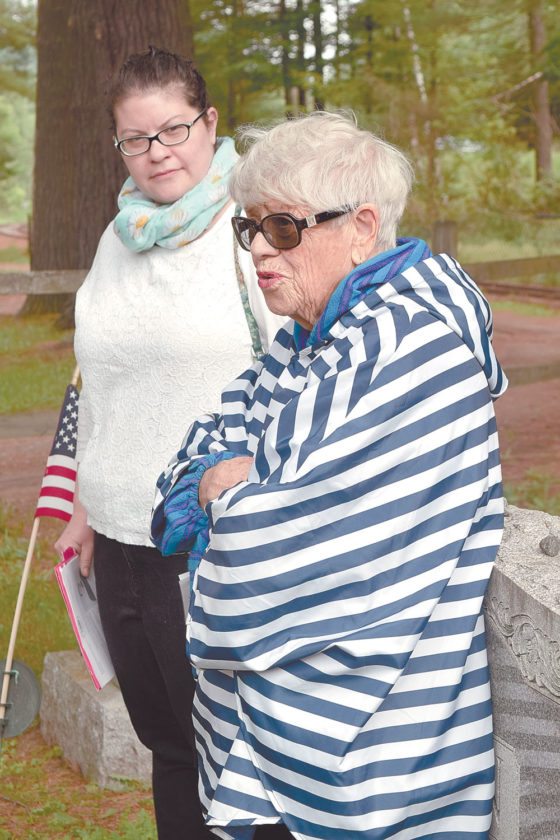
- Kari Harrington talks about her father, the late Knute Grytebust, a Norwegian sailor who came to Saranac Lake to cure from tuberculosis during World War II, Monday in Pine Ridge Cemetery. Standing behind her is her cousin Leif Sperre, who lives in Norway. (Enterprise photo — Chris Knight)
-
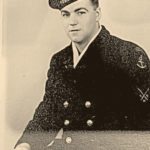
- Knute Grytebust
-
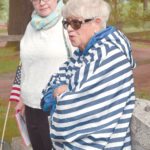
- Natalie Leduc talks about the Norwegian sailors who came to Saranac Lake to cure from tuberculosis and are buried in Pine Ridge Cemetery as Aurora Wheeler of Historic Saranac Lake listens. (Enterprise photo — Chris Knight)
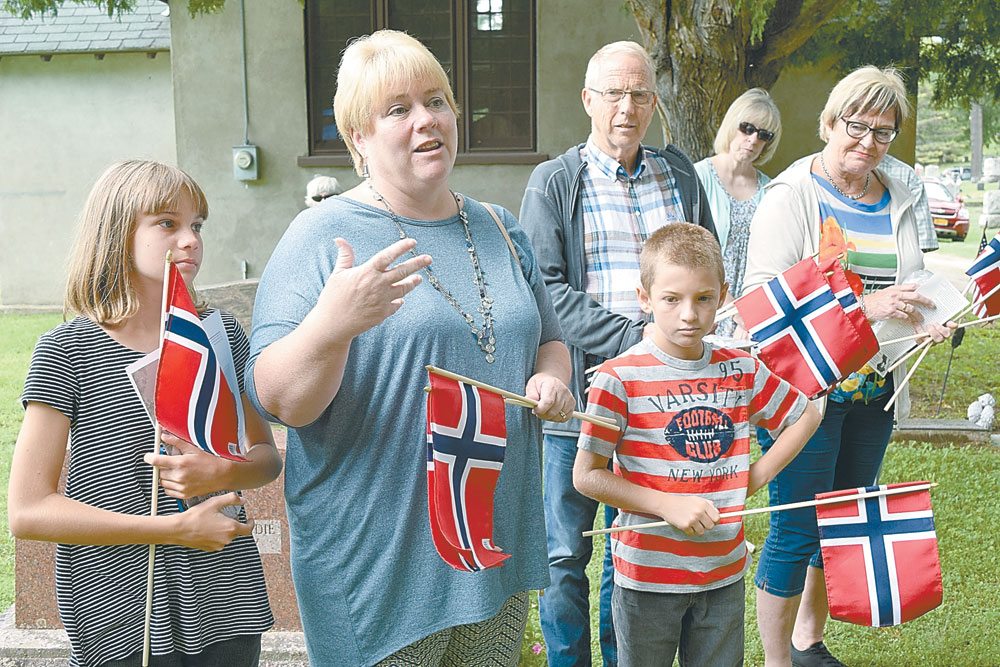
Kari Harrington talks about her father, the late Knute Grytebust, a Norwegian sailor who came to Saranac Lake to cure from tuberculosis during World War II, Monday in Pine Ridge Cemetery. Standing behind her is her cousin Leif Sperre, who lives in Norway. (Enterprise photo — Chris Knight)
SARANAC LAKE — The last of a group of World War II-era Norwegian sailors who came here to cure from tuberculosis has died.
Knute Grytebust, 97, will be laid to rest today in Malone, but he was remembered in Saranac Lake Monday at a small gathering beside a memorial to the sailors in Pine Ridge Cemetery.
Family members of Grytebust placed Norwegian flags at the stone, shared memories of Grytebust and celebrated the community’s connection to the Norwegian sailors.
“It’s been an emotional journey,” said Kari Harrington, Grytebust’s daughter. “I’m just very thankful for everyone that’s done as much as they have for keeping their memory alive. It’s very special.”
A large number of Norwegian sailors had been at sea in 1940 when Germany invaded and occupied Norway. They landed in New York City, after which some re-joined the war effort, supplying oil to Allied ships. Many, however, had contracted tuberculosis while working and living at sea in such close quarters.
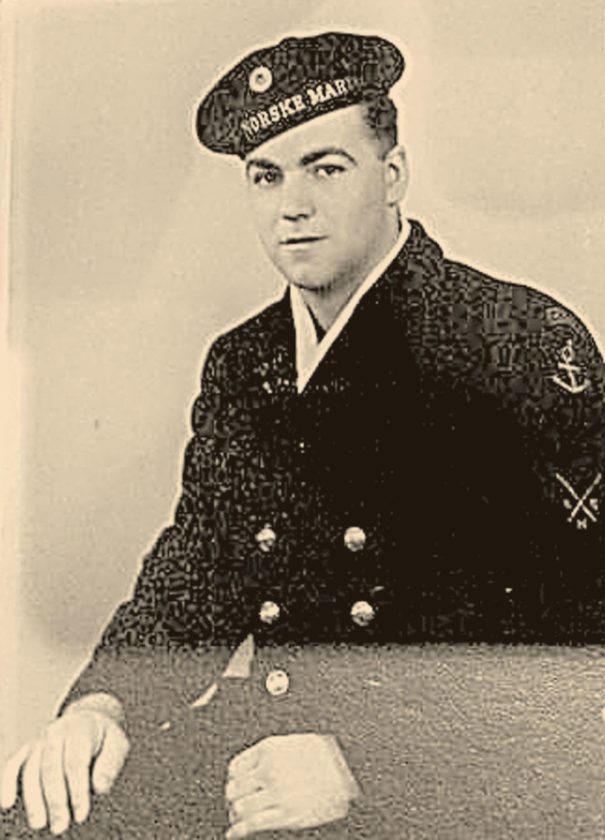
Knute Grytebust
The Norwegian government paid to have the sick sent to the Saranac Lake area to cure, but it’s unknown just how many came here. Historic Saranac Lake’s LocalWiki website lists about 100 names of Norwegian sailors who cured in Saranac Lake. In his book “Cure Cottages of Saranac Lake,” author and local historian Phil Gallos estimated the number at roughly 500. The sailors stayed in private cure cottages throughout the village, along with the Gabriels Sanatorium and Stony Wold, a sanatorium near Onchiota.
Many were able to return home after the war. Three — Jacob Jacobsen, John Pedersen and Alfred Larsen — married local girls and stayed in Saranac Lake. However, 15 men and one captain’s daughter succumbed to TB while they were here and are buried in Pine Ridge Cemetery. Larsen died in 1989 and was buried there with his fellow sailors.
The names of all the Norwegians buried at Pine Ridge are inscribed on ground-level concrete markers next to a large monument that reads, in Norwegian, “In memory of the Norwegian seamen who died in the struggle to free their homeland.” The site is surrounded by a black chain-link fence held up by posts shaped like anchors.
For years, this memorial has been cared for by cemetery volunteer Natalie Leduc, who organized Monday’s gathering. She was a young girl in the 1940s when the Norwegians arrived in Saranac Lake.
“I remember meeting them,” she said. “They were just a little bit older than me. They were in cure cottages and different homes around the community. You saw these boys on the street with their Greek fishing hats, and they were friendly and pleasant.”
Natalie Leduc talks about the Norwegian sailors who came to Saranac Lake to cure from tuberculosis and are buried in Pine Ridge Cemetery as Aurora Wheeler of Historic Saranac Lake listens. (Enterprise photo — Chris Knight)
“She’s just been amazing in terms of putting her heart and soul into caring for them,” Harrington said of Leduc. “That’s really how I look at it. She’s been taking care of them when their families couldn’t.”
A small monument with Grytebust’s name was recently added to the memorial. He lived in Saranac Lake briefly after the war and met his future wife Charlotte here. After they were married in 1945, Grytebust became an American citizen and the couple moved to Charlotte’s hometown of Chasm Falls, near Malone, where they lived and raised a family for the next 40 years. Charlotte Grytebust died in 1987. Knute Grytebust died in December.
Grytebust’s daughter said her father didn’t talk a lot about his time curing from TB in Saranac Lake until she started doing some family research.
“He talked about the cure cottages and how his best friend shared a room with him,” Harrington said. “He told me about surgery they did where they did an incision. It sounded like they almost took a pair of pliers and they would crunch the nerve, and it made the diaphragm go up, and it felt like you were being punched in the stomach. That was one of his treatments.”
In addition to Harrington and her family, who live in North Carolina, her brothers Leif Grytebust of South Carolina, Wesley Grytebust of North Carolina and Albert Grytebust of Malone and their families were also on hand for Monday’s gathering. So was Knute Grytebust’s nephew Leif Sperre, who traveled here from Norway.
“We had a special relation with Uncle Knute,” he said. “We came over for his 90th birthday, came over for his 95th birthday, and we promised we’d come back for his 100th birthday, but now we are here.”
The ranks of former Saranac Lake tuberculosis patients who are still alive are getting thinner and thinner as the years go by. Leduc called Monday’s remembrance of Grytebust “the culmination of all Saranac Lake’s years of curing people from TB.”
“It just seemed to me that when the last one died, something should be done to remind the people of the North Country of what Saranac Lake did do, and what a wonderful haven it was for these young people,” she said. “It’s part of the history of Saranac Lake. They came, they cured, and they died, and here we are saying goodbye.”
Local News

Constructing collaboration
Early-season paddlers
The pit and the potential for new housing

Authors to discuss ‘The First Adirondackers’ at John Brown Farm

Expect hunger to rise as new SNAP rules take effect