Diversifying Ironman
Minority groups use Facebook, meet-ups to increase interest in sport of triathlon
-
- Moira Horan of Spring Lake Heights, New Jersey holds up a sticker from the “Women For Tri” international group, which has more than 30,000 Facebook members worldwide. (Enterprise photo — Antonio Olivero)
-
- Member of the “Women For Tri” international group, which has more than 30,000 Facebook members worldwide, pose for a picture at their Ironman Lake Placid meet-up Friday morning at the Olympic Speedskating Oval with “The Voice of Ironman,” Mike Reilly (center, bottom row). (Enterprise photo — Antonio Olivero)
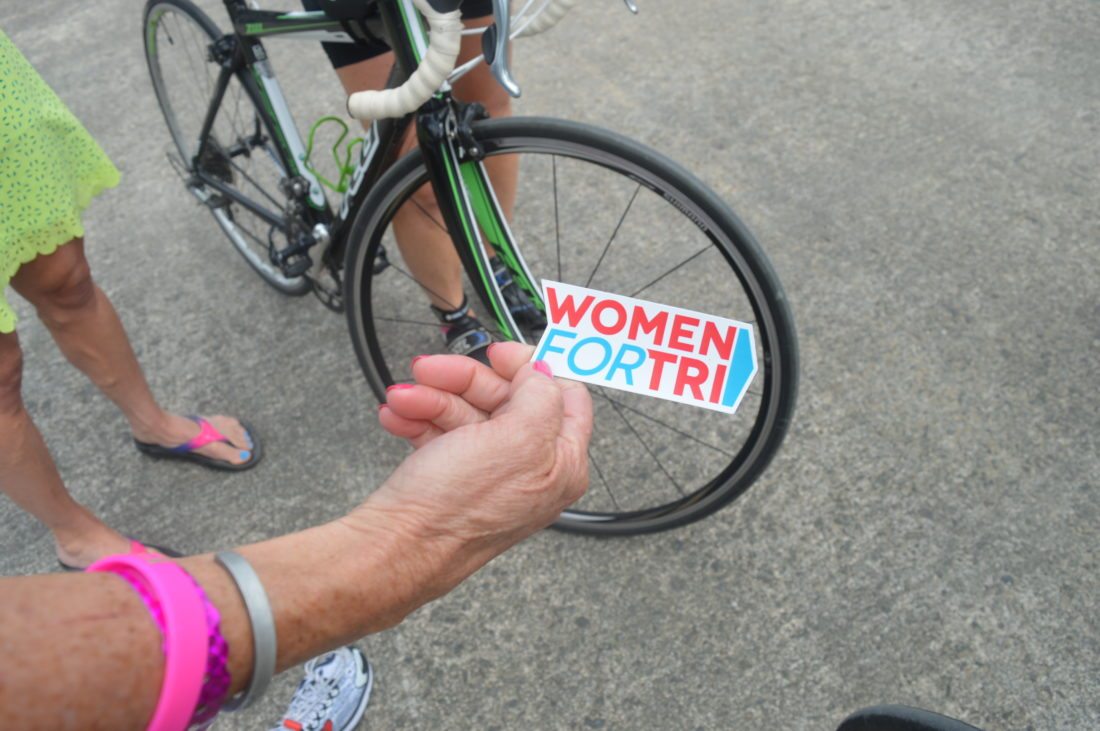
Moira Horan of Spring Lake Heights, New Jersey holds up a sticker from the “Women For Tri” international group, which has more than 30,000 Facebook members worldwide. (Enterprise photo — Antonio Olivero)
LAKE PLACID – Minutes before Moira Horan hosts a meet-up at the Olympic Speedskating Oval for dozens of members of an international group hatched on Facebook, “Women For Tri,” the Brooklyn-native thinks back to when she arrived at her first Ironman triathlon. It was 2001 in Panama City Beach, Florida.
Horan’s lasting impression was a pre-race scene that jarred her. It hinted at the disparity in participation between men and women in the sport.
“I just remember the men’s rack of (competitor) bags that went on forever, and ever and ever, it seemed,” Horan said. “Then there was this one little rack at the end that was for women — maybe 200 bags to, like, 1,500 for men. There just wasn’t that many of us.”
Thinking back to his first years participating in triathlons in the ’80s, Floridian Norman Seavers remembers an even wider gap for African-Americans at events.
“There was absolutely nobody but me for many, many years,” Seavers said. “The first four to five years I raced, I probably saw only one other (African-American) competitor annually.”
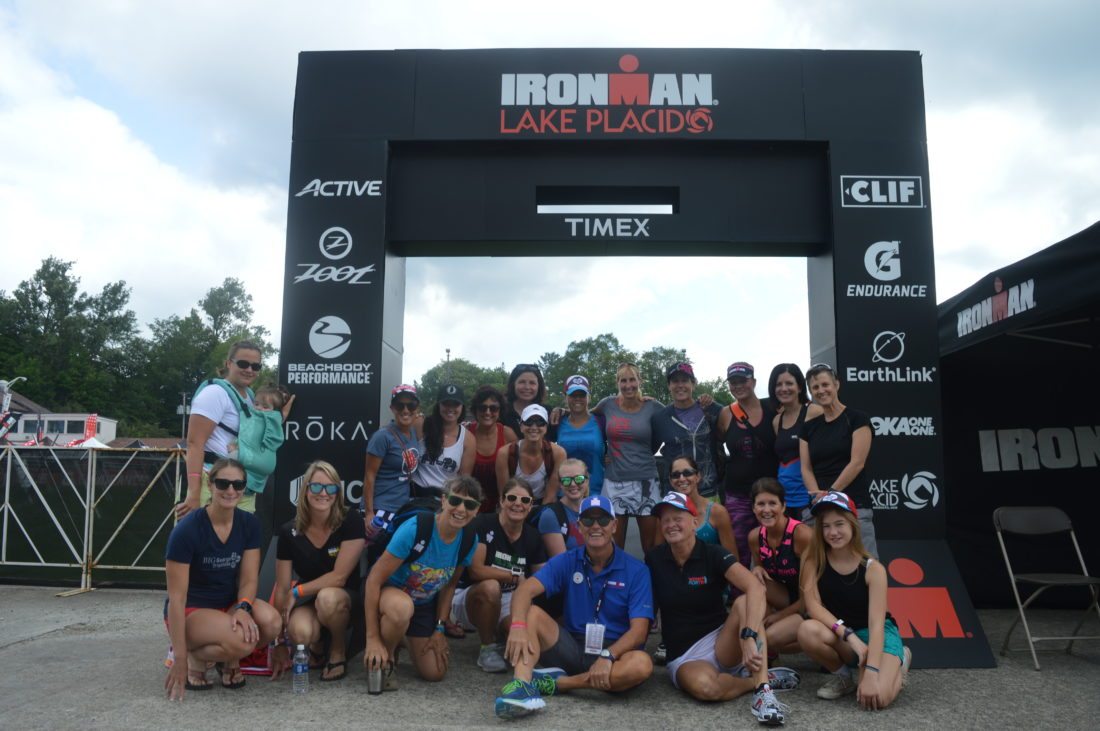
Member of the “Women For Tri” international group, which has more than 30,000 Facebook members worldwide, pose for a picture at their Ironman Lake Placid meet-up Friday morning at the Olympic Speedskating Oval with “The Voice of Ironman,” Mike Reilly (center, bottom row). (Enterprise photo — Antonio Olivero)
In the decades since, participation from women and African-Americans has increased, slowly and slightly. This year at Ironman Lake Placid, there will be approximately 1,982 males compared to 758 females. Statistics on the racial demographic backgrounds of competitors was not available.
This year’s event having that 28-percent female percentage may seem low, but female triathlete and Ironman Foundation Community Relations Manager Sarah Hartmann said it does represent a sudden uptick in involvement from women in the past couple of years.
As of 2015, Hartmann said the average percentage of women in Ironman races was just 20 percent. This year, it’s jumped to a worldwide average of 27 percent.
Hartmann credits groups like Women For Tri, which also launched in 2015, as well as an increased interest worldwide from women in other types of endurance events, such as half-marathons.
That, and Facebook groups.
Both Hartmann and Tony Brown, the founder of the largest African-American triathlon group in the world, Black Triathletes Association, said creating virtual communities and finding connections on Facebook has been critical to nurturing eventual in-person communities for minority triathletes.
As a 27-year-old female triathlete, Kierstin Clark of Keene, New Hampshire is one who has found a cure for triathlon training isolation through Women For Tri. Friday morning, she made her way to the Olympic Speedskating Oval with two older female triathlon buddies to meet “The Voice of Ironman,” Mike Reilly, at Women For Tri’s in-person meet-up.
“There aren’t a lot of people in my age group ever,” Clark said. “The women I train with, they are more experienced. So online I can see other people my age doing it as well. You know, it’s harder for people in their twenties to say, ‘I’m going out to do this on my own.’ This creates that safe community to ask those questions and stuff.”
“I think the organization — in two years — has done five to seven years of work of other organizations, getting women introduced to triathlon,” Reilly said.
When Brown, 49, began his triathlon career five years ago, though he was in one of the most common triathlon age groups — men in their early forties — he felt much the same way as Clark, so he launched BTA.
“I kind of felt alone,” Brown said from his home in Atlanta, Georgia.
“I created this Facebook group,” he added, “and what I had noticed is, I was getting a lot of African-American triathletes joining who all kind of shared the same frustration. We were all kind of self-coached. So we used the forum to communicate to weather our frustrations or the challenges we were facing.”
BTA increased in membership exponentially in the first few months, as both new triathletes and old-timers like Seavers took to what the online forum could provide them.
Brown utilized veterans like Seavers, who has completed more than 100 triathlons, as national ambassadors for BTA. Since, Seavers has helped to organize and conduct in-person grassroots informational outreach, educational clinics – especially for swimming, he said — and special meet-ups for members of BTA. He and Brown said it’s a huge part of what they do for BTA’s 3,323 online members.
And this weekend in Lake Placid, Brown said five members of BTA will be represented in Sunday’s race.
Horan does much of the same for Women For Tri, as she is one of several dozen ambassadors, including others as far away as Galway, Ireland, Walferdange, Luxembourg and Hong Kong. Along with organizing meet-ups and clinics, Women For Tri ambassadors have awarded more than $157,000 for triathlon clubs all over the world since their 2015 launch.
“Our clubs, they are really our squad on the ground,” Hartmann said. “They are doing incredible work, and the numbers prove it.”
Strategically, Women For Tri targets women who have been swept up in recent crazes, such as half-marathon. Two groups that both Women For Tri and BTA have working relationships with are Black Girls Run and Black Men Run. Seavers and Brown also singled out Diversity in Aquatics as a huge helper to the growth of African-Americans in triathlon.
Still, African-American involvement in triathlon remains very low. When U.S.A. Triathlon took a survey last year of more than 12,000 people from its membership it found that just under one percent of the respondents identified themselves as African-American. Ironman says it does not keep demographic information on participants.
But within the increasing trend of women and African-Americans taking part in half-marathons, Brown sees a gateway.
“Because of that growth in running, there is instinctively going to be those runners that are trying to push the limits and try triathlon,” Brown said.
In Women For Tri’s Facebook group alone, 33,400 women from as near as Wilmington and as far away as China belong. Not all are experienced triathletes. Some are just starting out with shorter “sprint” races while others have not competed yet, as they may be transitioning to the sport of “swim-bike-run” from 10K running races or swim clubs.
Whatever the case, Horan and Hartmann said groups like Women For Tri are focused on listening to those interested in the sport to answer common “barriers for entry” many women say discourage them from competing in a sport dominated by middle-aged white men.
Hartmann explains that in her travels across the country meeting with Women For Tri members, such as last week in Gainesville, Florida, common barriers identified include that many women don’t think they have the time to commit to triathlon due to more traditional maternal commitments. Other women aren’t as comfortable swimming or biking. Still others are concerned with their body image.
But the primary barrier of entry Hartmann and Horan see through their work with Women For Tri is that, women — more often than men – they say, desire a more communal and team-like element to triathlon training and competition. And that’s where the virtual connections on Facebook and follow-up meetings are critical.
“This is a closed group of over 30,000 women talking about every topic under the sun,” Hartmann said. “Imagine having that as just an in-person meeting? It is no holds barred, Let’s talk about every question that you have, no matter what it is.’ We really go under the hood and address all of those fears, concerns, little questions, big questions. It’s cool.”
Seavers feels strides have been made within the past five years for African-Americans in triathlon, though he added that the economic nature of the “basically middle class sport,” will always create a barrier for entry for those from poorer situations, whatever their ethnicity.
When it comes to race time, though, going all the way back to his start in the ’80s, Seavers said he’s never felt discrimination from a fellow competitor.
“On race day, everybody becomes the same,” he said. “This sport is interesting in that there is respect from all of your fellow competitors because everybody knows what it takes to get there.”
And one day, Horan, who attended Friday morning’s meet-up despite her current battle with breast cancer, said she hopes women will fully catch-up.
“I would love to see the day there’s as many women on that start line as men,” she said. “and there’s really no reason why there can’t be.”
Local News
Constructing collaboration
Early-season paddlers
The pit and the potential for new housing

Authors to discuss ‘The First Adirondackers’ at John Brown Farm

Expect hunger to rise as new SNAP rules take effect