
Cabin craftsman
Master builder, after wandering the earth and suffering health crises, brings Anne LaBastille’s cabin back to life
-
- Michael Frenette and Chloe Mattilio pose Thursday with their in-progress reassembly of “Woodswoman” author Anne LaBastille’s log cabin inside the Adirondack Experience museum in Blue Mountain Lake. They previously disassembled the cabin from its original location at Twitchell Lake near Big Moose. (Enterprise photo — Ben Gocker)
-

- Michael Frenette, right, laughs while talking with Joe Martens, left, then commissioner of the state Department of Environmental Conservation, and another person during an open house at Camp Santanoni in Newcomb, which Frenette restored. (Enterprise photo — Peter Crowley)
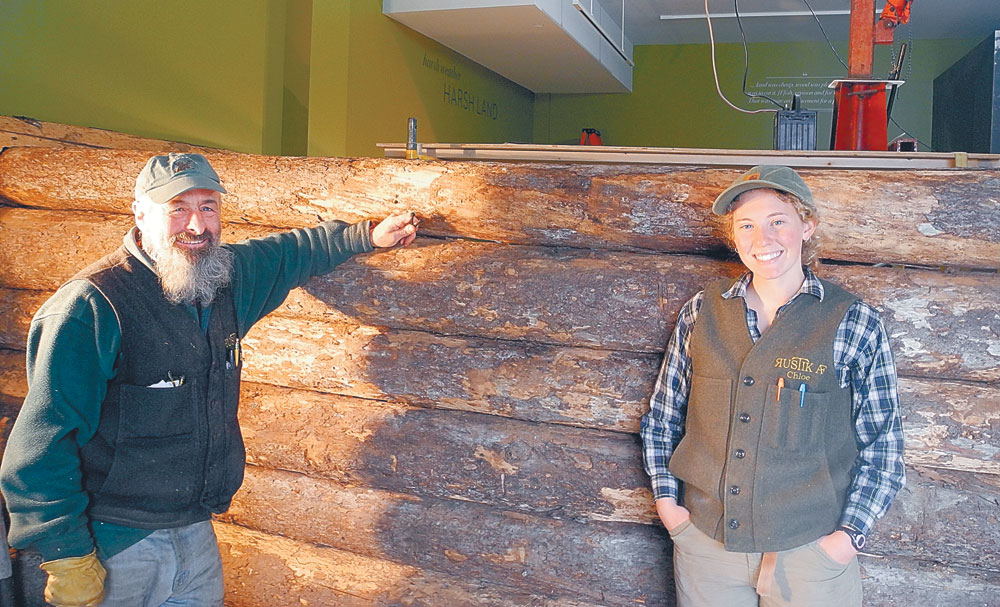
Michael Frenette and Chloe Mattilio pose Thursday with their in-progress reassembly of “Woodswoman” author Anne LaBastille’s log cabin inside the Adirondack Experience museum in Blue Mountain Lake. They previously disassembled the cabin from its original location at Twitchell Lake near Big Moose. (Enterprise photo — Ben Gocker)
BLUE MOUNTAIN LAKE — When the largest cultural history institution in the Adirondacks needs to deconstruct, move, then reconstruct what is perhaps the most famous cabin in the Blue Line, they call in a professional. Enter Michael Frenette.
In what is likely to be the crowning object of their revamped exhibition space, Adirondack Experience — known until Tuesday as the Adirondack Museum — is rebuilding Anne LaBastille’s 12-by-12-foot red spruce cabin log by log.
A wildlife ecologist by training, LaBastille is best known for her “Woodswoman” books in which she wrote about the solitary backcountry life she lived in and around her Twitchell Lake cabin in Big Moose.
Overseeing the reconstruction project is Tupper Lake native Michael Frenette, a professional for sure but an unorthodox one. Like LaBastille herself, Frenette is a self-reliant type with a wandering soul. His Toyota 4Runner’s license plate reads “GNOMADIC,” and the admittedly gruff, gnomic-looking woodworker, who doesn’t abide by a normal work schedule, lives alone with his two dogs off Paskungameh Road on the way to Piercefield. He jokes that he once traveled to the West Coast because one of his dogs told him to go.
“For me, even one person is a crowd,” Frenette said on Thursday, taking a break from beating LaBastille’s logs back into place.
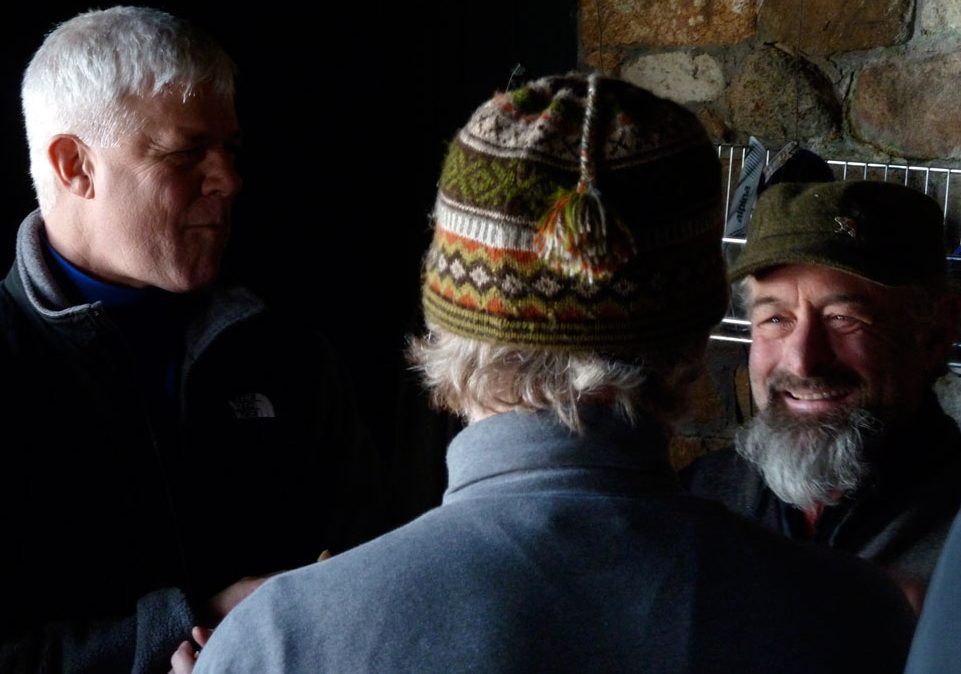
Michael Frenette, right, laughs while talking with Joe Martens, left, then commissioner of the state Department of Environmental Conservation, and another person during an open house at Camp Santanoni in Newcomb, which Frenette restored. (Enterprise photo — Peter Crowley)
“He’s known as the go-to-guy on log cabin restoration,” said Jennifer Bine, director of interpretation at Adirondack Experience. “He’s the authority on it, so that’s why he was brought in.”
“He’s an expert on historic structures,” said Laura Rice, Adirondack Experience’s chief curator. “Michael took the cabin apart, labeling each log so he’d know how they go back together.”
Even if he hadn’t labeled each log with a small circular metal tag, Frenette could probably piece the cabin back together through observation and memory.
“I’ve been working with logs so long, everything about them is a clue to me,” he said. From a line of creosote on one course of logs, Frenette can see how LaBastille’s porch was connected to the cabin. From healed slashes and abrasions in the wood, he can tell they were dragged through the forest with skidding cables. And from an eye-hook screwed in near the front door, he can see exactly where LaBastille hung her hammock.
“My mind is like a steel trap,” Frenette said. “Rusted shut.”
That rusty brain comes from years of experience, as well as life-threatening illness. At the age of 19, after suffering a grand mal seizure, Frenette was diagnosed with a meningioma. An early use of CT scan technology in Albany disclosed the tumor.
“The doctors told me I’d probably die,” Frenette said, “and if I lived, I’d probably be paralyzed.”
After successful brain surgery, the 20-year-old Frenette was back in Tupper and working on building a small cabin on his parents’ land near where he lives today.
“After surgery, I didn’t really want to be part of society,” he said. “My right arm was paralyzed, and I had a big scar on my head.”
To this day his right hand is still desensitized.
“Zippers scare the hell out of me,” he said.
Frenette’s love of the outdoors took him from stints working as a ranger at the Raquette Falls station and Lake Colden outpost to traveling the world to mountain climb. He’s visited New Zealand, China, Iceland, Pakistan, Egypt and Ecuador — to name just a few places — but it was a trip to Norway that may have had the most profound impact on the future direction of his life, and which, in many ways, led him to LaBastille’s cabin.
After years of building furniture, doing fine carpentry work and jacking up the occasional barn in New York’s North Country, Frenette was selected as the sole representative from the United States to attend an international course on wood restoration, held by the International Council of Monument Sites. Hundreds applied, and Frenette was chosen. He was joined by 17 other fellows from around the world.
“I never really had a purely preservation outlook until I went to Norway,” he said. “I bought into the whole preserving-historical-structures-for-their-value thing.”
When he returned from Norway, Steven Engelhart, executive director of Adirondack Architectural Heritage, reached out to him for help saving the run-down Camp Santanoni in Newcomb. For nearly 20 years now, Frenette has spent a good portion of the year living at Santanoni and working to restore and preserve it.
But LaBastille’s cabin is different for him.
“Santanoni was a static problem: It was there and needed to be brought to life,” he said. “This had a lot of challenges: Take it down in the winter; move it across the ice. This is a special project. Probably a bucket list.”
Though Frenette likes to present himself as an irascible loner, he has had to accept help in recent years following a stroke. His assistant, who he says is the only person crazy enough to work with him, is recent Paul Smith’s College graduate Chloe Mattilio.
“I was working for the Adirondack Watershed Institute, and this guy rolls up in a beat-up truck and asks if I want a coffee and a doughnut” she said. “I asked him if he knew of any part-time jobs, and he asked me if I wanted to help clean up this cabin on Twitchell Lake. I had no idea it was Anne LaBastille’s cabin.”
Frenette smiled: “So she went to a shack in the woods with me and no cell service.”
“With Michael, I’m never sure I should say I know him,” Mattilio said.
“I think I’ve gotten to the point where I’m infamous now,” Frenette added.
The Anne LaBastille cabin will open to the public on July 1, following a large private party on June 30 for members and donors.
Local News
SUNY chancellor talks Reconnect program at NCCC
North Country students attend women in law event
WCSC awards scholarships to locals
SARANAC LAKE — The Women’s College Scholarship Club is accepting applications for $3,000 scholarships which ...
ANCA’s 2026 Climate & Energy Conference gathers innovators and communities in Lake Placid

SL Civic Center receives Stewart’s Holiday Match grant support
Tupper Lake VFD, neighboring departments put mattress fire to bed
TUPPER LAKE — Quick action in the dead of night by Tupper Lake volunteer firefighters and several neighboring ...