Future of field pondered after iconic ‘red barn’ is torn down
-
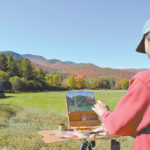
- John Abisch of Montreal paints the iconic “Red Barn” in Keene at the intersection of state Route 73 and 9N one last time in October, just two months before the state Department of Environmental Conservation took down the barn Dec. 20. (Enterprise photo — Antonio Olivero)
-
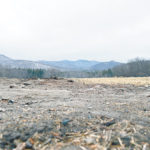
- The location in Keene were the iconic ‘Red Barn’ formerly stood until last week, as seen Tuesday. (Enterprise photo — Antonio Olivero)

John Abisch of Montreal paints the iconic “Red Barn” in Keene at the intersection of state Route 73 and 9N one last time in October, just two months before the state Department of Environmental Conservation took down the barn Dec. 20. (Enterprise photo — Antonio Olivero)
KEENE — Last Tuesday, just hours before the state Department of Environmental Conservation demolished the iconic ”Red Barn’ in Keene at the intersection of state Routes 73 and 9N, acting Keene Town Supervisor Paul Martin received a phone call from Bob Stegemann, DEC’s Region 5 director. It was the news many in the mountain town had been expecting for years: the barn was coming down.
To Martin and many in Keene, the demolition of the barn was warranted, as many realized keeping it upright was a liability to the state on a Forest Preserve land with a Wild Forest classification. The barn itself stood as a non-conforming structure under the Adirondack Park State Land Master Plan and as such, the DEC said, the barn could not be rebuilt.
Martin said there was some disappointment and sadness expressed throughout town at the decision, as he described the barn as a landmark as recognizable to some as the Holt House at Marcy Field.
“There was quite a lot of affection for the barn in the community by some people. They wanted it to be restored, but it was way too late for that,” Martin said. “It should have probably been removed 20 years ago. That was the reason it eventually deteriorated.”
For many in Keene like Martin, the barn represented a situation where the reason that drew people to the barn also was the reason why it had to come down. For years the barn, which was built in the early 1960s, was a favorite photography and painting spot for an endless amount of tourists traveling through Keene, some returning to the spot each year as a tradition.
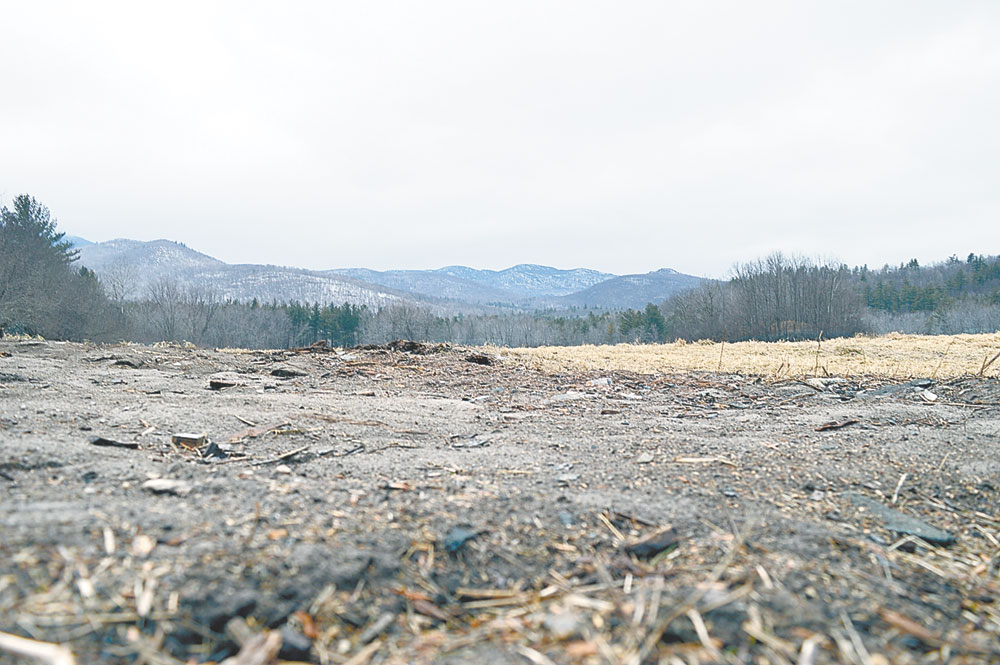
The location in Keene were the iconic ‘Red Barn’ formerly stood until last week, as seen Tuesday. (Enterprise photo — Antonio Olivero)
But in some cases, those same people also put themselves in dangerous positions for a photo of or within the deteriorating barn. In one case, Martin said he saw people enter the barn, scale its stairs and open a second floor door, sticking their heads out for a picture.
“And that’s exactly what the state was afraid of,” he said. “If it got a heavy snowfall on it and somebody had gone in and it collapsed, it would have been catastrophic.”
Carl Heilman was one photographer who took many photos of the barn, both from its exterior as well as inside. The Adirondack photographer said he had upwards of 100 unique photos of the barn and the vista provided by the field it sat on. The view showcases Blueberry, Porter and Cascade mountains, and the field was formerly privately owned by the Whitney family, who once had a small diner restaurant located on the field side of the junction.
“That’s why there used to be that really wide turnout, room for both a structure and parking,” said Tony Goodwin, the former historian for the town of Keene. “There was an eatery of some sort there.”
Heilman said he had photographed most everywhere in the barn: upstairs, in both rooms downstairs and shots of an elm tree out through the structure’s windows. Despite all his trips to the location, he said he believed many others probably took even more photos.
His last trip to photograph the barn was last January, when he went to the second floor of the barn, an example he said as to why the state demolished the structure. But he said he noticed someone had reinforced the rafters on the second floor, which he described as “quite sturdy.”
“Really there was only one corner where it was going down,” Heilman said. “The roof itself was nice and in tact. I didn’t hesitate to go upstairs.
“Somebody had taken where the rafters come down and sit on a sill, somebody had taken extra two-by-four and 2-by-6, and kind of pegged them into floor and pinned them into rafters at right angles, so the rafters would not sink into the floor. It held roof intact on that side even though the shingles and the boards were rotted out.”
Although many tourists loved the barn, they did not know the relatively short history of the structure relative to other similar barns in the area. Goodwin, a Keene resident for 40 years, said it was on land that at that time was already owned by the state. The intention for the barn, he said, was to have a structure where the state could continue to allow the harvesting of hay on the field in order to keep it an open space.
“There was never any written agreement because once it became state land it became Forest Preserve and something not supposed to be managed as farm land,” Goodwin said. “But because of its history and because of the popular sentiment, the state continued to allow haying to continue on that land for many years after the state acquisition.”
The field it sat on may have been similar to other barns in Keene that housed similar barns going back more than a century but, Martin said, the ‘Red Barn,’ was much younger.
“This was a new one but it had an amazing following because of its location,” Martin said.
Goodwin said in the 1980s the hay crop on the field began to thin out as a result of the state applying less fertilizer on the land and weeds encroached The state was not interested in tilling the field, fertilizing and replanting, Goodwin said.
“That’s when the really intensive haying ended,” he said.
In recent years, both the town and the state have mowed the field several times, Goodwin said, including once last summer. But some in Keene are worried not enough of the original field’s area is being mowed and not frequently enough, threatening one of the state’s great vistas.
Goodwin said 70 to 80 percent of the field has not grown in enough to threaten the open space aspect of the property, though he estimated only 10 percent of the land was mowed last summer.
“Part of the problem was the right side of that field became flooded by beavers,” he added. “It used to be it went much beyond what was currently mowed as of last summer. I don’t know how many acres that field once was, but I would suspect that it was several hundred acres.”
Vinny McClelland, the owner of The Mountaineer in Keene Valley, said he is concerned about losing the vista. The longtime area resident said he felt the barn was in bad shape and needed to come down, though his bigger issue was hoping the state continues to clear the field.
As for his memories of the barn, he described it as a curiosity as a child growing up. He never entered or used the structure, though he bird hunted on the property.
“There were huge flocks of geese that used to settle in there,” McClelland said. “It was just spectacular.
“Times change,” he added. “It’s too bad because (the barn) was pretty. It certainly added character to the view, but personally I’m not that upset. But I will be upset if they don’t get after that field.”
Local News
Tupper Lake VFD, neighboring departments put mattress fire to bed
TUPPER LAKE — Quick action in the dead of night by Tupper Lake volunteer firefighters and several neighboring ...
Work underway for fifth ‘Bigrow Show’ at Tupper Arts
At Whiteface, the show goes on

Maple magic

Epstein, Iran and ICE top concerns at Saturday’s ‘No Kings’ rally in Saranac Lake