
Remembering Brother Yusuf
There are those who walk this earth with purpose, but it doesn’t always begin that way.
Brother Yusuf Abdul-Wasi found his purpose in the unlikeliest of circumstances, and he wanted to share it with the world.
It was nature that moved him, and nature that made a difference in his life. It pulled him from the troubles he faced as a young adult, and he used it to change lives.
Yusuf had a gentle way, which he used to build a legacy of taking kids out of the inner city and introducing them to the outdoors. He loved the Adirondacks. He loved helping kids. And he loved his wife, Cherrie Burgess.
Yusuf died unexpectedly Dec. 5. He was 64 years old.
“Leading up to his death, he wasn’t feeling too good one day, and I cupped his face in my hands and I told him, ‘You know what? We’ve been married for 45 years and I still don’t want anybody else in my life but you. Even with your faults and your positiveness, I don’t want anybody else,'” Cherrie said. “And he looked up at me and said, ‘You know what, Cherrie? I love you, too.'”
Cherrie’s husband was born Joseph Burgess. He later changed his name to Brother Yusuf Abdul-Wasi, after he converted to Islam.
Things weren’t always congenial between Cherrie and Yusuf. Cherrie’s family moved to Long Island’s Hempstead neighborhood from North Carolina the same week Yusuf’s family moved there from Brooklyn.
The couple met in school when they were 11 years old.
“He used to pull my hair, and I couldn’t stand him because I was still playing with dolls,” Cherrie said with a warm laugh. “Then one day, my older sister kept seeing him walking behind me in school, so she pulled him over and said, ‘So, you like my sister?’ He smiled and said yes, and that’s how I met him.”
Wedding bells might not have seemed obvious at the time, but Yusuf was a different kind of boy and Cherrie was beginning to see that. For one thing, he didn’t have the interest in sports that his five brothers had. Instead, he considered himself a “closet environmentalist,” which meant that instead of hitting the court, he headed into nature.
One of Yusuf’s favorite places to go was nearby Hempstead Lake Reservoir, especially when he cut class.
“When he started showing that he liked nature, it wasn’t a surprise to me because every summer I was sent to my grandfather’s farm, and we fished and we grew our own vegetables, and things like that,” Cherrie said. “When Yusuf started growing things, he would get joy out of watching things grow out of the earth, from a seed to a fruit. He was so happy to see that, and I would just smile to myself because I grew up with that.”
Cherrie said Yusuf didn’t have a close relationship with his father, and as a result, he entered the military during his senior year of high school and was quickly sent to Vietnam to work as a radio communicator. He was only 17 years old.
“He witnessed a lot of things over there, and he got introduced to drugs,” Cherrie said. “When he came home from the service, he was addicted to drugs. They train you to kill, and you’re over there in this country killing people, and you come back home and the services are not there.”
Yusuf was 19 when he came home, and he began stealing to support his habit. He was eventually arrested and sent to the now-closed Camp Gabriels in the town of Brighton.
While there, Yusuf and other inmates were taken outside of the prison to clean up debris. That was Yusuf’s introduction to the region, and he later said being in the Adirondacks kept him sane while he was incarcerated.
The bad things didn’t matter to Cherrie, who refused to let Yusuf’s actions define him.
“I stayed with him because I was his friend,” Cherrie said. “I saw something in him that outweighed the negative aspects of his life. I knew deep down that he was a good person, and I felt that he had made a mistake. I loved him.”
When one of Yusuf’s counselors prescribed kayaking as a way to cope with the post-traumatic stress he suffered from Vietnam, he and Cherrie began kayaking together every weekend. Eventually, she bought him one for Father’s Day.
Yusuf kept that kayak on top of his car, and wherever he traveled, whether for business or pleasure, he would find a place to use it. But that wasn’t all.
It turned out that Yusuf didn’t want to let the actions of his past define him, either.
It started while Yusuf worked as a gang prevention specialist at the Boys & Girls Club in Albany. He began recruiting young people in nearby urban areas to join him on adventures that included hiking, kayaking and skiing.
From there, Yusuf’s involvement with getting youth outside and helping people branched out in countless directions. During his life, he gave presentations all over the world, co-founded a re-entry program for people who have been incarcerated called ROOTS, worked in the Diversity Department of the state Department of Environmental Conservation, and founded and served as the executive director of the Youth Ed-Venture & Nature Network program.
Jen Kretser, director of programs for The Wild Center, said she met Yusuf at an environmental education conference in Vermont about a dozen years ago. She was the education director for the DEC at the time.
Kretser described Yusuf as a magnetic presence that embodied kindness, humor and authenticity. She saw those traits come through when he spoke, and she saw how children reacted to him while hiking to the summits of mountains like Cascade, Mount Jo and Mount Van Hoevenberg.
“He really felt the power of nature as a way to connect to something larger than yourself, but to also connect with yourself, with others, and with something really positive,” Kretser said. “He just thought there was so much in that connection piece – the camaraderie of having an experience together, the personal growth, the challenge, and setting a goal and accomplishing it. The kids he worked with saw that, too.”
A lot of those kids had never been in the woods, let alone on top of a mountain.
Kretser said Yusuf didn’t leave his work on the trail, either. He was involved with The Wild Center’s annual Youth Climate Summit, started a community garden in Albany, got kids to visit DEC camps and helped get scholarships in place. The man was simply indefatigable.
“He’s going to be so missed,” Kretser said. “I’m going to miss hearing his voice, and talking with him about all of these big ideas. He made so many tireless efforts to connect youth to the outdoors. He was just amazing.”
Cheryl Charles met Yusuf at a May 2007 conference in Lake Placid that honored the 100th birthday of environmentalist Rachel Carson. They were both keynote speakers.
Charles, who is the CEO emeritus, co-founder and former president of the Children & Nature Network, was immediately impressed by the way Yusuf focused on the children he brought to the event. During the presentation, the kids showed pictures they took in the Adirondacks, which captured the effects of climate change.
In fall 2007, Yusuf was offered a spot on the board of directors of the Children & Nature Network, which he accepted.
“The Network is now building a worldwide movement to reconnect children to nature because the fact is, kids’ disconnect is really a problem all over the world,” Charles said. “He was an important part of that, not just our work locally, but internationally as well.”
Richard Louv, an author who is involved in the Children & Nature Network, met Yusuf around the time he joined the C&NN board of directors. Louv is perhaps most well-known for his book “Last Child in the Woods: Saving Our Children From Nature-Deficit Disorder.”
Like Kretser and Charles, Louv said he was immediately struck by the hope Yusuf instilled upon children.
“They just loved him,” Louv said. “If there is a heaven, I saw it in their eyes when they looked at him.”
Louv loved hanging out with Yusuf, and he recalled introducing him to fly fishing.
Louv said the first time Yusuf caught a fish was in the Pecos River in New Mexico, and as soon as he pulled it from the water, he immediately began celebrating the “trout” he had hooked.
“I didn’t have the heart to tell him it wasn’t a trout; it was a bottom feeder,” Louv said with a laugh. “After that, he ended up taking inner city kids from Albany fly fishing. That became part of the whole trip.”
Yusuf found ways to make those trips happen. He secured the equipment and the transportation, and he went directly to each kid’s home to get permission slips signed if he needed to.
He didn’t want anyone left behind, and he really didn’t want them left inside.
Yusuf also wanted people to understand the North Country’s place in the history of civil rights.
Martha Swan, director of John Brown Lives, met Yusuf in 2000, when he brought a group of kids up from Albany to attend a reading of Frederick Douglas’ posthumous tribute to John Brown.
“There was this slew of kids sitting on the floor of this church, kind of wide-eyed, listening to this tribute,” Swan said.
Yusuf and Swan began working on projects together, including ones that dealt with racial justice issues. Most notably, he helped with the Timbuktu Project, which raised awareness about a black, 120,000-acre settlement that was created in the Adirondacks in the 1840s to make African Americans eligible to vote.
Under the law at that time, only people who could meet a $250 property requirement could vote.
“Over time, he and I got talking about how we were going to approach the elephant in the room of mass incarceration, the gross preponderance of African American men who are basically out of sight, out of mind, but here, in the prisons,” Swan said. “We ended up developing a project, and we’re still doing it, through conversation and looking at history.”
Yusuf also returned to the Adirondacks to speak about his own time incarcerated here. It was not something he was ashamed of. On the contrary, it was a story he seemed to embrace as an example of how lives can change.
Swan said John Brown Lives is actively looking for ways to continue Yusuf’s work, not only concerning racial justice issues, but in getting more kids to enjoy the outdoors. In that sense, Swan said his legacy will live on.
But if you talk to Louv, he’ll tell you Yusuf is never far away.
“Brother Yusuf’s death is different in the sense that, I’ve had good friends die, and when they’re gone, most of them are gone,” Louv said. “It’s not that I forget them, I just can’t really sense their presence. Brother Yusuf, he’s not gone. He’s out there, smiling somewhere, and he’s very busy.”
Local News
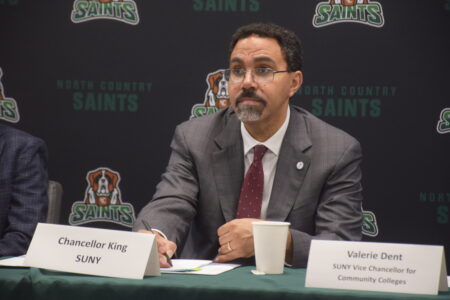
SUNY chancellor talks Reconnect program at NCCC
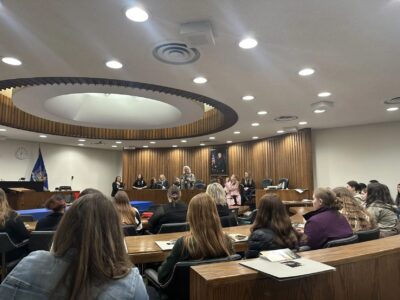
North Country students attend women in law event
WCSC awards scholarships to locals
SARANAC LAKE — The Women’s College Scholarship Club is accepting applications for $3,000 scholarships which ...
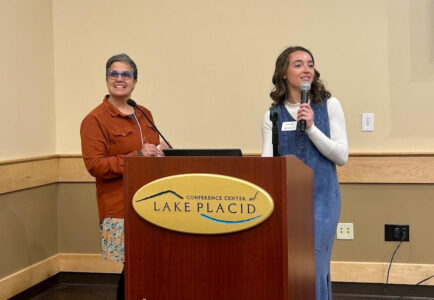
ANCA’s 2026 Climate & Energy Conference gathers innovators and communities in Lake Placid

SL Civic Center receives Stewart’s Holiday Match grant support
Tupper Lake VFD, neighboring departments put mattress fire to bed
TUPPER LAKE — Quick action in the dead of night by Tupper Lake volunteer firefighters and several neighboring ...