
Hochul stays mum on sanctuary bill
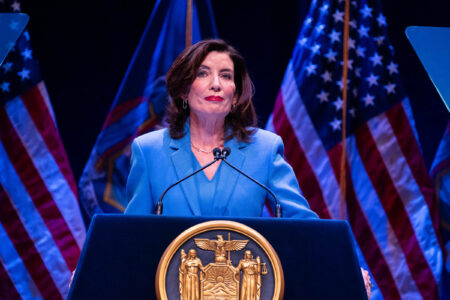
“We will not allow the use of state resources to assist in federal immigration raids,” Gov. Kathy Hochul declared halfway through her 2026 State of the State address, bringing an auditorium of lawmakers to their feet for two consecutive standing ovations.
Her statement came after she decried an ICE officer’s fatal shooting of Renee Good in Minneapolis last week, describing it as an immigration operation “that never should have been there.” Shortly after Hochul’s address, President Donald Trump announced his plans to cut federal funding to what it considers sanctuary jurisdictions, including New York state.
Advocates and some lawmakers welcomed a ban on putting state resources toward federal immigration enforcement, but said that Hochul’s proposal — which places restrictions on the use of state funding, but wouldn’t necessarily restrict local agencies using their own funding to collaborate with federal operations — would barely strengthen existing restrictions.
Jackie Bray, commissioner of New York’s Division of Homeland Security and Emergency Services, told New York Focus that the policy wouldn’t ban local law enforcement from working with federal agents simply because they receive state money, but it would prohibit them from putting any of their state dollars toward federal immigration enforcement. “This is about funding streams,” said Bray, who is charged with strategizing New York’s response to the potential deployment of federal agents and National Guard troops.
Hochul stayed mum on immigration advocates’ top priority: the New York For All Act, a broad sanctuary bill that would prohibit local law enforcement from collaborating with ICE. The bill gained momentum in the legislature in the past week after vocal support from Senate Majority Leader Andrea Stewart-Cousins and amid a public outcry over the Minneapolis shooting. The legislation would also prohibit state and local law enforcement agencies from sharing sensitive data or using state or local funds to assist federal immigration enforcement efforts. It would invalidate more than a dozen 287(g) agreements across the state that currently deputize local law enforcement officers to assist with federal immigration enforcement.
Linda Flor Brito, senior policy and campaigns organizer with the Immigrant Defense Project, wrote in a statement, “The Governor touted aging Executive Orders which are limited in scope and woefully behind the due process protections most other ‘Blue States’ have already adopted,” referring to state sanctuary laws in California, Washington, Oregon and others.
Hochul’s agenda included a policy that would protect certain “sensitive locations,” such as houses of worship, schools and hospitals, from civil immigration enforcement, protections which used to exist at the federal level and were repealed by the Trump administration in January 2025.
Hochul also proposed a policy that would allow New Yorkers to bring state-level civil actions against federal officers for violating their constitutional rights. Bray said that she anticipated that those civil suits would be challenged by Trump, but added, “We’ve been suing the Trump administration for months, and, frankly, winning.” (State Senator Zellnor Myrie sponsors similar legislation.) When pressed on why the governor did not come out in favor of New York For All, Bray voiced a concern about state overreach.
“We’re going to have conversations about how we best protect our immigrant New Yorkers and still also respect local control and local agencies’ right to have control over what they’re doing in their communities,” she said.
Hochul also did not voice support for the Dignity Not Detention Act, another major legislative priority for immigrant rights groups that would prohibit state and local entities from operating immigration detention facilities or entering into immigration detention contracts. Nor did she back a bundle of legislation that would fund the rollout of a right to counsel in immigration courts.
New York news
Hochul stays mum on sanctuary bill
“We will not allow the use of state resources to assist in federal immigration raids,” Gov. Kathy Hochul ...
Child care promises leave funding questions open
After pledging last year to put New York state “on a pathway” to universal child care, Gov. Kathy Hochul used ...
Hochul stands by her plan to avoid tax hikes
Gov. Kathy Hochul has been clear that she doesn’t want to raise taxes this year. “We’ve managed our money ...
Prosecutor urges manslaughter verdict for former Marcy CO
UTICA — A New York prison guard who failed to intervene as he watched an inmate being beaten to death should be ...
Affordability still top of mind for Hochul in 2026 State of the State
DEC summer camp registration opens in March
ALBANY — New York State Department of Environmental Conservation Commissioner Amanda Lefton recently announced ...