
Hochul stands by her plan to avoid tax hikes
A boom year on Wall Street may help offset federal cuts — for now
Gov. Kathy Hochul has been clear that she doesn’t want to raise taxes this year.
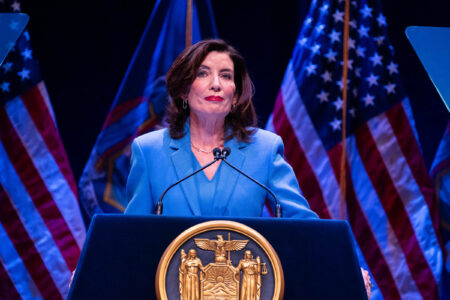
“We’ve managed our money responsibly,” Hochul said during her State of the State address on Tuesday. “And that means we can make transformative investments in our future without raising taxes, without saddling the next generation with mountains of debt.”
But can that plan survive massive cuts by the Trump administration?
Kathryn Wylde, president of the leading business group Partnership for New York City, said that based on her discussions with the governor, she expects that much will depend on whether the Trump administration fully implements multibillion-dollar cuts to state health care funding.
“If the federal government does not provide some relief on Medicaid and health insurance, if they don’t roll some of those cuts back, we could find a situation where millions of New Yorkers lose their health care,” Wylde said. “In talking with [the governor’s office],” she added, “they know the state cannot afford long-term entitlement commitments. But can they bridge immediate federal cuts that would have a devastating impact on many New York families?”
“They’re looking at it in terms of a potential short-term crisis that they’d have to deal with, which is the smart way,” Wylde said. “And I don’t think the business community has any choice but to support that kind of practical approach.”
A boom year on Wall Street generated billions more in tax revenue than expected, helping drive New York’s reserves to a record high. If tax receipts continue to exceed forecasts, the Hochul administration may be able to offset the federal cuts with existing funds, Wylde said. If revenues don’t climb and federal cuts remain deep, a short-term corporate tax increase — which Hochul was reportedly considering late last year — could be on the table.
This comes as Hochul has proposed a phased-in statewide universal child care program that will cost billions of dollars annually. Hochul says the state knows how it will fund the expansion for two years, but it’s unclear how it will be paid for after that.
Hochul’s pledge to fund the program will help New York City’s new mayor, Zohran Mamdani, deliver on a major campaign promise. Yet in remarks to reporters following Hochul’s speech, Mamdani continued to stress that he is seeking to pay for his full agenda by raising taxes on the state’s wealthiest, including “New York’s most profitable corporations.”
Raising taxes could be a significant point of contention during this year’s budget negotiations — and Democrats who control the Senate and Assembly have consistently backed the idea of raising further revenue from New York’s wealthiest.
Jasmine Gripper, co-director of the left-wing New York Working Families Party, says that for the child care program to be truly universal and sustainable, it will need dedicated revenue from a tax increase.
“To make a two-year commitment with no plans afterwards,” Gripper said, prompts the question: “Is this a true commitment, or is she just trying to get through the election cycle and then going to drop off and leave families hanging?”
Gripper tried to preempt fears of tax flight. “The beautiful thing about the corporate tax, the way it’s structured, is that businesses can’t leave New York to avoid it,” she said. “It doesn’t matter where your headquarters are if you’re doing business in New York.”
But state budget director Blake Washington told New York Focus that with higher-than-expected Wall Street revenues and rainy day funds available, now is not the time to seek a tax increase — even if there is ambiguity about the child care program’s long-term funding.
“Any investment the state ever does, from $1 to $1 billion, carries inherent risk — some things that we know about and some things that are outside of our control,” Washington said. “There are a whole bunch of advocacy groups I’m aware of that are for increasing taxes. It’s not necessarily [a position] that the governor shares. We want to ask for dollars when we need them the most. Right now, we don’t need extra dollars from the state taxpayer.”
Hochul said last week that targeted savings within state agency budgets would also help pay for the child care initiative. Washington indicated that these generally were reductions in agency spending, not cuts.
Andrew Rein, president of the fiscally conservative Citizens Budget Commission, has proposed finding savings within the state budget to fund Hochul’s affordability agenda, including by eliminating school aid increases in districts with declining enrollment, which would save $500 million, redirecting $2.5 billion given to the wealthiest school districts, and curbing economic development subsidies like the film tax credit.
“It’s about making those smart choices,” Rein said, “even when they’re hard.”
Washington said he doesn’t expect those provisions to be included in the budget, and that the state was “not removing tax credits that are assured to certain industries.”
Hochul’s State of the State briefing book did contain several smaller-scale tax proposals. They included a major expansion of the Empire State Child Credit, an elimination of state income taxes on up to $25,000 of tipped worker income, a sales tax exemption for electricity sold at commercial electric vehicle charging stations, and the extension of refundable investment tax credits for dairy farmers.
New York news
Hochul stays mum on sanctuary bill
“We will not allow the use of state resources to assist in federal immigration raids,” Gov. Kathy Hochul ...
Child care promises leave funding questions open
After pledging last year to put New York state “on a pathway” to universal child care, Gov. Kathy Hochul used ...
Hochul stands by her plan to avoid tax hikes
Gov. Kathy Hochul has been clear that she doesn’t want to raise taxes this year. “We’ve managed our money ...
Prosecutor urges manslaughter verdict for former Marcy CO
UTICA — A New York prison guard who failed to intervene as he watched an inmate being beaten to death should be ...
Affordability still top of mind for Hochul in 2026 State of the State
DEC summer camp registration opens in March
ALBANY — New York State Department of Environmental Conservation Commissioner Amanda Lefton recently announced ...