Labor Gap, part 2: School counselors focus on college readiness
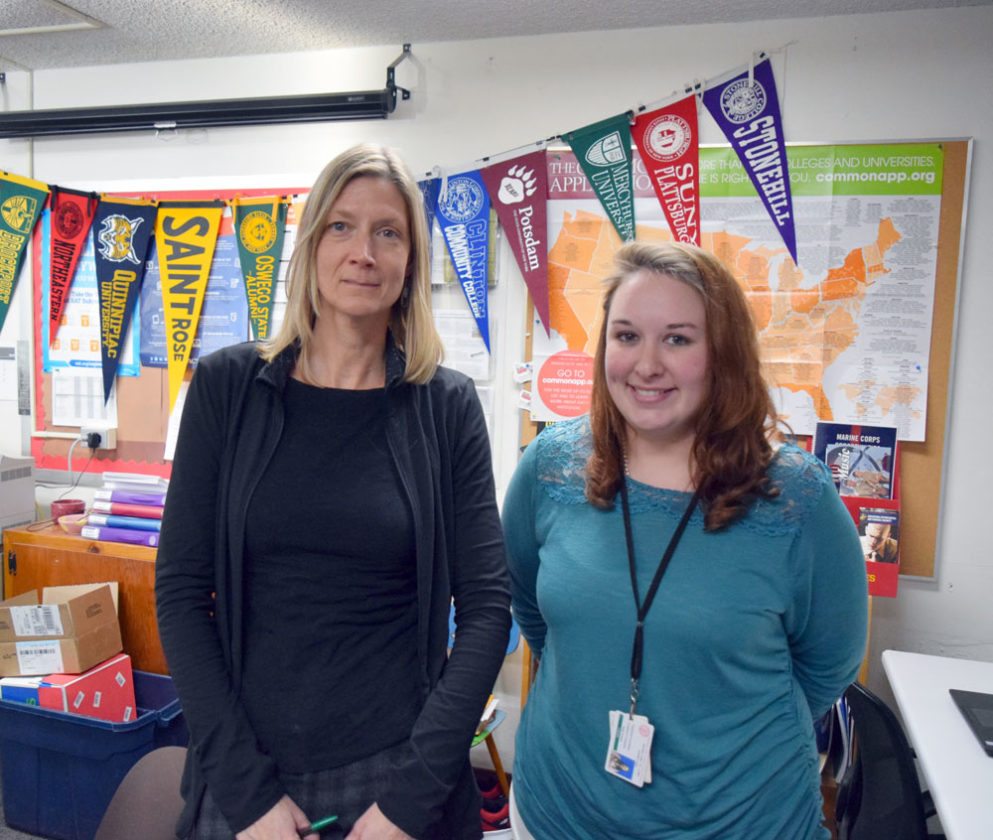
Saranac Lake High School counselors Christina Bell and Stephanie Bluestein help students with college applications as well as getting through the social thickets of high school. (Enterprise photo — Glynis Hart)
(The Enterprise is publishing a series of articles about employers finding workers to be in short supply these days.)
—
SARANAC LAKE — How ready are graduating seniors for the world of work? At Saranac Lake High School, school counselors Christine Bell and Stephanie Bluestein do their best to help students find out what they want to do.
Career counseling is only part of their job. From day to day, they help students with their social problems, relationships with parents and teachers and adding and dropping classes. They give referrals to mental health providers, mediate conflicts between students and teachers, and deal with substance abuse issues. Students who are failing a class or being bullied, have disabilities or low self-esteem find their way to the school counselors’ offices.
“Our main domain is personal and social counseling,” said Bell. Most school counselors have a four-year degree in psychology or human services, and a master’s in school counseling. “We learn skills to help students when they’re in a crisis.”
To help students find a career path, they start young. “We start them in middle school,” said Bluestein. “We do an interest inventory, using the Naviance program.”
Naviance, marketed by Hobson International, provides interest assessment tools to help school districts “align student strengths and interests to post-secondary goals,” according to its website. Bluestein said it surveys the students’ interests and suggests jobs based on those interests, as well as assisting them with resume-building and searching for the right college.
As the school year goes through, the counselors shepherd students through all the requirements needed for graduation and college applications.
“Testing is a reality,” said Bell. “AP exams, SATs — regardless of how anyone feels about them, it’s a big deal.
“My biggest job is getting them to get their requirements finished,” said Bluestein. “It’s pretty predictable — we’re on a timeline. We’re trying to help freshmen adjust, then we’re right into college applications.”
The counselors host a Parent Night in the spring to guide parents through the college application process.
The Adirondack Educational Center offers another path to the world of work. In 10th grade, students get a tour of the BOCES facility and learn about the vocational classes there, which culminate in certifications required for jobs such as cosmetology, auto mechanics and building trades.
Students go to AEC for half a day and take classes in the high school the rest of the day.
“We have a good amount of our students go to AEC and still come out with an advanced Regents diploma,” said Bluestein. “I think it’s a good thing they’re getting a trade. They can cut hair while they’re going to college for business.”
“Colleges really like the CTE [Career and Technical Education] diploma,” added Bell.
What if students don’t think college is for them? “We have some students who feel they aren’t ready,” said Bluestein. “They have the option to stay here [in Saranac Lake] and build a foundation — we have a good group of schools, like North Country Community College, that are close.”
Students also hear from military recruiters several times a year, who set up a table by the cafeteria, and ROTC, which can assist college-bound seniors who commit to military service. All branches of the military make occasional visits to the high school for recruiting events.
Students can also learn about the job market by holding part-time jobs and helping community groups. “We just had a blood drive the students helped with,” said Bluestein.
As part of the students school-to-career path, the counselors see themselves helping students choose what’s right for them. They sometimes have employment agencies come talk to the students about jobs, “but that’s a specific skill set,” said Bluestein.
Pressed as to whether any students were involved in apprenticeships, Bluestein said they have one this year.
“I think we do a pretty good job giving the kids options to do whatever they need to do to be successful,” said Bluestein.
“There are students who are academically motivated from day one,” said Bell. “New York state’s pretty tough [for graduation requirements]. They expect a lot — if a student wants to go to college, you want to try to make that happen.”
Local News
Improv, irony and accents
Letting it all out
SARANAC LAKE — AI music videos; personal attacks; allegations of propaganda, misinformation and secrecy; ...

North Country New Year celebration returns on NYE
ACF accepting grant applications, support for Generous Acts
LAKE PLACID — Community organizations are encouraged to submit grant applications to Adirondack Community ...

Lake Placid native’s jersey retired at SUNY Oswego