Patching the cracks
Old plumbing pipes, cafeteria floors slated for replacement at Tupper Middle-High school
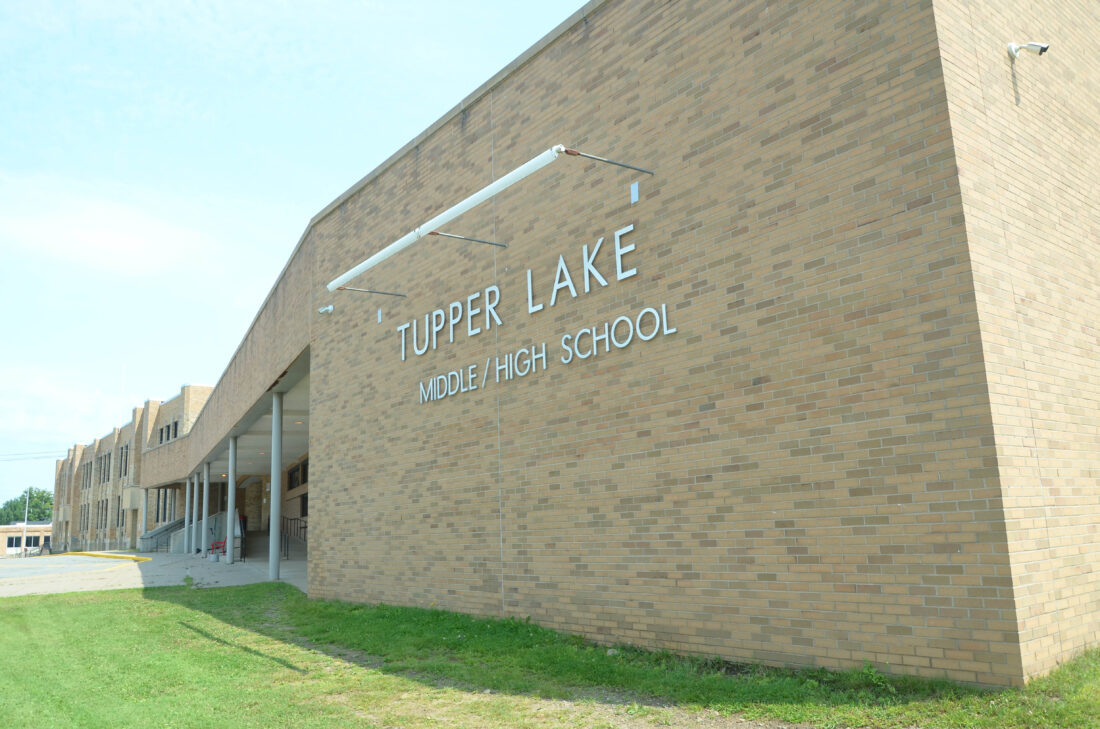
The Tupper Lake Middle-High School is seen in August 2024. (Enterprise photo — Aaron Marbone)
TUPPER LAKE — The Tupper Lake Central School District is targeting old lead pipes and a busted cafeteria floor, both at the middle-high school, for its upcoming capital outlay project.
The district’s board of education approved a resolution at its Dec. 1 meeting to move forward with the set of projects, although the scope of work won’t be finalized until bids come in, as the cost is capped. The vote was 4-0, with board member Josh Tremblay absent from the meeting.
Capital outlay projects are similar to capital improvement projects in that they both focus on school infrastructure upgrades, though outlay projects tend to be considerably smaller in scale. Unlike capital improvement projects, these don’t require a separate voter approval, but are incorporated in school districts’ annual budgets.
The projects are essentially a state-incentivized way for school districts to keep their buildings up to snuff. That’s because districts receive hefty reimbursements for these projects — as long as they fall within the $100,000 cost cap — in state aid the following year.
The exact amount is determined through a complex formula that takes into account project specifics and the district’s socioeconomic factors. TLCSD Superintendent Jaycee Welsh said the final reimbursement figure for this project will fall between 75% and 80%. It was 79% last year.
“Most school districts do one a year because you spend $100,000 and you get upwards of $70,000 back,” she said.
Welsh noted that districts are somewhat constrained with capital outlay projects, since the reimbursement cap hasn’t been raised to keep pace with inflation in recent years. There’s no state reimbursement for any costs that exceed the cap.
“It’s a grossly outdated cap,” she said. “That $100,000 has been around forever. School districts have lobbied for years for that to be a higher number.”
Since the school board has approved the project, it will now head to the state education department. Welsh said the state typically doesn’t take too long to approve these, since they are relatively minor in scope. She was hopeful that requests for proposals could go out over the winter, and work could be refined by and begin in the spring.
Given the cap, Welsh said the district officials will do everything in their power to make sure the outlay project nets the most “bang for its buck.” She said it’s helpful that a larger capital improvement project is occurring there simultaneously, as some costs can be piggybacked.
“We’re very lucky,” Welsh said. “Some of the contractors that are already here, specifically our plumbing contractor, are just ideal.”
Welsh said the projects were identified from a building condition survey that was done several years ago, but still includes priorities that haven’t yet been attended to.
“We try to find areas that were of the biggest concern, but we weren’t able to put them into our capital project,” she said. “That’s how most school districts chip away at their capital outlays.”
She said the lead continues to be a concern, and while the district has taken measures to ensure that all sources of drinking water are safe, there are many sinks and other water outlets that are served by older lead pipes that cannot be used at the moment. Welsh said the goal is to make sure that every sink in the building is eventually safe enough to be turned back on.
She said the school’s architects will determine, based on bids, which pipes will be prioritized for replacement in this project, considering both the cost and the beneficial impact that getting a particular sink back online would make for the school community.
The cafeteria floor is a priority because it’s too cracked in spots at the moment for the school to effectively use its movable dividing wall, should it ever want to put on multiple functions at once in that space.
Welsh said this capital outlay project is focused entirely on the middle-high school because the district has already spent its maximum allowable spending outlay at L.P. Quinn Elementary School for this cycle, which is between three and five years, meaning that any additional spending there would not receive state reimbursement.
This was largely a result of athletic field improvements, which count toward the elementary school — even as they are used by students in all grade levels — as they are within the elementary school’s property bounds.
Local News

A community’s generosity
Patching the cracks
APA’s top lawyer leaves as howitzer hearing looms
Report details accessibility of Adirondack trails
KEENE — A new report from the Adirondack Land Trust, “Ground Truthing Accessible Wildland Trails Across the ...
ACW to present Queer Lit Night at Hex and Hop Brewing
SARANAC LAKE — The Adirondack Center for Writing will host a Queer Lit Night at Hex and Hop Brewing in ...