Lake Placid native’s jersey retired at SUNY Oswego
-
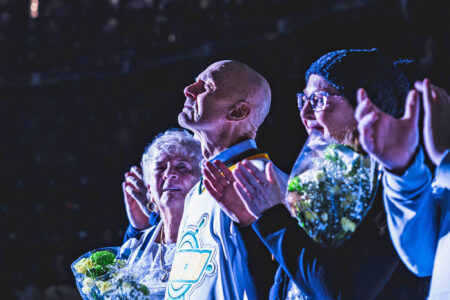
- Pete Sears gets emotional as he watches his jersey get raised to the rafters ahead of a home SUNY Oswego men’s hockey game on Nov. 15 against Skidmore. (Provided photo — Carolyn Sculco/SUNY Oswego)
-
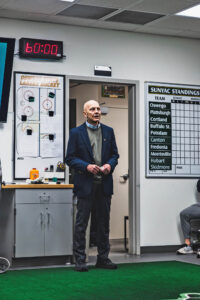
- Pete Sears talks to the SUNY Oswego men’s hockey team ahead of a home game on Nov. 15 against Skidmore. (Provided photo — Carolyn Sculco/SUNY Oswego)
-
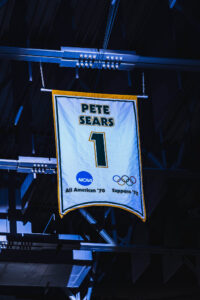
- Pete Sears’ No. 1 jersey is raised to the rafters ahead of a home SUNY Oswego men’s hockey game on Nov. 15 against Skidmore. (Provided photo — Carolyn Sculco/SUNY Oswego)
-
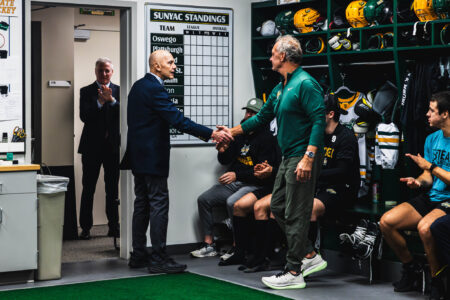
- Pete Sears, left, shakes long-time SUNY Oswego men’s hockey coach Ed Gosek’s hand ahead of a home game on Nov. 15 against Skidmore. (Provided photo — Carolyn Sculco/SUNY Oswego)
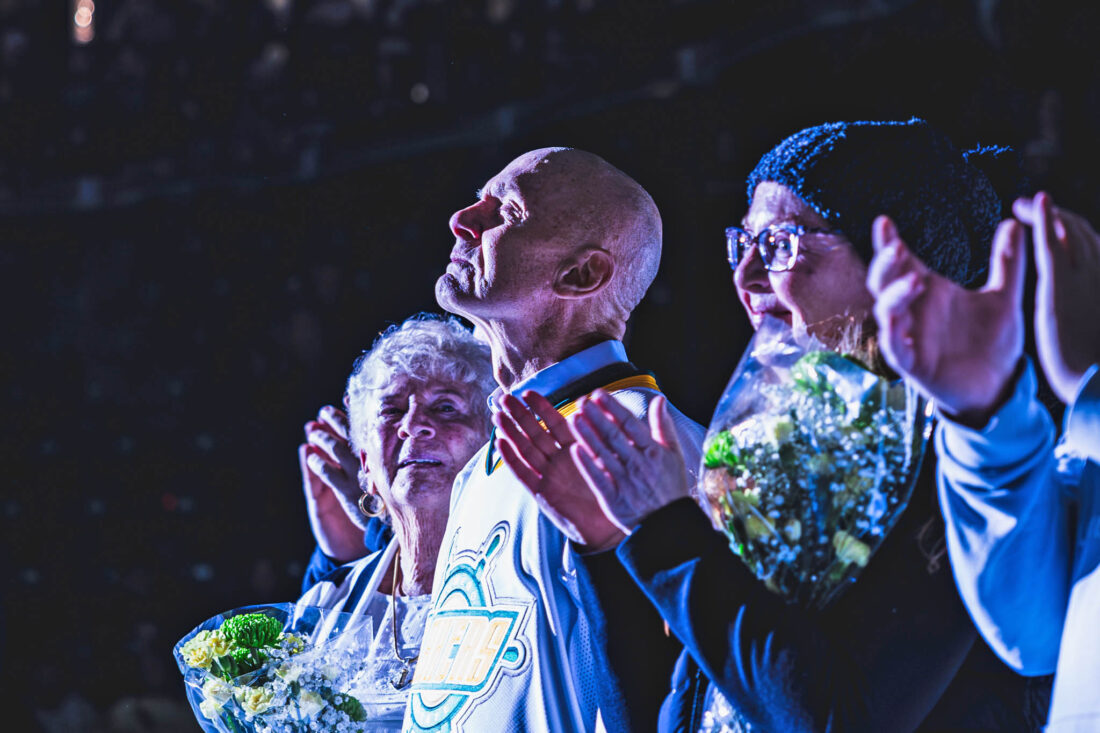
Pete Sears gets emotional as he watches his jersey get raised to the rafters ahead of a home SUNY Oswego men’s hockey game on Nov. 15 against Skidmore. (Provided photo — Carolyn Sculco/SUNY Oswego)
LAKE PLACID — The SUNY Oswego men’s hockey program has had hundreds of men’s hockey players in its more than 60 years of existence. But there’s only one player whose jersey hangs from the rafters.
During an Oswego State men’s hockey game on Nov. 15 against Skidmore College, Pete Sears, who grew up in Lake Placid, had his No. 1 SUNY Oswego jersey raised to the rafters of the Deborah F. Stanley Arena.
The now-78-year-old stood by his wife and other family members as his jersey was unveiled. The moment was a bit overwhelming.
“When they brought the jersey down from the rafters there and hung it in the rink,” Sears said, “it brought a few tears to my eyes and a lot of memories that I went through.”
The Lake Placid native and now-long-time resident of Oswego was a standout goaltender while at the college. Sears also won a silver medal at the 1972 Olympic Winter Games and spent decades at Oswego State, helping coach in various roles while contributing to the college’s growth of the men’s powerhouse hockey program.
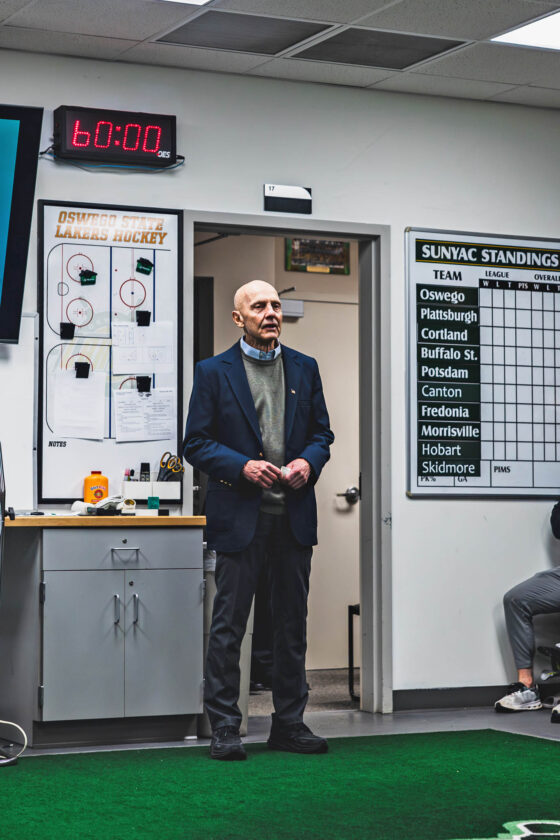
Pete Sears talks to the SUNY Oswego men’s hockey team ahead of a home game on Nov. 15 against Skidmore. (Provided photo — Carolyn Sculco/SUNY Oswego)
While SUNY Oswego has a rich history of hockey, Sears stands alone as the only player ever to have their jersey retired.
“When talk of retiring numbers of past Lakers legends began, there was only one name that was discussed about who should be first — Pete Sears,” long-time SUNY Oswego men’s hockey head coach Ed Gosek said in a statement. “In the history of the program, we’ve had lots of great players, but none have been greater than Pete. He and his wife Kay have been shining examples, mentors and friends to countless members of the Oswego community for more than 50 years, myself included.”
–
Lake Placid
–
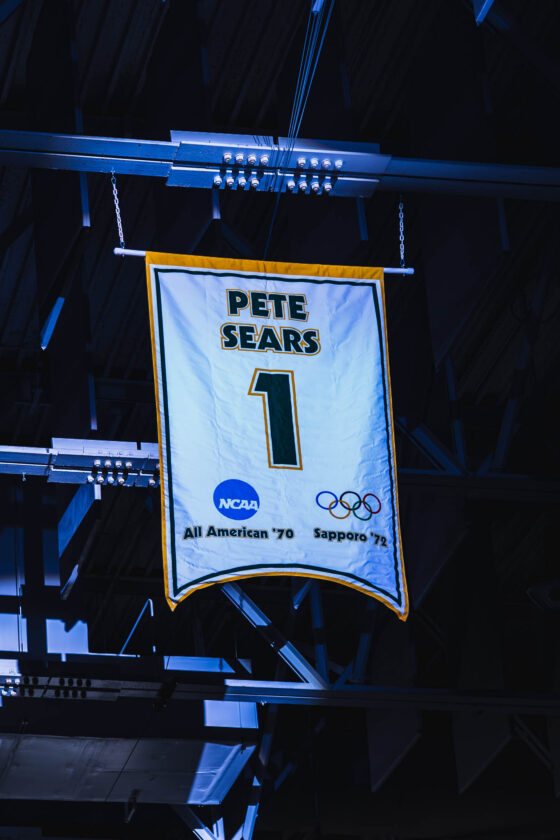
Pete Sears’ No. 1 jersey is raised to the rafters ahead of a home SUNY Oswego men’s hockey game on Nov. 15 against Skidmore. (Provided photo — Carolyn Sculco/SUNY Oswego)
Some of Sears’ earliest memories of hockey came when he was around 7 years old. Back then, he and other local youngsters skated and played the sport on Mirror Lake.
“They used to keep that swept off for us,” Sears said. “Then the fire department would flood it at night, and we’d come out and the ice would be just like glass.”
Sometimes he’d even play with the high school kids.
“When you’re that young, you had to work like heck to try to keep up with the high school kids, just so they might pass you the puck once in a while,” Sears said. “Or just have you on their team, because we used to pick up teams. Then we would play.”
But to him, playing with the older kids both made him better and enjoy the game.
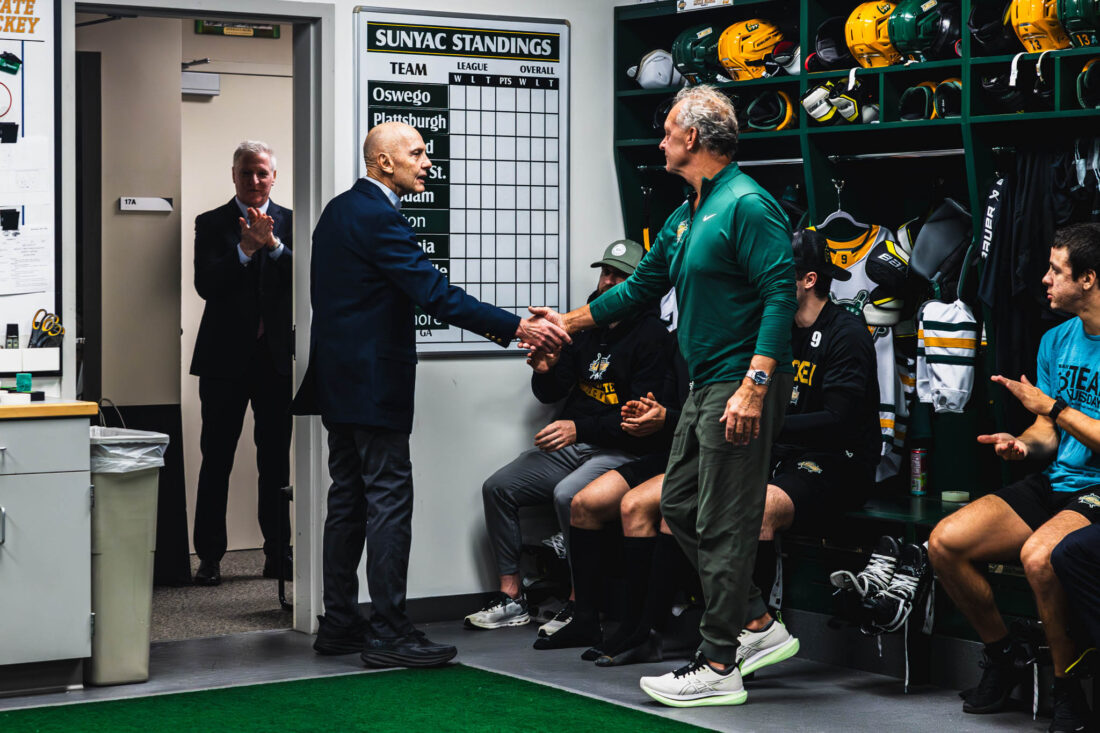
Pete Sears, left, shakes long-time SUNY Oswego men’s hockey coach Ed Gosek’s hand ahead of a home game on Nov. 15 against Skidmore. (Provided photo — Carolyn Sculco/SUNY Oswego)
A couple of times a week, he would play inside the old Olympic Center while part of the Lake Placid Pee Wee Hockey Association. His youth teams would travel toward Massena and Potsdam or even into Canada.
“(The Pee Wee Association is) really what supported all of the kids who were involved in hockey up there,” Sears said. “It had a lot of good people that were coaching us.”
Among those included Stan Pelkey, Percy Drouin, Bobby Preston, Jimmy Valenze, Ken Lebel and Ray Pratt — just to name a few.
“All of those guys were very influential in helping all of us kids enjoy the game of hockey,” Sears said.
As his hockey journey progressed, he started to get noticed by college teams. As a senior in high school, then-Clarkson University’s men’s hockey coach Len Ceglarski reached out to Sears.
“I can remember he invited me down to Potsdam, and he invited us to his house and we had dinner with him,” Sears said. “But he knew that I really wasn’t ready to play in his program, but he wanted me to go to Northwood School.”
Sears said he wasn’t comfortable going to a prep school. Instead, he heard about a new hockey program that was starting up in Oswego from a group of locals — Ernie Hough, Gary Whitamore and Frank Schissler.
“They kind of encouraged me to go down there, and that’s what I did,” he said. “And I guess going down there is what kind of led to all the other good things that have happened in my life. So I really think I made the right decision.”
–
Oswego
–
Sears has now spent around 60 years living in the Oswego area.
He was first a teacher at Mexico High School before putting in more than 30 years at the Oswego Middle School. Sears was also the head coach of the Oswego boys varsity hockey team from 1979 to 1998, where he led his teams to 10 Section III League titles, five Section III championships and three state championship appearances.
He then took a role with Oswego State as a goaltender coach from 2000 to 2015, and was a part of the college’s NCAA DIII national championship-winning team in 2007 that defeated Middlebury College, which was coached at the time by fellow Lake Placid native Bill Beaney — whose family, Sears said, he’s pretty close with.
But even during his time helping coach the goalies, Sears was coy about taking any credit, as he said the goaltenders were already good before he even started coaching there.
“The team was very successful and they were very responsive,” he said. “I didn’t try to change anything the goalies were doing, but I just tried to work with them and help them develop their strong points and work on a little bit of the things I thought they could work on.”
Through its more than 50 years, the Lakers’ men’s hockey program has posted a winning percentage of 65%. Sears said he’s heard people call Oswego, “Hockey town USA.”
But hockey wasn’t always as well-known as it is now — especially not at the college. Sears said it was just a gradual progression that brought it right to where it is today.
When he first came to SUNY Oswego, the men’s hockey program wasn’t even an NCAA DII team … It was just a club sport.
“We ended up playing a lot of Canadian colleges,” Sears said. “So we were on the road a lot playing up there, but we had a good competition and we had some good players. A lot of the players on my team I had played against in high school. We had some guys from Massena, Canton and Potsdam, as well as the three guys that were with me from Lake Placid.
“We had a few Canadian players come down, and we had a few guys from New England,” he added. “So even though it was a brand-new program and it was a club team, the guys there that played in that club team were pretty good hockey players.”
The following year, Sears said the team moved up to Division III and played in the newly formed Finger Lakes League.
But shortly after that season in 1967, Sears was drafted into the United States Army and served as a combat infantry squad leader during the Vietnam War in 1968. After returning as a veteran from active duty, he came back to Oswego and returned to playing hockey.
“(When) I came back, we had a new coach, they started bringing in even more players and the programs started to grow,” he said.
Sears was the cornerstone of those early Oswego squads, earning the team’s Most Valuable Player award in 1967, 1970 and 1971. He also earned recognition as the program’s first All-American in the 1969-70 season.
The program has since seen around 30 All-American players and accumulated more than 1,000 total wins since it started. Sears said the main reason for its growth is that SUNY Oswego has only had five total coaches in its more than 60 years. And Sears has built relationships with all of them over the years, including Gosek, the current head coach, whom Sears has known since he was young.
“When you have a coach who’s been here a while, gets to know the kids, he gets to set the program up the way he wants to,” he said. “I think that’s probably one of the big reasons that the program has stayed strong and over time.”
–
The Olympics
–
For the most part, the United States’ 1972 men’s Olympic hockey roster isn’t that odd. It includes players from major NCAA Division I schools in Massachusetts and Minnesota, and even Gordie Howe’s son, Mark Howe.
But at the top of the rosters, there’s No. 1 Pete Sears, a goalie from SUNY Oswego. Sears was the only one on the roster to have come from a then-Division II college hockey program. While it’s strange to see an Oswego player on the roster, Sears knew he always had a chance to be on that team.
Just four years prior, Sears had tried out for the 1968 Olympic team, but came up short. However, he did catch the eye of the Olympic coach, Murray Williamson, who asked him to play in a developmental league in Green Bay, Wisconsin.
So when the 1972 Olympic Winter Games came around, Sears connected with Williamson, who he hadn’t seen in four years.
“He said, ‘Would you be able to come out and play a summer hockey league in Minneapolis?'” Sears said. “So I went out there and I played on a summer hockey league, and that’s where he got to see me play a little bit. I got a chance to play against just about all Division I players in that summer hockey league.”
He added that playing in this league gave him the confidence that he could play at that level of competition.
“And everything just kind of fell into place after that,” he added. “So it was a very interesting experience having a go through all that to try to make an Olympic team.”
Sears said he didn’t even know he made the team until about three weeks before we went to the Olympics. And that time … was very stressful.
“Because you didn’t know if you were going to be called in the next day, and be sent down the road,” he said. “So the day I was called in to see the coach, I thought I was gone.”
But that wasn’t the case, Williamson instead told him that Mike Curran, who played for the University of North Dakota at the time, was going to be the starting goalie, and they needed a backup.
“He said that if you could accept your role on the team as being the backup goaltender, then we would love to have you,” Sear said. “I think he saw how much I wanted it because I had gone out to Minneapolis that summer and worked all summer and played out there so that they could see me.”
While Sears never got to play in the Olympics, he did play in some exhibition contests ahead of the Games. The team also won its first Olympic hockey medal in 12 years, which Sears said was an upset.
“(We were) selected to finish close to last (place),” he said. “I think because the previous years, they hadn’t been too successful and when they saw our team, they just didn’t have much confidence in us. But with our Olympic coach and the guys that we had there, we may not have had some of the best players, but we have the best team. That’s how we felt and it worked out very well for us.”
Following those Games, Sears played professional minor league hockey in Cleveland, St. Petersburg and Columbus before closing out his playing days.
But as Sears looked on at his long storied career with the sport, he said it all wouldn’t have happened had it not been for where he grew up.
“Even though I’ve spent my last 60 years in Oswego, I still consider myself a native of Lake Placid and there are still a few people I know up there,” he said. “(There are) just so many great memories, and I couldn’t have grown up in a better place than Lake Placid.”
Local News
Improv, irony and accents
Letting it all out
SARANAC LAKE — AI music videos; personal attacks; allegations of propaganda, misinformation and secrecy; ...

North Country New Year celebration returns on NYE
ACF accepting grant applications, support for Generous Acts
LAKE PLACID — Community organizations are encouraged to submit grant applications to Adirondack Community ...
Lake Placid native’s jersey retired at SUNY Oswego