
Cashman settling in as region’s newest Assemblymember
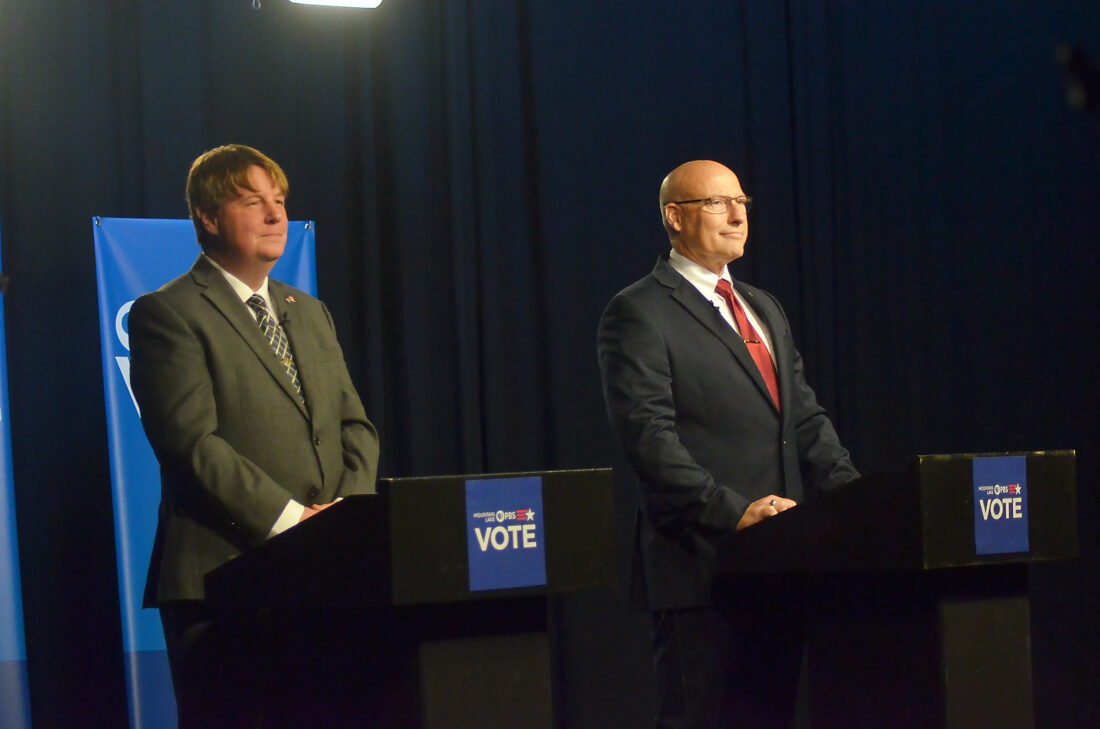
Then-candidates Michael Cashman, left, and Brent Davison are seen at the Mountain Lake PBS debate in October. (Enterprise photo — Aaron Marbone)
SARANAC LAKE — State Assemblyman Michael S. Cashman, D-Plattsburgh, didn’t have too much time to celebrate his victory in a hotly contested special election race for the 115th district on Nov. 4. The reason? His new job started almost immediately after the results came in.
Unlike a regular election, where candidates have almost two months between election night and when they take the oath of office, Cashman was sworn in just nine days after election day, leaving little time to build up logistics and knowledge in advance.
Going into the election, however, Cashman said he knew that if he won, it would be a quick learning curve, with much of it coming in the early days of the job. Looking back on his first month in office, Cashman said he’s focused on building up his foundation.
This includes vetting and hiring a legislative and district staff, opening offices in the district and in Albany, continuing to travel and meet constituents across the 115th district — one of the largest in the state geographically — and beginning to receive his committee assignments. The district includes all of Clinton and Franklin counties and the towns of Keene, Jay, North Elba, St. Armand and Wilmington in Essex County.
Cashman has been assigned to the Agriculture; Tourism, Parks, Arts and Sports Development; and Veterans’ Affairs committees thus far, with more assignments coming. Assemblymembers can serve on up to six standing committees.
“Assemblymembers are asked where they feel they can contribute to the work, but also, there’s no guarantee,” Cashman said. “I made sure to share that the needs of the district align with these committees.”
Cashman’s district office is located at 202 U.S. Oval, Plattsburgh, NY 12903. If it sounds familiar, it’s the same address as former Assemblyman Billy Jones’ district office. Cashman said he’s focusing on hiring a staff dedicated to constituent services, and working through the vast state bureaucracy to help North Country residents with their needs as they reach out to his office.
“(I’m) continuing to listen to small businesses, educators, veterans, first responders, working families,” he said. “That’s a huge part of this job.”
Cashman said community organizations, agencies or individuals with upcoming events who would like to can feel free to reach out to his office and invite him to learn more about their work. It’s something he said he enjoys receiving as a public servant.
In Albany, he said he’s reading up on matters before the Assembly and engaging with his fellow lawmakers to get up to speed on big issues before the chamber in this upcoming session, which begins in January.
“The priorities that I ran on — making affordability work for the North Country, being serious about public safety and protecting our future through investments in infrastructure, education and health care — that’s a guiding framework,” he said. “Conversations with individuals — showing up, listening — is part of that. I’m doing a lot of reading. I’m having a lot of conversations with my colleagues across the state to get caught up to speed and be prepared to engage with the session that will be before us in the beginning of January.”
–
A close race
–
Whether it was the wall-to-wall television commercials, mail flyers or yard signs at seemingly every intersection, one thing was clear: the special election race for the 115th district was hard-fought, with hefty spending from both sides.
Much to the chagrin of many who endured the relentless candidate advertisements, the spending, from a purely political standpoint, was perfectly rational. Why? The 115th district had seen some of the closest results, by proxy, in the 2024 general election of any Assembly district.
Though Jones had run unopposed for the actual Assembly seat in 2024, the presidential election results within the district’s bounds were razor thin, with President Donald Trump winning these areas by a margin of just 1.25%, his 50.47% to then-Vice President Kamala Harris’ 49.22% (with the other 0.31% split between third party candidates or write-ins).
It showed that the district was very much up for grabs — if it wasn’t for Jones, a centrist Democrat from northern Franklin County who retained a relatively high level of favorability in the North Country. In 2022, Jones won reelection 62.83% to challenger Stephen Chilton III’s 37.14%.
It was a 25.69% margin that far outpaced the two top ticket Democrats running that year within the district. U.S. Senator Chuck Schumer and Gov. Kathy Hochul were both running that year for reelection to their respective offices. While each won statewide, Schumer lost within the 115th district by a 0.55% margin, and Hochul lost by 12.24%.
This past summer, Republicans got their wish. Jones announced he would be resigning to take a position with Clinton Community College. His departure would trigger a special election that coincided with the 2025 general election. Given special election laws, candidates were chosen by county party chairs, as opposed to a direct primary open to the political parties’ registered voters.
The county party chairs’ votes were weighted by enrollment within the district. In the 115th district, that gave sole discretion to the Clinton County chairs, as the county has an outright majority of both registered Democrats and Republicans within the district.
The Democrats chose Cashman, who was the Plattsburgh town supervisor at the time. The Republicans chose Brent Davison, of Mooers Forks in Clinton County, who had recently retired as the State Police’s Troop B commander, having attained the rank of major. Cashman was also endorsed by the Working Families Party, and Davison was endorsed by the Conservative Party. There were no other named candidates whose names appeared on the ballot for this race.
The Republican selection process sparked a rift between Clinton County Republican Party Chairwoman Jerika Manning and Rep. Elise Stefanik, R-Schuylerville, of New York’s 21st Congressional District, as Stefanik had publicly endorsed Malone village Mayor Andrea Dumas ahead of the county party’s eventual selection of Davison. More on that selection process is available at tinyurl.com/3tnnaswn.
Ultimately, Cashman would go on to carry the district by a 1,754-vote (4.63%) margin, earning 19,797 votes (52.28%) to Davison’s 18,043 (47.65%), according to official election results, with each county board of elections within the district having re-canvassed and certified their results.
These figures were rounded to the nearest hundredth of 1% and don’t include blank or void ballots — as the absence of an affirmative selection of a candidate makes them akin to a non-vote — but the results do include the 25 total write-in ballots, which amounted to 0.07% of the vote.
The district lived up to its competitive nature. In the 2024 general election — the most recent year that state Assembly elections were held throughout New York — only 10 of the 150 districts had closer margins. In a race this close, it’s difficult to point to a specific factor that swung the margin. Besides the candidates themselves, voters could have been influenced by a myriad of factors, including sentiments about the national political discourse, statewide issues, or competitive local races, such as a town supervisor or council election.
“I think you have to ask individuals why they vote for individuals,” Cashman said. “What I have always focused on as a public servant is substance that is focused around a model of listening, learning and leading on behalf of the people that I’ve so humbly been allowed to serve. That’s what it is, to me, about.”
Cashman credited his successful campaign, in part, to traveling the North Country far and wide.
“For a special election, 60 days, we put thousands upon thousands of miles on the car,” he said. “And I haven’t let up on the gas since. I continue to get out in the district because it’s critical to hear directly from constituents so you can serve them directly.”
–
Detailed results
–
Cashman saw his strongest results in the district’s five towns in Essex County. He won these areas by a combined 25.82% margin, his 62.90% to Davison’s 37.08%.
Clinton County, both candidates’ home turf, was the closest of the three counties and a bellwether of sorts, with Cashman winning it by a narrow 3.37% margin, his 51.66% to Davison’s 48.29%. Within Clinton County, Cashman only won in the city and town of Plattsburgh, but his wide margins there, combined with their relatively high populations, were enough to offset the winning margins Davison had in the 13 other townships throughout the county.
In Franklin County, Davison was the victor, winning it by a similarly narrow 2.15% margin. Though it was the only one of three counties Cashman lost, it was where the Democrat made his biggest gains, relative to the 2024 presidential election results, where he finished 6.83% ahead of Harris’s margin. He improved on Harris’s margin by 5.52% in Clinton County and 1.82% in Essex County.
Another likely element of Cashman’s victory was the turnout. Bluer areas of the district tended to see higher turnout rates — as a percentage of overall actively registered voters as of Nov. 1 — compared to red areas. The part of Essex County in the district saw the highest voter turnout at 50.49%, followed by Clinton County at 44.25%, and then Franklin County at 39.37%. Four of the five individual townships with the highest turnout were carried by Cashman, while four of the five that saw the lowest turnout were won by Davison.
The top five towns that had the highest turnout in this election include:
– Wilmington: 65.60%, margin: Cashman 5.19%
– Duane: 64.19%, margin: Davison 1.05%
– Keene: 60.89%, margin: Cashman 45.55%
– Franklin: 56.52%, margin: Cashman 20.82%
– Jay: 56.03%, margin: Cashman 14.93%
The top five towns that had the lowest turnout in this election include:
– Bombay: 22.19%, margin: Cashman 44.10%
– Westville: 31.51%, margin: Davison 35.91%
– Brandon: 32.81%, margin: Davison 58.73%
– Bangor: 34.82%, margin: Davison 30.43%
– Malone: 35.89%, margin: Davison 1.14%
Local News
Cookies, cocoa and Claus

‘Miracle on Ice’ gold medal moment
Cashman settling in as region’s newest Assemblymember
Improv, irony and accents
Letting it all out
SARANAC LAKE — AI music videos; personal attacks; allegations of propaganda, misinformation and secrecy; ...
