
Lewis howitzer testing range proposal headlines APA meeting Thursday
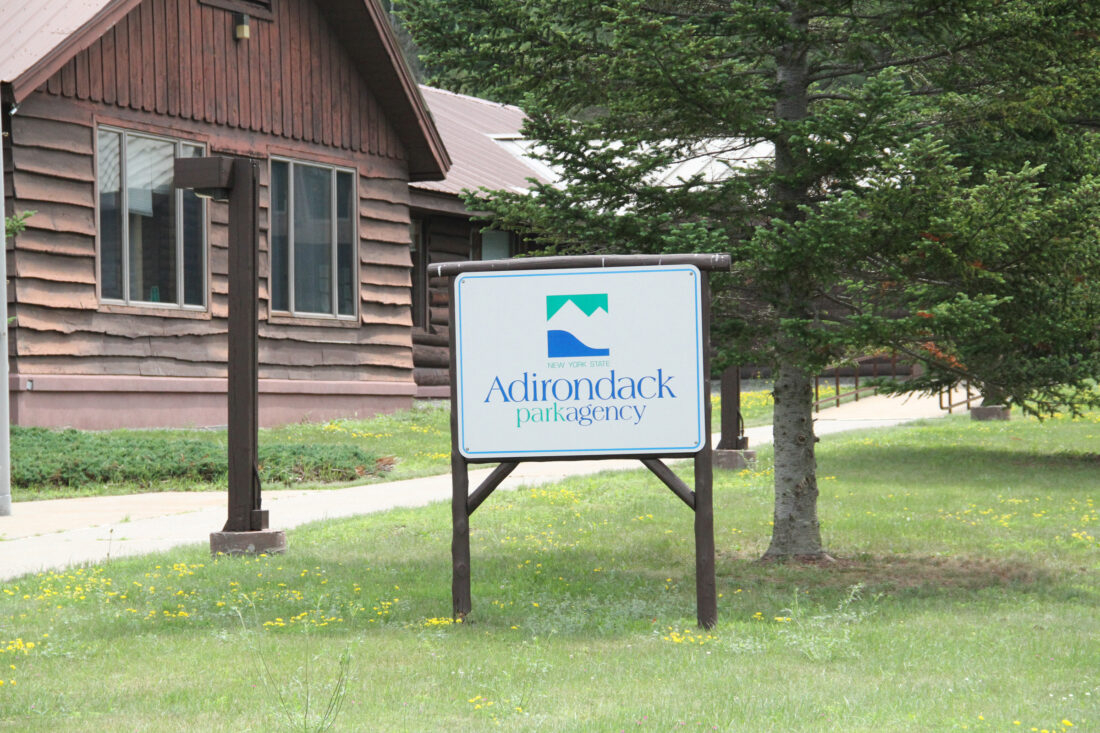
The Adirondack Park Agency Headquarters sign is seen in 2021. (Enterprise photo — Andy Flynn)
RAY BROOK — A fork in the road lies ahead for one of its most high-profile, high-caliber and controversial projects to come before the Adirondack Park Agency in years.
On Thursday, the APA board is set to vote on whether to approve or send to an adjudicatory hearing a proposed artillery weapons testing range for the internal ballistics of 155 mm howitzer cannon barrels in the town of Lewis, in northeast Essex County.
The APA meeting is set to begin at 1 p.m., with the board scheduled to consider this project at 1:30 p.m. The public meeting will be held in person at the agency’s Ray Brook headquarters. People can also watch remotely at tinyurl.com/APANov2025Thu. The passcode to join is 665476. Per APA policy, public comments are not allowed for any project before the agency at that meeting, given the window for public written comments in advance.
The range is proposed on land currently classified for rural use. The project proposes that a portable 155 mm howitzer assembly barrel be placed on a 100-foot by 100-foot crushed gravel pad and fire steel projectiles into a target area. The proposal calls for the assembly to be fired up to 30 times per year on weekdays, between 10 a.m. and 4 p.m. The projectiles are proposed to be stopped by an 8-foot by 8-foot by 40-foot-long metal shipping container, or similar structure, filled with sand and other material. No explosive warheads are proposed to be fired.
The project’s applicant is Michael Hopmeier of Unconventional Concepts, Inc. He is represented by attorney Matthew Norfolk of Norfolk Beier PLLC. The project was first proposed in 2021, though APA staff sent various notices of application incompletion. It was considered complete by agency staff in September.
APA staff is recommending that the board vote to send the proposal to an adjudicatory hearing, which is the only way the agency can deny or substantially modify a permit that is deemed complete for purposes of review. The APA board hasn’t held an adjudicatory hearing since 2011. Most complete permits are either approved by staff or come before the board, and are approved with minor changes by the applicant.
There are three avenues for a proposal to be sent to an adjudicatory hearing. These include:
¯ A proposed project does not meet applicable legal standards for project approval.
¯ The project could only be approved if it is significantly modified or conditioned.
¯ A hearing is necessary to obtain information necessary for the board to make findings and determinations required by law or regulation.
“The referral to a hearing will seek, through an independent, fair and impartial process, to fully address the substantive and significant questions surrounding this project and ensure a complete record upon which the Agency will ultimately render its final determination,” APA assistant public information officer Ben Brosseau said in a statement.
APA staff are recommending the board vote to send it to a hearing because of issues with the availability of information regarding the potential compatibility of the proposal with the Adirondack Park Land Use and Development Plan and the potential for undue adverse impacts.
These issues are explained in further detail in a staff draft project order. That can be viewed at tinyurl.com/y2s2ee9d.
The project has received a massive amount of public interest, with more than 1,400 written comments submitted — all but 19 of which are in opposition — according to the APA, which added that 97% of those were received between Oct. 1 and Oct. 30 and that 15 of the 44 residences that would be within two miles of the range submitted comments. Many cited the impact on human health and safety, wildlife, and compatibility with surrounding residential, commercial and recreational land uses. Those can be viewed at tinyurl.com/bdemcybu.
Hopmeier submitted a letter, dated Nov. 6, responding to the public comments. He wrote that many of them were from people who either live far away from the project or would not be impacted by it.
“Many of the comments provided no thoughtful input, revealed no critical information, were unrelated to reality, were based on demonstrably false information or were from submissions designed to provide quantitative, but not qualitative, input,” Hopmeier wrote.
His full letter can be viewed at tinyurl.com/58s2zrxe.
The APA will continue its meeting on Friday for matters unrelated to the weapons testing range proposal. The last time the agency held a two-day monthly meeting was Aug. 17 and 18, 2023.
–
What happens in an adjudicatory hearing
–
An adjudicatory hearing takes place in front of an impartial administrative law judge, who oversees arguments and evidence, though the APA board — after the hearing — makes the ultimate decision on approving with or without conditions, modifying with or without conditions or denying the project.
The administrative law judge has broad authority to control and maintain the efficiency of the hearing under APA’s hearing process rules, though the judge’s rulings may be appealed to the APA board at the end of the hearing by either party. The APA board may also decide to review a judge’s ruling during the hearing if the failure to do so could “unduly disadvantage” one of the parties, according to the APA’s guide to adjudicatory hearings.
The administrative law judge’s final review of the hearing is presented to the APA board for its members to take into account before rendering a decision. The APA board’s ruling can be further appealed to state court.
Local News

December on track to finish as third coldest for Tri-Lakes this century

Remembering Eleanor Sweeney

Bridging classroom and career
Cashman appointed chair of NY-Canada Task Force
ALBANY — Assemblyman Michael S. Cashman is settling into his new role in the state capitol ahead of the ...
Roller coaster day of weather for Tri-Lakes
SARANAC LAKE — Winter is showing no signs of slowing down. Another mixed precipitation storm, accompanied by ...
