
Acting state police commander talks priorities
RAY BROOK – For the past four years, state police Capt. John Tibbitts has kept two photos of Colin Gillis on a bulletin board in his office, next to a list of other missing persons.
It’s a visual reminder, he says, not to give up on the search for the young man from Tupper Lake who disappeared in March 2012.
He says the case will continue to be a priority now that he’s taking over as acting commander of state police Troop B, an appointment he hopes will become long-term.
“To this day, that’s one of those cases where I see his face every day,” Tibbitts said. “Once I get set up in this office, I’m sure it’s going to continue that way. That’s one I really want to find closure to.”
Tibbitts took charge of Troop B last month following the retirement of Maj. Charles Guess. Tibbitts is a nearly 31-year state police veteran, originally from the Albany area. He outlined his priorities and his approach to the top law enforcement job in the region in an interview last week.
—
Unexpected career
Tibbitts was a 20-year-old criminal justice student at the State University of New York at Albany when he took the state police exam in May 1985.
“It was because a buddy of mine, who retired a couple of months ago; he needed a ride to the exam,” Tibbitts recalled. “I had wanted to be a Colonie cop, but he said, ‘Take the exam.’ So I took the test, and I was the first person out of the exam hall. The trooper who was standing there, he looks at me. I had long hair, a beard, an earring. I was wearing engineer boots, jeans and a flannel shirt. He said, ‘Well how’d you do?’ I said, ‘I think I got my name right.'”
A few months later, when he got the results, he discovered he ranked 112th out of thousands of people who took the exam.
“I had a long talk with my dad, and he said, ‘You know, kid, state benefits are great.’ I said OK,” Tibbitts said. “I was only planning on doing this a couple years. I went into the academy on September 30th of that year and never looked back.”
Tibbitts worked his way up through the ranks to a lieutenant position in traffic services at state police headquarters in Albany when he transferred to Troop B in January 2005. Since then, he’s been the captain in charge of the troop’s Zone 3, which includes all of Essex County, southern Franklin County and part of Hamilton County.
—
Drug abuse
Tibbitts said heroin and opioid abuse is the biggest issue facing North Country communities.
“The drug problem is just huge,” he said. “If you talk to Captain (Robert) LaFountain, (head of the Troop B Bureau of Criminal Investigation), he makes a pretty cogent argument for all crime in the North Country being a result of the demand for drugs. I don’t think he’s far off the mark.
“On the computer, when you get burglaries or stolen items, it goes out as a teletype. It used to be you’d see a burglary teletype every three or four days. Now, every day I’ve got a list of four or five burglaries that have occurred.”
There’s been an evolution in drug abuse from marijuana to heroin, fentanyl and methamphetamine, Tibbitts said.
“Most of our drug arrests are multi-drug. When I got up here 10 years ago, I’d get a call from a trooper saying, ‘I got 100 pounds of marijuana.’ That was simple. It was one drug. It was a large load. Now we’re finding sale amounts of heroin and ecstasy, along with personal-use amounts of marijuana and suboxone, and they’re all together.”
Heroin used to be an inner-city drug, but now it’s a scourge of rural communities, Tibbitts said. It’s typically coming to the North Country from dealers in big population centers downstate, who get their supply from Mexico and the Middle East, sometimes by way of Canada.
Who’s involved in this drug trade?
“Everybody,” Tibbitts said. “You could take the biggest urban gang and the most complex cartel, and you can go right down to the person who’s working the overnight shift at the gas station. Everybody’s selling it: lower class, upper class, middle class. Everybody’s using it.
“We aren’t going to arrest our way out of the problem,” he continued. “It’s gotta be a partnership with everybody involved: treatment, law enforcement, prosecution, the public defender’s office. I sit on task forces in Essex County and Franklin County. We’re looking for new ideas to try and figure out a way to just get a handle on this. I don’t want to say any problem is beyond us, but this is a huge issue.”
—
Unsolved mysteries
Asked about the number of unsolved missing-persons cases in the region, like the disappearance of Colin Gillis, Tibbitts recalled a conversation with Dick Depuy of Saranac Lake, who had been a state police captain in charge of the search for Douglas Legg, an 8-year-old boy who went missing from his family’s property in the town of Newcomb in July 1971.
“He looked at me and says, ‘You know, John, I can’t get past the fact that if there had been one more bush we had gone around, we would have found him,'” Tibbitts said. “That’s always kind of stuck with me. It put into my mind the idea of, ‘OK, what haven’t we checked?'”
As for Gillis disappearance, Tibbitts said police still don’t have any solid clues about what happened to him, so the investigation has to continue.
“Every rumor, every scrap of conversation, every person that looked cross-eyed to an investigator, they’ve been vetted,” he said. “You know what? They’re going to get vetted again. We’re going to continue this investigation, and if it requires us going back to re-interview people we interviewed right after his disappearance, we’re going to do it again.”
There are other missing persons cases where police have a better idea about where to look, Tibbitts said. He talked about a jet carrying five people that crashed in Lake Champlain in the early 1970s. It’s never been found, but police started looking at the case again recently, spurred on by the efforts of state Forest Ranger Scott van Laer, who’s been researching plane crashes in the region on his own time.
“He said, ‘Could you assist us if we start opening this up a little bit?'” Tibbitts said. “Since that time, we’ve been working cooperatively with Vermont State Police and the (National Transportation Safety Board) and the family to see what we could do about finding the airplane. To these people, it’s very real. One family member has done a lot of work into looking where it might have gone down, and there’s been a lot of searching done by us and by private companies, but so far we’ve come up with absolutely zero.
“The Adirondacks are filled with stories like that.”
—
New scrutiny
Police officers across the country have been under much more scrutiny lately, in the wake of a string of fatal police shootings, some of which have been captured on video.
Tibbitts said he believes state troopers enjoy “a certain degree of mutual respect with the people who live up here.
“We don’t have, in many instances, the interactions that they have on a regular basis in other parts of the country, where there’s more people and a greater amount of culturally diverse people,” he said. “That being said, the message has gone out to everyone to be situationally and tactically aware of their surroundings, to take steps to ensure their safety and their partner’s safety, on and off duty.”
State police in Troop B have had some incidents of people being pulled over and recording their interactions with the officer on video. Tibbitts said he looks at those incidents as “trainable moments.
“We’re high profile. You can’t hide in a blue and gold car wearing a gray uniform and a big hat. You represent the division. You represent law enforcement. You represent authority. Not everybody’s going to love you. If you want love, be a fireman. Everybody loves a fireman.”
When he first started his career, Tibbitts said he worked with many old-school troopers who didn’t like cameras being pointed in their faces. He said the cameras and sometimes the people would often end up broken.
“I’m an old-school guy now, but I know there’s things we have to do and there’s certain things we can absolutely not do,” he said. “You’ve got to be a quiet professional. You’ve got to be able to talk to people. Especially up here when your nearest backup is 45 minutes away and you’ve got an angry group of drunken bar-goers, and they’re ready to go at it with you. You’ve got to know how to talk them down.”
Local News

Snowy scenes

Northern Lights Choir to perform
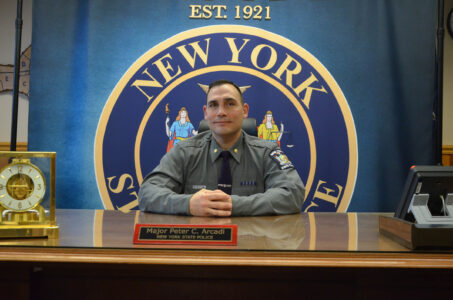
Meet the new NYSP troop leader

Jingle Bell Run/Walk returns to Lake Placid

Winter Carnival pages selected
2026 Empire Pass now available for purchase, renewal online
ALBANY — The New York State Office of Parks, Recreation and Historic Preservation announced the 2026 Empire Pass ...